Key Laboratory for Medical Virology and Viral Diseases, National Institute for Viral Disease Control and Prevention, National Health Commission of the People's Republic of China, Beijing, China.
Department of Medical Microbiology, Weifang Medical University, Weifang, China.
Front Cell Infect Microbiol. 2022 Aug 8;12:927490. doi: 10.3389/fcimb.2022.927490. eCollection 2022.
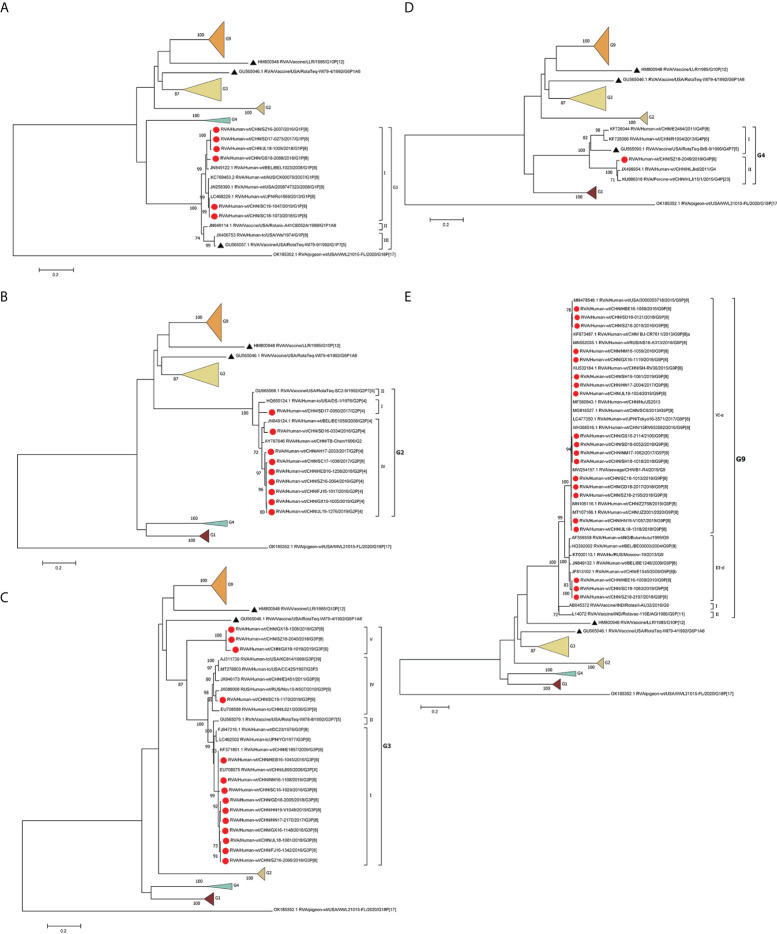
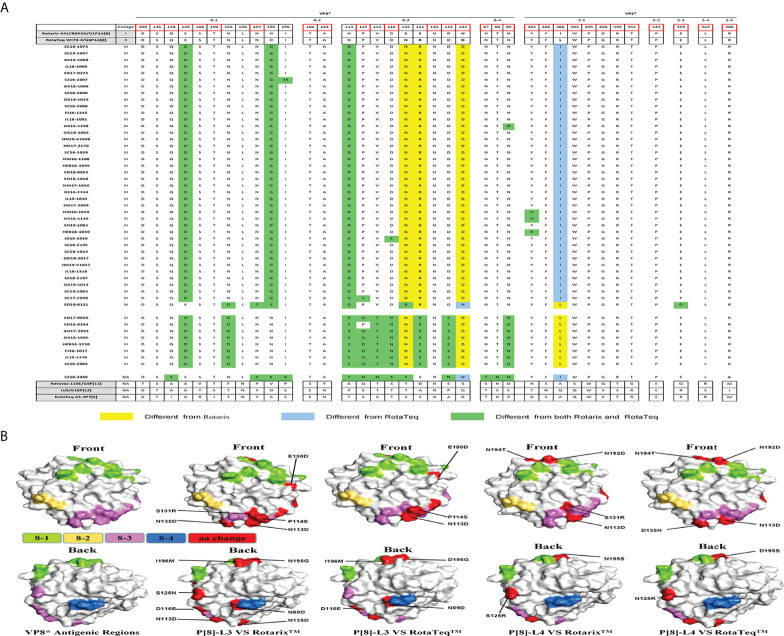
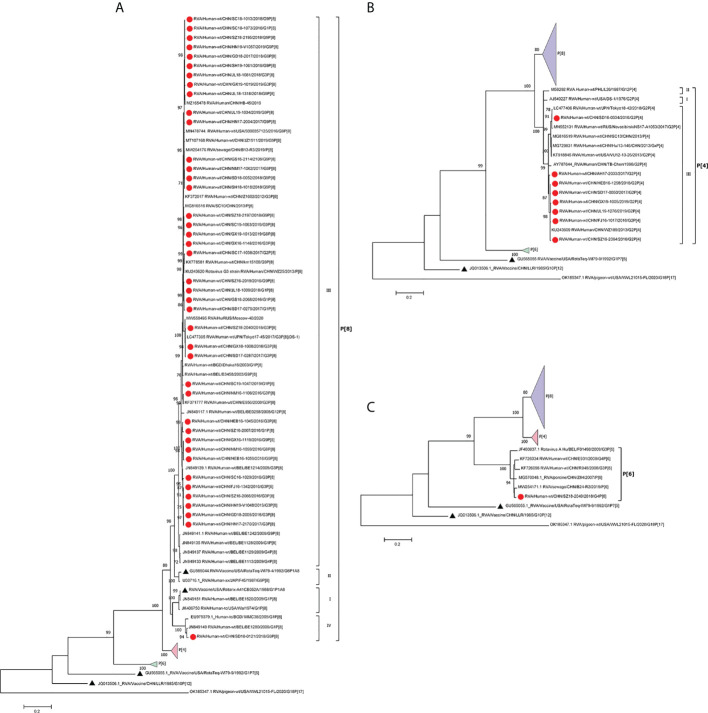
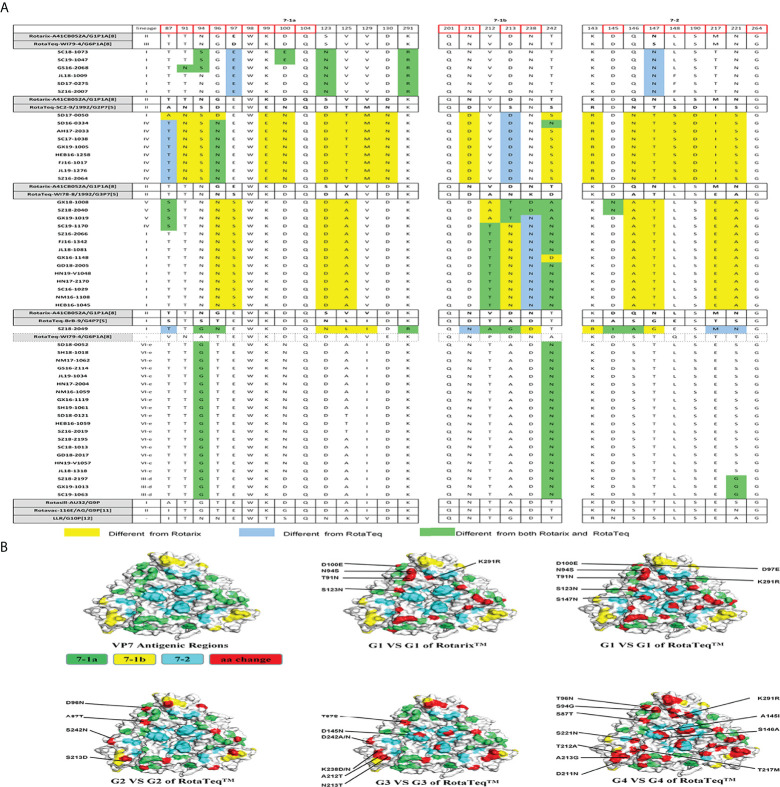
Group A rotaviruses (RVAs) are the most common etiological agents of severe acute diarrhea among children under 5 years old worldwide. At present, two live-attenuated RVA vaccines, LLR (G10P[15]) and RotaTeq (G1-G4, G6 P[8], P[5]), have been introduced to mainland China. Although RVA vaccines can provide homotypic and partially heterotypic protection against several strains, it is necessary to explore the genetic and antigenic variations between circulating RVAs and vaccine strains. In this study, we sequenced viral protein VP7 and VP4 outer capsid proteins of 50 RVA strains circulating in China from 2016 to 2019. The VP7 and VP4 sequences of almost all strains showed high homology to those of previously reported human strains and vaccine strains of the same genotype. However, in the presumed antigenic epitopes of the VP7 and VP4, multiple amino acid variations were found, regardless of the G and P genotypes of these strains. Moreover, all circulating G3 RVA strains in China potentially possess an extra N-linked glycosylation site compared with the G3 strain of RotaTeq. The potential N-linked glycosylation site at residues 69-71 was found in all G9 strains in China but not in the G9 strain of the Rotavac or Rotasill vaccine. These variations in antigenic sites might result in the selection of strains that escape the RVA neutralizing-antibody pressure imposed by vaccines. Furthermore, the G4 and P[6] genotypes in this study showed high homology to those of porcine strains, indicating the transmission of G4 and P[6] genotypes from pigs to humans in China. More genetic surveillance with antigenic evaluation in prevalent RVAs is necessary for developing and implementing rotavirus vaccines in China.
A 组轮状病毒(RVAs)是全球 5 岁以下儿童严重急性腹泻的最常见病因。目前,两种减毒活 RVAs 疫苗,LLR(G10P[15])和 RotaTeq(G1-G4、G6 P[8]、P[5]),已引入中国大陆。虽然 RVA 疫苗可以针对几种株提供同型和部分异型保护,但有必要探索循环 RVAs 与疫苗株之间的遗传和抗原变异。在本研究中,我们对 2016 年至 2019 年中国流行的 50 株 RVA 进行了病毒蛋白 VP7 和 VP4 外壳蛋白的测序。几乎所有株的 VP7 和 VP4 序列与先前报道的人类株和同基因型疫苗株高度同源。然而,在 VP7 和 VP4 的假定抗原表位中,发现了多种氨基酸变异,而不管这些株的 G 和 P 基因型如何。此外,与 RotaTeq 的 G3 株相比,中国所有流行的 G3 RVA 株可能具有额外的 N 连接糖基化位点。在中国,所有 G9 株都在第 69-71 位残基发现潜在的 N 连接糖基化位点,但 Rotavac 或 Rotasill 疫苗的 G9 株则没有。这些抗原位点的变异可能导致逃避疫苗施加的 RVA 中和抗体压力的株的选择。此外,本研究中的 G4 和 P[6]基因型与猪株高度同源,表明 G4 和 P[6]基因型在中国从猪传播到人。需要对流行的 RVAs 进行更多的遗传监测和抗原评估,以在中国开发和实施轮状病毒疫苗。