CEB-Centre of Biological Engineering, Universidade do Minho, Campus de Gualtar, 4710-057 Braga, Portugal.
LABBELS-Associate Laboratory, 4710-057 Braga, Portugal.
Biosensors (Basel). 2022 Aug 8;12(8):614. doi: 10.3390/bios12080614.
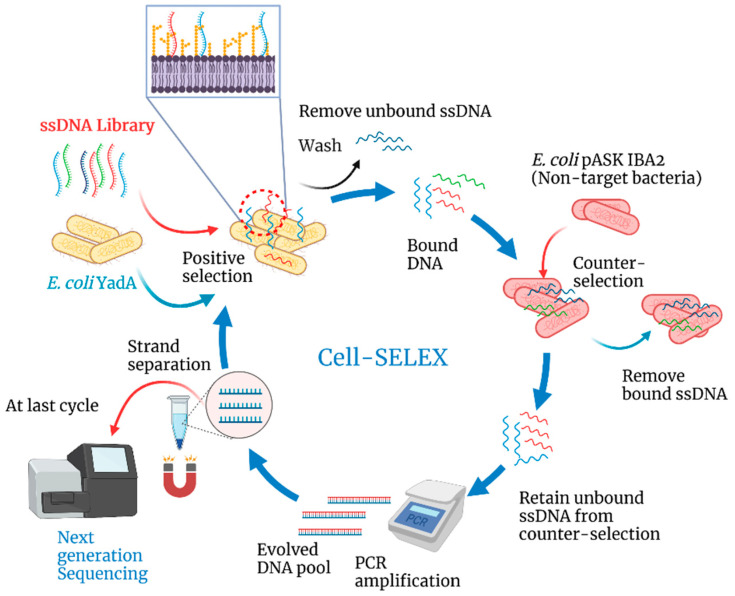
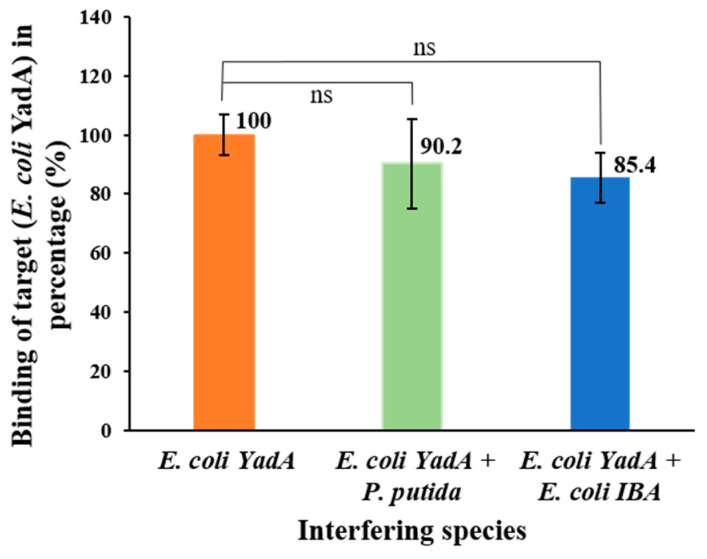
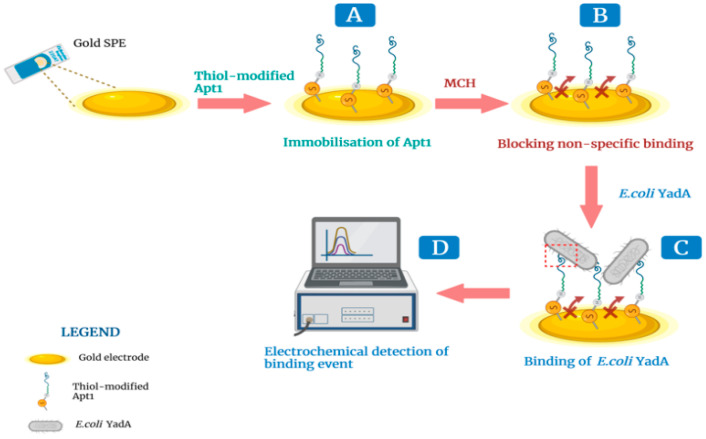
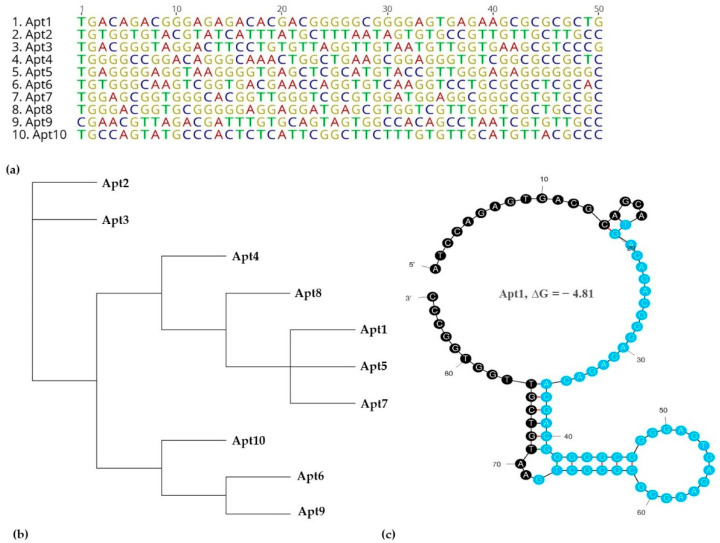
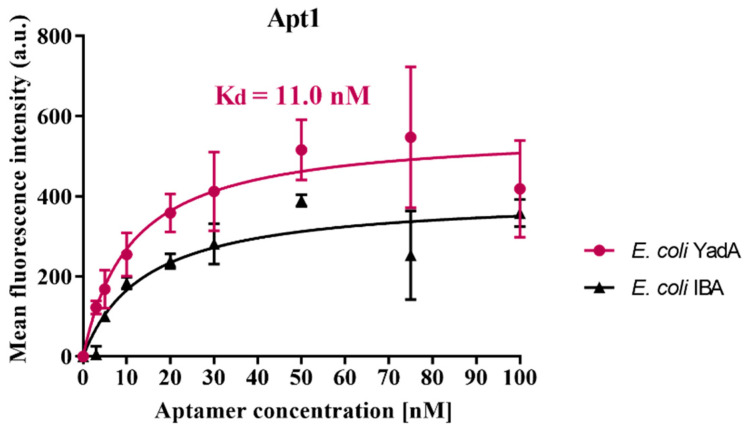
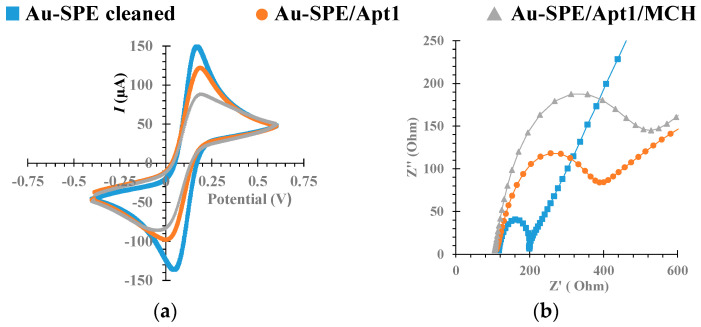
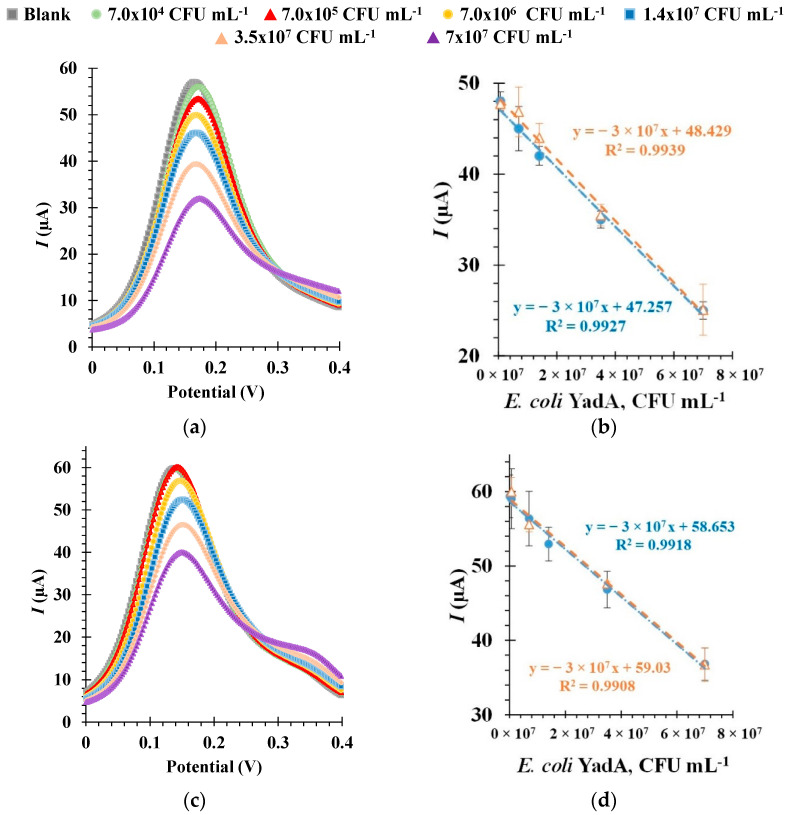
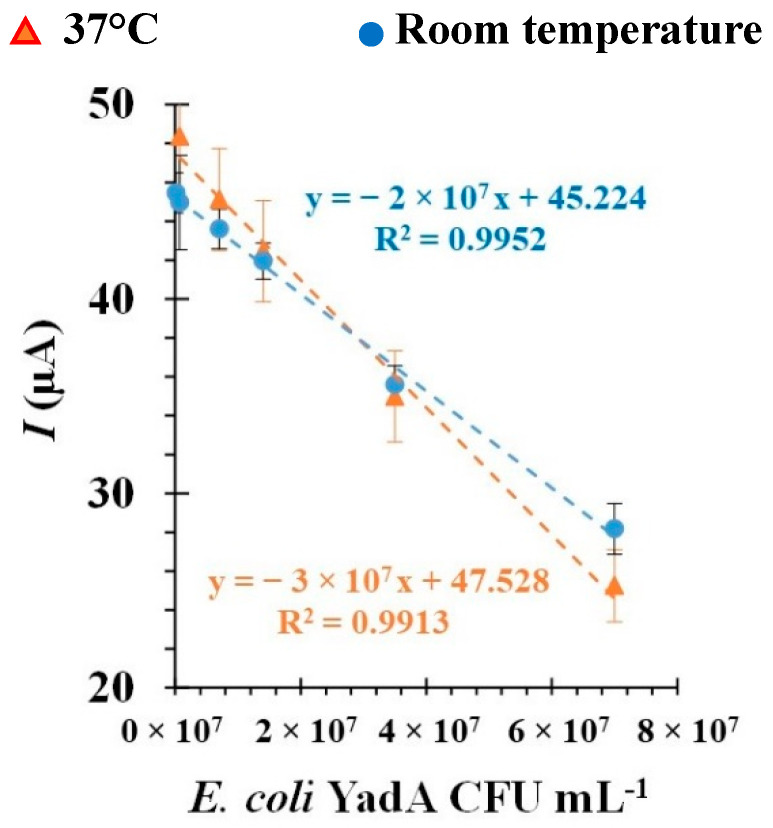
New point-of-care (POC) diagnosis of bacterial infections are imperative to overcome the deficiencies of conventional methods, such as culture and molecular methods. In this study, we identified new aptamers that bind to the virulence factor Yersinia adhesin A (YadA) of Yersinia enterocolitica using cell-systematic evolution of ligands by exponential enrichment (cell-SELEX). Escherichia coli expressing YadA on the cell surface was used as a target cell. After eight cycles of selection, the final aptamer pool was sequenced by high throughput sequencing using the Illumina Novaseq platform. The sequencing data, analyzed using the Geneious software, was aligned, filtered and demultiplexed to obtain the key nucleotides possibly involved in the target binding. The most promising aptamer candidate, Apt1, bound specifically to YadA with a dissociation constant (Kd) of 11 nM. Apt1 was used to develop a simple electrochemical biosensor with a two-step, label-free design towards the detection of YadA. The sensor surface modifications and its ability to bind successfully and stably to YadA were confirmed by cyclic voltammetry, impedance spectroscopy and square wave voltammetry. The biosensor enabled the detection of YadA in a linear range between 7.0 × 10⁴ and 7.0 × 10⁷ CFU mL−1 and showed a square correlation coefficient >0.99. The standard deviation and the limit of detection was ~2.5% and 7.0 × 10⁴ CFU mL−1, respectively. Overall, the results suggest that this novel biosensor incorporating Apt1 can potentially be used as a sensitive POC detection system to aid the diagnosis of Y. enterocolitica infections. Furthermore, this simple yet innovative approach could be replicated to select aptamers for other (bacterial) targets and to develop the corresponding biosensors for their detection.
新的即时检测(POC)细菌感染诊断方法对于克服传统方法(如培养和分子方法)的不足至关重要。在这项研究中,我们使用细胞系统进化配体指数富集(cell-SELEX)技术,鉴定了能够与肠耶尔森氏菌(Yersinia enterocolitica)毒力因子耶尔森氏菌黏附素 A(YadA)结合的新适配体。我们将表面表达 YadA 的大肠杆菌作为靶细胞。经过八轮筛选,使用 Illumina Novaseq 平台对高通量测序获得的最终适配体库进行测序。使用 Geneious 软件对测序数据进行分析,通过对齐、过滤和去复用获得可能与靶标结合的关键核苷酸。最有前途的适配体候选物 Apt1 与 YadA 特异性结合,解离常数(Kd)为 11 nM。Apt1 用于开发一种简单的电化学生物传感器,该传感器采用两步、无标记设计,用于检测 YadA。通过循环伏安法、阻抗谱和方波伏安法证实了传感器表面修饰及其与 YadA 成功且稳定结合的能力。该生物传感器能够在 7.0×10⁴ 至 7.0×10⁷ CFU mL−1 的线性范围内检测 YadA,显示出 >0.99 的方相关系数。标准偏差和检测限分别约为 2.5%和 7.0×10⁴ CFU mL−1。总的来说,结果表明,这种结合 Apt1 的新型生物传感器具有作为 POC 敏感检测系统的潜力,有助于肠耶尔森氏菌感染的诊断。此外,这种简单而创新的方法可以复制,以选择针对其他(细菌)靶标的适配体,并开发用于检测它们的相应生物传感器。