Department of Biochemistry and Molecular Biology, Thomas Jefferson University, 1020 Locust Street, Philadelphia, PA 19107, USA.
Macromolecular Diffraction Facility, Cornell High Energy Synchrotron Source (MacCHESS), Cornell University, 161 Synchrotron Drive, Ithaca, NY 14853, USA.
J Mol Biol. 2022 Oct 30;434(20):167799. doi: 10.1016/j.jmb.2022.167799. Epub 2022 Aug 22.
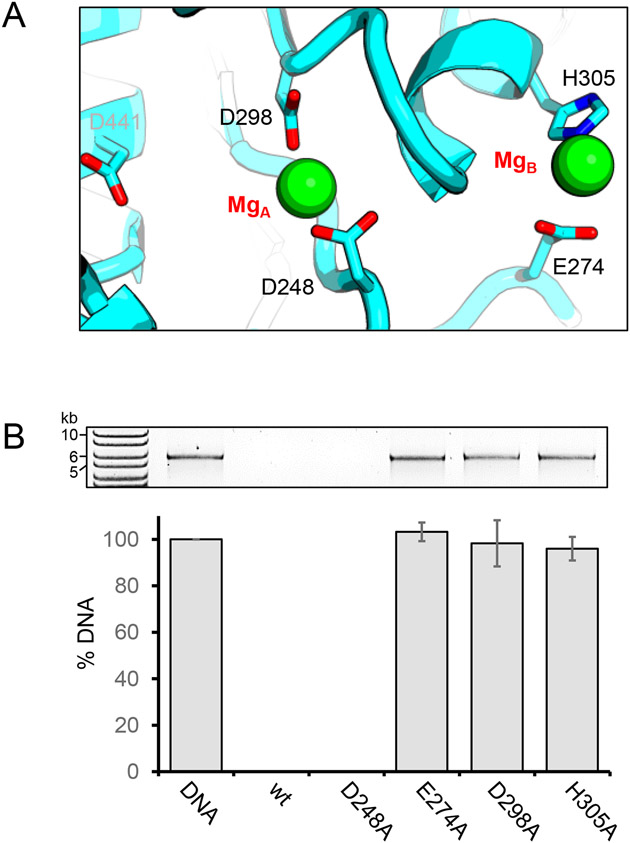
Pseudomonas phages are increasingly important biomedicines for phage therapy, but little is known about how these viruses package DNA. This paper explores the terminase subunits from the Myoviridae E217, a Pseudomonas-phage used in an experimental cocktail to eradicate P. aeruginosa in vitro and in animal models. We identified the large (TerL) and small (TerS) terminase subunits in two genes ∼58 kbs away from each other in the E217 genome. TerL presents a classical two-domain architecture, consisting of an N-terminal ATPase and C-terminal nuclease domain arranged into a bean-shaped tertiary structure. A 2.05 Å crystal structure of the C-terminal domain revealed an RNase H-like fold with two magnesium ions in the nuclease active site. Mutations in TerL residues involved in magnesium coordination had a dominant-negative effect on phage growth. However, the two ions identified in the active site were too far from each other to promote two-metal-ion catalysis, suggesting a conformational change is required for nuclease activity. We also determined a 3.38 Å cryo-EM reconstruction of E217 TerS that revealed a ring-like decamer, departing from the most common nonameric quaternary structure observed thus far. E217 TerS contains both N-terminal helix-turn-helix motifs enriched in basic residues and a central channel lined with basic residues large enough to accommodate double-stranded DNA. Overexpression of TerS caused a more than a 4-fold reduction of E217 burst size, suggesting a catalytic amount of the protein is required for packaging. Together, these data expand the molecular repertoire of viral terminase subunits to Pseudomonas-phages used for phage therapy.
假单胞菌噬菌体在噬菌体治疗中越来越重要,但人们对这些病毒如何包装 DNA 知之甚少。本文研究了 Myoviridae E217 的末端酶亚基,E217 是一种用于体外和动物模型中消除铜绿假单胞菌的实验鸡尾酒中的假单胞菌噬菌体。我们在 E217 基因组中彼此相距约 58 kbs 的两个基因中鉴定出了大(TerL)和小(TerS)末端酶亚基。TerL 呈现出经典的双结构域结构,由 N 端 ATP 酶和 C 端核酸酶域组成,排列成豆形三级结构。C 端结构域的 2.05 Å 晶体结构揭示了具有两个镁离子的 RNase H 样折叠,位于核酸酶活性位点中。TerL 残基中涉及镁配位的突变对噬菌体生长有显性负效应。然而,活性位点中鉴定出的两个离子彼此相距太远,无法促进双金属离子催化,表明需要构象变化才能进行核酸酶活性。我们还确定了 E217 TerS 的 3.38 Å 冷冻电镜重建,揭示了一个环形的十聚体,与迄今为止观察到的最常见的非九聚体四级结构不同。E217 TerS 包含富含碱性残基的 N 端螺旋-转角-螺旋基序和带有碱性残基的中心通道,足以容纳双链 DNA。TerS 的过表达导致 E217 爆发大小减少了超过 4 倍,表明包装需要催化量的蛋白质。总之,这些数据扩展了用于噬菌体治疗的假单胞菌噬菌体的病毒末端酶亚基的分子谱。