Wang Yanyan, Li Huimin, Buttimer Colin, Zhang Hui, Zhou Yan, Ji Linchun, Li Yue, Wang Ran, Bao Hongduo
School of Food and Bioengineering, University of Jiangsu, Zhenjiang 212013, China; Jiangsu Key Laboratory of Food Quality and Safety-State Key Laboratory Cultivation Base of MOST, Institute of Food Safety and Nutrition, Jiangsu Academy of Agricultural Sciences, Nanjing 210014, China.
Jiangsu Key Laboratory of Food Quality and Safety-State Key Laboratory Cultivation Base of MOST, Institute of Food Safety and Nutrition, Jiangsu Academy of Agricultural Sciences, Nanjing 210014, China; College of Veterinary Medicine, Nanjing Agricultural University, Nanjing 210095, China.
Poult Sci. 2025 Apr;104(4):104969. doi: 10.1016/j.psj.2025.104969. Epub 2025 Mar 1.
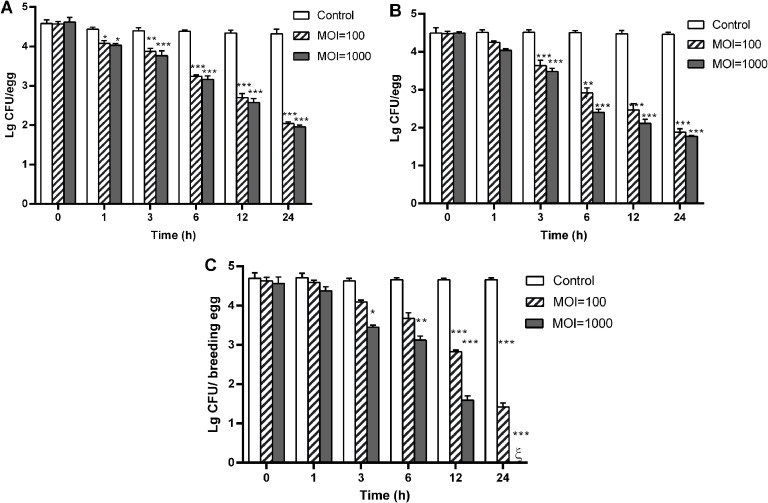
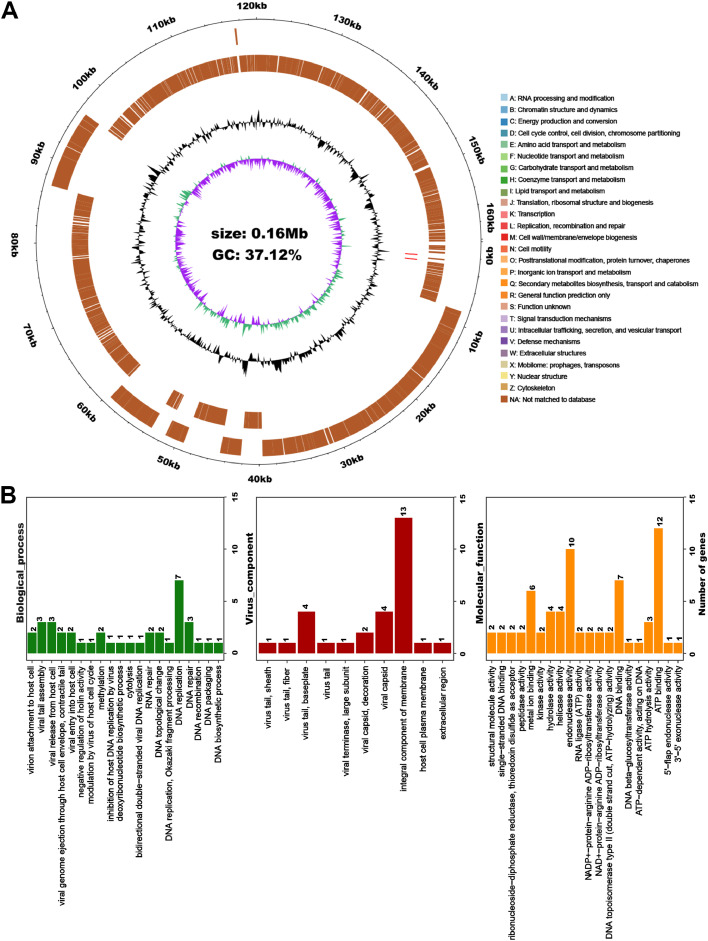
Salmonella is a major foodborne pathogen, that poses a serious threat to poultry farm production. Phage-based biocontrol offered a promising alternative strategy to eradicate the persistent and challenging infections caused by Salmonella in this setting. This study isolated and purified the lytic Salmonella phage vB_SenM_BP13076 (simple as BP13076) using its host strain Salmonella Enteritidis ATCC 13076. Its genome was extensively analyzed, and its potential biocontrol application towards eggs was investigated. Morphological analyses revealed that phage BP13076 is characterized by an icosahedral head and a contractile tail, placing it among Caudoviricetes. The phage demonstrated a broad host range, lysing 66 out of 68 tested Salmonella strains, including eight globally prevalent serovars. Moreover, it also exhibited a short latent period of approximately 5 min and a burst size of about 10 PFU/cell. It also demonstrates good thermal stability and a wide pH range tolerance. The genome of phage BP13076 consists of 160, 318 bp of dsDNA with a G + C content of 37.13% with nucleotide homology placing it among phages of the genus Gelderlandvirus. Notably, the genomic analysis revealed no known genes associated with virulence, antibiotic resistance, or lysogeny, making it a safe candidate for biocontrol applications. In vitro, bacteriostatic tests indicated higher MOI (multiplicity of infection), resulting in a more significant reduction in Salmonella counts. When applied to table and breeding eggs, phage BP13076 at MOIs of 100 and 1000 resulted in a significant decrease in Salmonella levels compared to the positive control groups. These findings highlight the efficacy of phage BP13076 as a promising biocontrol agent for managing Salmonella contamination and transmission for table and breeding eggs, offering a foundation for its potential application in the prevention and control of Salmonella in the poultry industry.
沙门氏菌是一种主要的食源性病原体,对家禽养殖场的生产构成严重威胁。基于噬菌体的生物防治为根除沙门氏菌在这种情况下引起的持续性和挑战性感染提供了一种有前景的替代策略。本研究使用其宿主菌株肠炎沙门氏菌ATCC 13076分离并纯化了裂解性沙门氏菌噬菌体vB_SenM_BP13076(简称为BP13076)。对其基因组进行了广泛分析,并研究了其对鸡蛋的潜在生物防治应用。形态学分析表明,噬菌体BP13076的特征是具有二十面体头部和收缩尾部,属于有尾噬菌体目。该噬菌体表现出广泛的宿主范围,在68株测试的沙门氏菌菌株中裂解了66株,包括8种全球流行的血清型。此外,它还表现出约5分钟的短潜伏期和约10个噬菌斑形成单位/细胞的裂解量。它还具有良好的热稳定性和宽pH范围耐受性。噬菌体BP13076的基因组由160318 bp的双链DNA组成,G + C含量为37.13%;核苷酸同源性分析表明它属于盖尔德兰病毒属噬菌体。值得注意的是,基因组分析未发现与毒力、抗生素抗性或溶原性相关的已知基因,使其成为生物防治应用的安全候选者。体外抑菌试验表明,感染复数(MOI)越高,沙门氏菌数量的减少越显著。当应用于食用蛋和种蛋时,MOI为100和1000的噬菌体BP13076与阳性对照组相比,沙门氏菌水平显著降低。这些发现突出了噬菌体BP13076作为一种有前景的生物防治剂在控制食用蛋和种蛋的沙门氏菌污染和传播方面的功效,为其在家禽业沙门氏菌防控中的潜在应用奠定了基础。