Department of Biochemistry and Biomedical Sciences, Farncombe Family Digestive Health Research Institute, and Centre for Metabolism, Obesity and Diabetes Research, McMaster University, Hamilton, Ontario, Canada.
Department of Genetics and Medicine, Stanford University, Stanford, California, USA.
Gut. 2023 Mar;72(3):460-471. doi: 10.1136/gutjnl-2022-328185. Epub 2022 Aug 25.
Bariatric surgery is an effective treatment for type 2 diabetes (T2D) that changes gut microbial composition. We determined whether the gut microbiota in humans after restrictive or malabsorptive bariatric surgery was sufficient to lower blood glucose.
Women with obesity and T2D had biliopancreatic diversion with duodenal switch (BPD-DS) or laparoscopic sleeve gastrectomy (LSG). Faecal samples from the same patient before and after each surgery were used to colonise rodents, and determinants of blood glucose control were assessed.
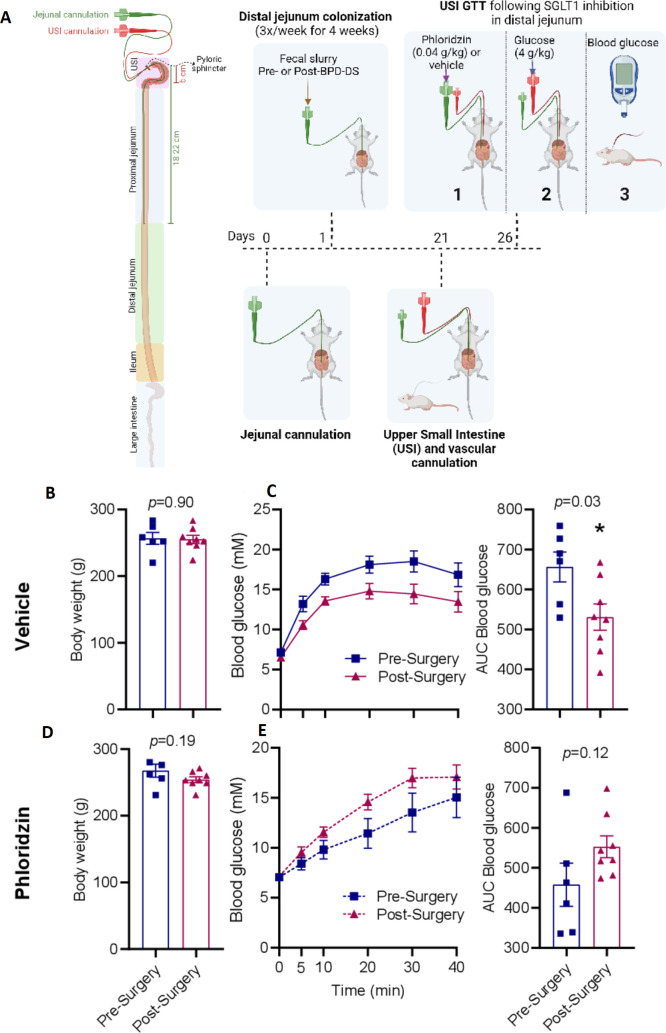
Glucose tolerance was improved in germ-free mice orally colonised for 7 weeks with human microbiota after either BPD-DS or LSG, whereas food intake, fat mass, insulin resistance, secretion and clearance were unchanged. Mice colonised with microbiota post-BPD-DS had lower villus height/width and crypt depth in the distal jejunum and lower intestinal glucose absorption. Inhibition of sodium-glucose cotransporter (Sglt)1 abrogated microbiota-transmissible improvements in blood glucose control in mice. In specific pathogen-free (SPF) rats, intrajejunal colonisation for 4 weeks with microbiota post-BPD-DS was sufficient to improve blood glucose control, which was negated after intrajejunal Sglt-1 inhibition. Higher and lower coincided with improvements in blood glucose control after colonisation with human bacteria post-BPD-DS and LSG.
Exposure of rodents to human gut microbiota after restrictive or malabsorptive bariatric surgery improves glycaemic control. The gut microbiota after bariatric surgery is a standalone factor that alters upper gut intestinal morphology and lowers Sglt1-mediated intestinal glucose absorption, which improves blood glucose control independently from changes in obesity, insulin or insulin resistance.
减重手术是治疗 2 型糖尿病(T2D)的有效方法,可改变肠道微生物组成。我们确定接受限制型或吸收不良型减重手术后的人类肠道微生物群是否足以降低血糖。
肥胖合并 T2D 的女性接受胆胰分流十二指肠转位术(BPD-DS)或腹腔镜袖状胃切除术(LSG)。每位患者手术前后的粪便样本用于定植啮齿动物,并评估血糖控制的决定因素。
接受 BPD-DS 或 LSG 后,用人类微生物群连续 7 周口饲的无菌小鼠糖耐量得到改善,而摄食量、脂肪量、胰岛素抵抗、分泌和清除率不变。接受 BPD-DS 后定植微生物群的小鼠在空肠远端的绒毛高度/宽度和隐窝深度较低,以及肠道葡萄糖吸收减少。抑制钠-葡萄糖共转运蛋白(Sglt)1 阻断了微生物群可传递的改善血糖控制作用。在无菌(SPF)大鼠中,用 BPD-DS 后定植于空肠内的微生物群进行 4 周定植足以改善血糖控制,而空肠内 Sglt-1 抑制后则消除了这种作用。更高和更低与接受 BPD-DS 后定植人类细菌和 LSG 后改善血糖控制相吻合。
限制型或吸收不良型减重手术后,将人类肠道微生物群暴露于啮齿动物可改善血糖控制。减重手术后的肠道微生物群是一个独立的因素,可改变上消化道肠道形态,并降低 Sglt1 介导的肠道葡萄糖吸收,从而独立于肥胖、胰岛素或胰岛素抵抗的变化来改善血糖控制。