Lyu Ying, Guan Yinglu, Deliu Lisa, Humphrey Ericka, Frontera Joanna K, Yang Youn Joo, Zamler Daniel, Kim Kun Hee, Mohanty Vakul, Jin Kevin, Mohanty Vakul, Liu Virginia, Dou Jinzhuang, Veillon Lucas J, Kumar Shwetha V, Lorenzi Philip L, Chen Yang, McAndrews Kathleen M, Grivennikov Sergei, Song Xingzhi, Zhang Jianhua, Xi Yuanxin, Wang Jing, Chen Ken, Nagarajan Priyadharsini, Ge Yejing
Department of Cancer Biology, University of Texas MD Anderson Cancer Center, Houston, Texas 77030, USA.
Department of Bioinformatics and Computational Biology, University of Texas MD Anderson Cancer Center, Houston, Texas 77030, USA.
Genes Dev. 2022 Aug 25;36(13-14):822-42. doi: 10.1101/gad.349662.122.
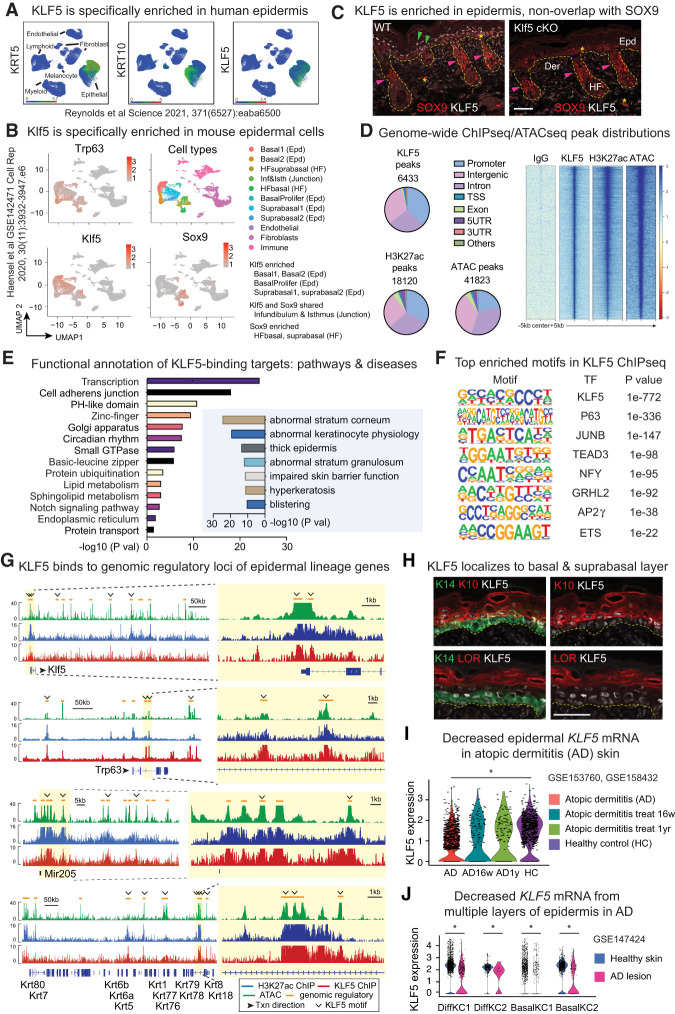
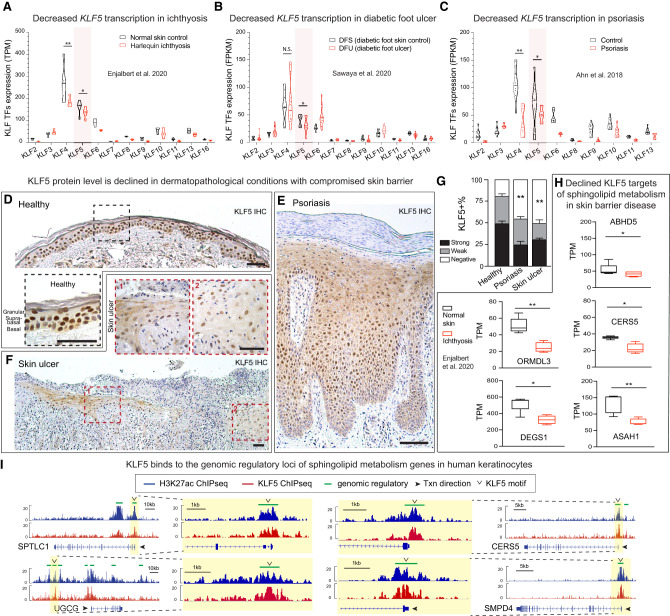
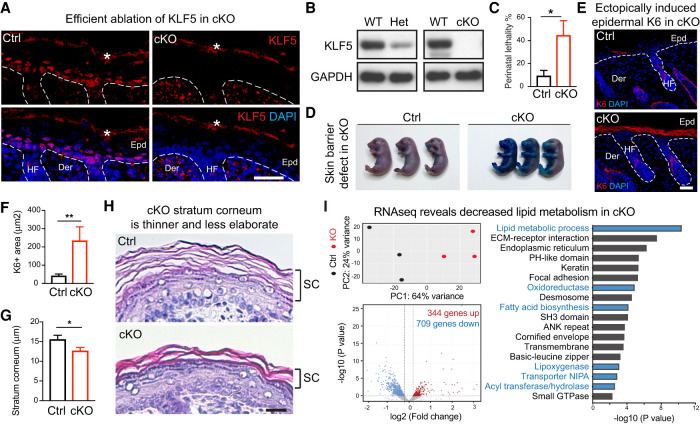
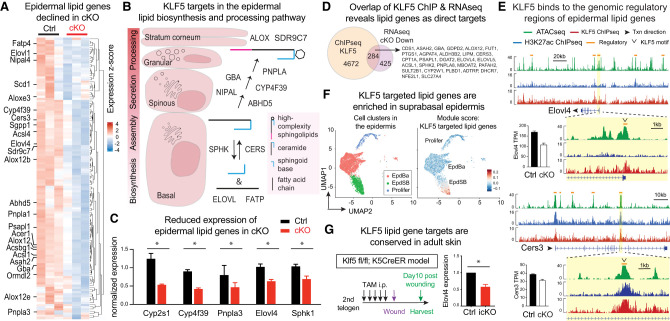
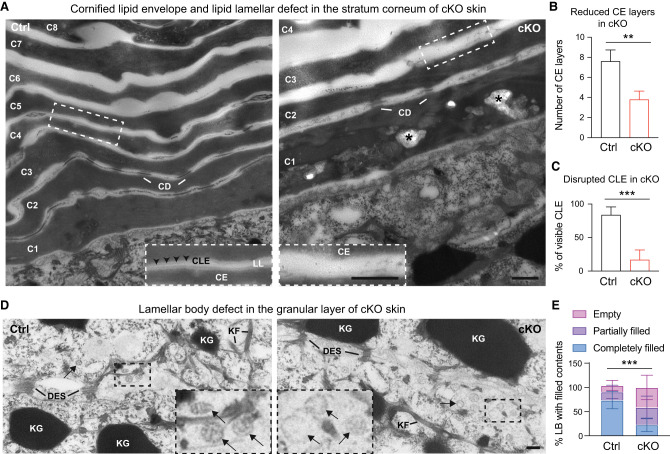
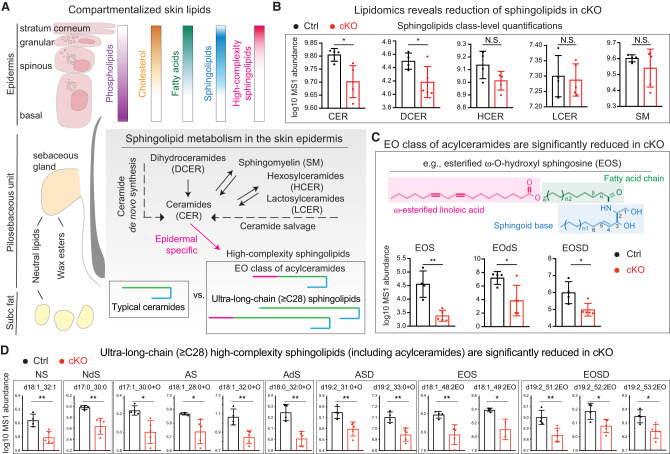
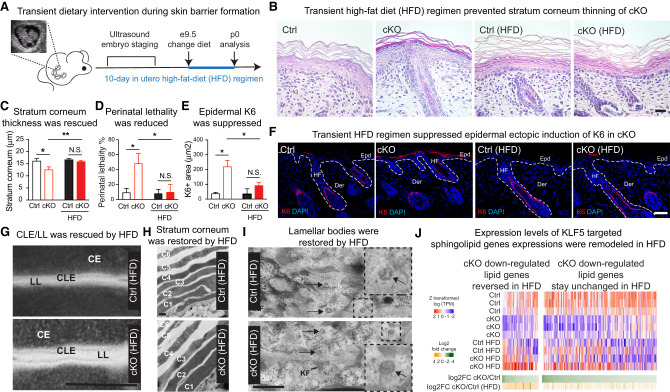
Stem cells are fundamental units of tissue remodeling whose functions are dictated by lineage-specific transcription factors. Home to epidermal stem cells and their upward-stratifying progenies, skin relies on its secretory functions to form the outermost protective barrier, of which a transcriptional orchestrator has been elusive. KLF5 is a Krüppel-like transcription factor broadly involved in development and regeneration whose lineage specificity, if any, remains unclear. Here we report KLF5 specifically marks the epidermis, and its deletion leads to skin barrier dysfunction in vivo. Lipid envelopes and secretory lamellar bodies are defective in KLF5-deficient skin, accompanied by preferential loss of complex sphingolipids. KLF5 binds to and transcriptionally regulates genes encoding rate-limiting sphingolipid metabolism enzymes. Remarkably, skin barrier defects elicited by KLF5 ablation can be rescued by dietary interventions. Finally, we found that KLF5 is widely suppressed in human diseases with disrupted epidermal secretion, and its regulation of sphingolipid metabolism is conserved in human skin. Altogether, we established KLF5 as a disease-relevant transcription factor governing sphingolipid metabolism and barrier function in the skin, likely representing a long-sought secretory lineage-defining factor across tissue types.
干细胞是组织重塑的基本单位,其功能由谱系特异性转录因子决定。皮肤是表皮干细胞及其向上分层后代的所在地,它依靠其分泌功能形成最外层的保护屏障,而其中的转录协调因子一直难以捉摸。KLF5是一种广泛参与发育和再生的Krüppel样转录因子,其谱系特异性(如果有的话)仍不清楚。在这里,我们报告KLF5特异性标记表皮,其缺失导致体内皮肤屏障功能障碍。在KLF5缺陷的皮肤中,脂质包膜和分泌性板层小体存在缺陷,同时伴有复合鞘脂的优先丢失。KLF5结合并转录调控编码鞘脂代谢限速酶的基因。值得注意的是,通过饮食干预可以挽救KLF5缺失引起的皮肤屏障缺陷。最后,我们发现KLF5在表皮分泌紊乱的人类疾病中被广泛抑制,并且其对鞘脂代谢的调控在人类皮肤中是保守的。总之,我们确立了KLF5作为一种与疾病相关的转录因子,它调控皮肤中的鞘脂代谢和屏障功能,可能代表了一种长期寻找的跨组织类型的分泌谱系定义因子。