Division of Advanced Internal Medicine, Department of Medicine, National University Hospital, 1E Kent Ridge Road, Singapore, 119228, Singapore.
Alice Lee Centre for Nursing Studies, Yong Loo Lin School of Medicine, National University of Singapore, Level 2, Clinical Research Centre, Block MD11, 10 Medical Drive, Singapore, 117597, Singapore.
J Gen Intern Med. 2023 Feb;38(3):691-698. doi: 10.1007/s11606-022-07765-1. Epub 2022 Aug 25.
Hospital at Home (HaH) programs have been shown to improve clinical outcomes, quality of care, and patient satisfaction. However, how Asian patients experience HaH remained underexplored.
To explore the perceptions and experiences of patients and caregivers admitted to a hospital-at-home program in Singapore.
Descriptive qualitative study design.
Purposive sampling was used to conduct 36 interviews with 13 patients, nine Legally Acceptable Representatives (LARs), and 14 caregivers until data saturation was achieved.
NUHS@Home is a HaH program providing care through a multi-disciplinary team, enabled by remote vital signs monitoring through a tablet and wireless blood pressure and oxygen meters.
This study used in-depth semi-structured individual interviews. Interviews were transcribed and thematically analyzed using Braun and Clark's six-step inductive approach.
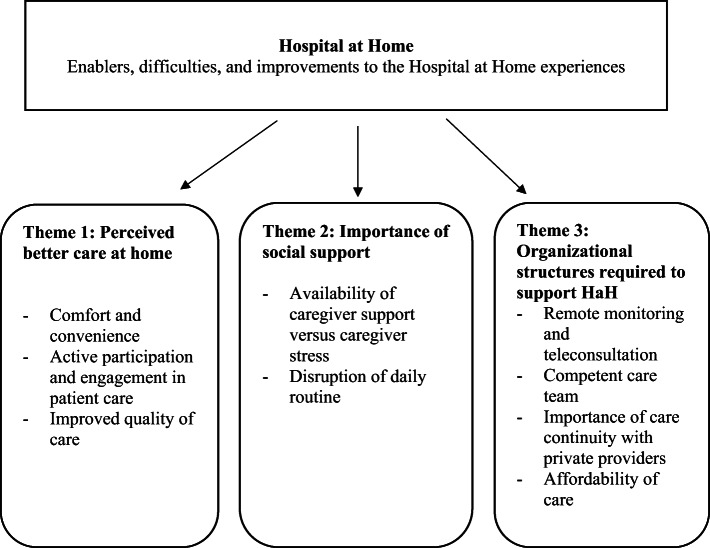
The overarching theme identified was "Enablers, difficulties, and improvements to the HaH experiences" which was supported by three key themes: (1) Perceived better care at home, (2) Importance of social support, and (3) Organizational structures required to support HaH. Participants described overall HaH experiences around factors contributing to their impeding engagement, overall satisfaction, and quality of care.
Although HaH is unfamiliar to the Singapore population, most of the participants in this study had an overall positive experience. The key challenges found in this paper were the stress and inconvenience caused to caregivers. The enablers for positive HaH experiences were (1) consideration of patient's family members as key participants in the patients' therapeutic alliance; (2) the HaH care team must be accessible, approachable, and reassuring, and communicate frequently and timely with patients and their families; and (3) financing strategies to ensure HaH out-of-pockets costs remain affordable which are critical to keeping HaH as an option for patients and families.
医院居家(HaH)项目已被证明可改善临床结果、护理质量和患者满意度。然而,亚洲患者对 HaH 的体验仍未得到充分探索。
探讨新加坡 HaH 项目中患者和护理人员的认知和体验。
描述性定性研究设计。
采用目的抽样法,对 13 名患者、9 名法定可接受代表(LAR)和 14 名护理人员进行了 36 次访谈,直至达到数据饱和。
NUHS@Home 是一个 HaH 项目,通过多学科团队提供护理,通过平板电脑和无线血压和血氧计进行远程生命体征监测。
本研究采用深入的半结构化个体访谈。访谈通过 Braun 和 Clark 的六步归纳法进行转录和主题分析。
确定的总体主题是“HaH 体验的促成因素、困难和改进”,这由三个关键主题支持:(1)在家中获得更好的护理,(2)社会支持的重要性,(3)支持 HaH 所需的组织结构。参与者描述了围绕阻碍他们参与、整体满意度和护理质量的因素的整体 HaH 体验。
尽管 HaH 对新加坡人口来说并不熟悉,但本研究中的大多数参与者总体上有积极的体验。本文发现的主要挑战是护理人员的压力和不便。积极的 HaH 体验的促成因素是:(1)将患者的家庭成员视为患者治疗联盟的关键参与者;(2)HaH 护理团队必须易于接近、令人安心,并与患者及其家属经常且及时地沟通;(3)确保 HaH 的自付费用负担得起的融资策略,这对于将 HaH 作为患者和家庭的选择至关重要。