Tokutake Yukako, Takanashi Ryo, Kikusato Motoi, Toyomizu Masaaki, Sato Kan
Animal Nutrition, Life Sciences, Graduate School of Agricultural Science, Tohoku University, Sendai 980-8572, Japan.
Animals (Basel). 2022 Aug 12;12(16):2056. doi: 10.3390/ani12162056.
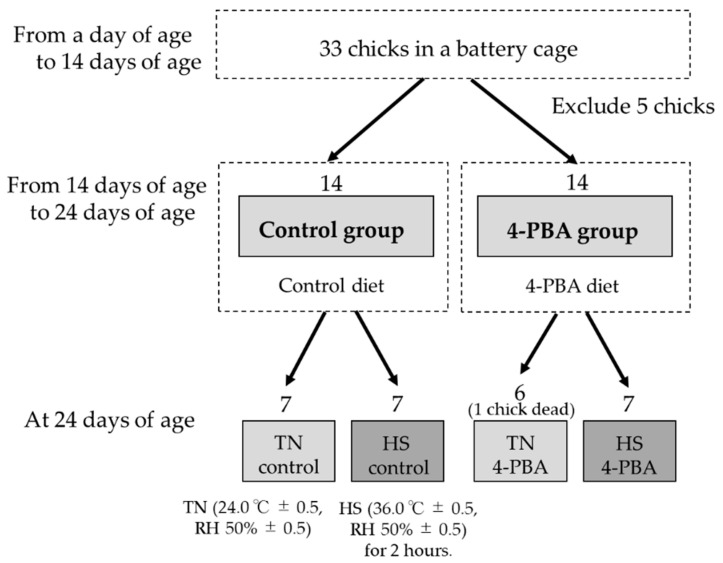
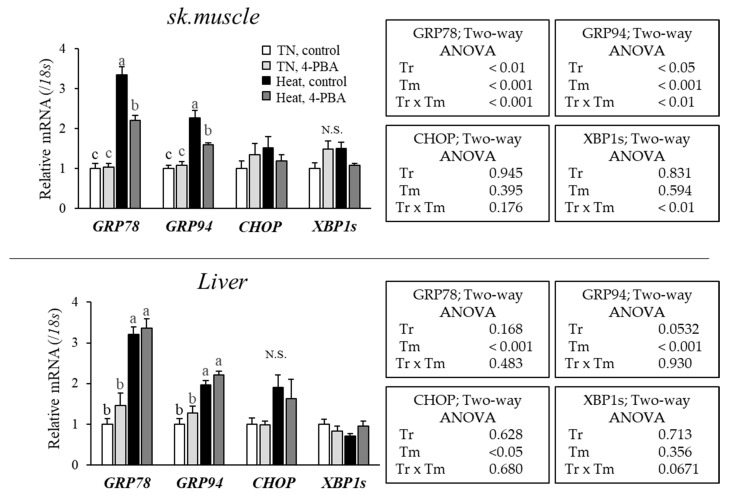
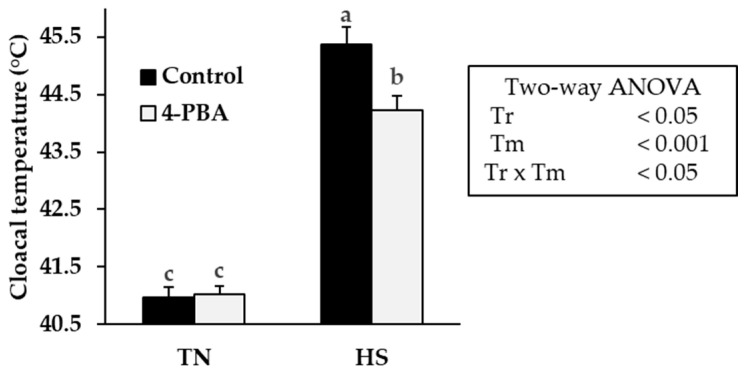
Hot, humid weather causes heat stress (HS) in broiler chickens, which can lead to high mortality. A recent study found that HS causes endoplasmic reticulum (ER) stress. However, the possible involvement of ER stress in HS-induced physiological alterations in broiler chickens is unclear. This study aimed to evaluate the effect of the dietary supplementation of 4-phenylbutyric acid (4-PBA), an alleviator of ER stress, in acute HS-exposed young broiler chickens. Twenty-eight 14-day-old male broiler chickens (ROSS 308) were divided into two groups and fed either a control diet or a diet containing 4-PBA (5.25 g per kg of diet feed) for 10 days. At 24 days old, each group of chickens was kept in thermoneutral (24 ± 0.5 °C) or acute HS (36 ± 0.5 °C) conditions for 2 h. The results showed that thermoneutral birds supplemented with 4-PBA exhibited no negative effects in terms of broiler body weight gain and tissue weight compared to non-supplemental birds. HS increased body temperature in both the control and 4-PBA groups, but the elevation was significantly lower in the 4-PBA group than in the control group. The plasma non-esterified fatty acid concentration was significantly increased by HS treatment in non-supplemental groups, while the increase was partially attenuated in the 4-PBA group. Moreover, 4-PBA prevented HS-induced gene elevation of the ER stress markers GRP78 and GRP94 in the skeletal muscle. These findings suggest that the 4-PBA effect may be specific to the skeletal muscle in HS-exposed birds and that 4-PBA supplementation attenuated HS-induced muscle ER stress, which could be associated with a supplementation of the body temperature elevation and lipolysis.
炎热潮湿的天气会导致肉鸡出现热应激(HS),进而可能导致高死亡率。最近的一项研究发现,热应激会引发内质网(ER)应激。然而,内质网应激在热应激诱导的肉鸡生理变化中可能发挥的作用尚不清楚。本研究旨在评估日粮中添加4-苯基丁酸(4-PBA,一种内质网应激缓解剂)对急性热应激暴露的幼龄肉鸡的影响。将28只14日龄雄性肉鸡(ROSS 308)分为两组,分别饲喂对照日粮或含4-PBA的日粮(每千克日粮5.25克),持续10天。在24日龄时,每组鸡分别置于热中性(24±0.5℃)或急性热应激(36±0.5℃)条件下2小时。结果表明,与未添加4-PBA的肉鸡相比,添加4-PBA的热中性肉鸡在体重增加和组织重量方面没有负面影响。热应激使对照组和4-PBA组的体温均升高,但4-PBA组的升高幅度明显低于对照组。在未添加4-PBA的组中,热应激处理显著提高了血浆非酯化脂肪酸浓度,而在4-PBA组中这种增加部分得到缓解。此外,4-PBA可防止热应激诱导的骨骼肌中内质网应激标志物GRP78和GRP94基因表达升高。这些发现表明,4-PBA的作用可能对热应激暴露鸡的骨骼肌具有特异性,并且添加4-PBA可减轻热应激诱导的肌肉内质网应激,这可能与体温升高和脂肪分解的缓解有关。