Gao Yutong, Zhang Zhenying, Chen Binli, Wang Xiying
School of Education, University of North Carolina at Chapel Hill, Chapel Hill, NC 27599, USA.
Institute for Education Theories, Faculty of Education, Beijing Normal University, Beijing 100875, China.
Children (Basel). 2022 Jul 28;9(8):1127. doi: 10.3390/children9081127.
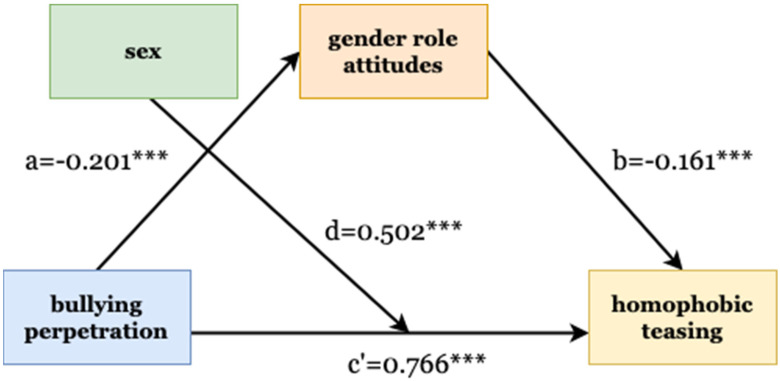
Homophobic teasing or name-calling, one form of school-related gender-based violence, refers to the use of derogatory language or actions towards sexual- or gender-nonconforming individuals. Research in the Global North has indicated that it is highly prevalent among adolescents, and is associated with a broad range of negative outcomes for both victims and perpetrators. However, such behaviors remain understudied in China. Using a cross-sectional design, the present study investigated the structural relations between homophobic teasing, bullying perpetration, and gender role attitudes among 1915 Chinese high school students. The results showed that 11.5% of the participants had perpetrated such harassment in the past month. Structural equation analyses revealed that bullying perpetration predicted more teasing involvement, and that the relationship was partially mediated by gender role attitudes among both female and male youth. The moderation effect of sex was found only for the direct effect of bullying; such that males who engaged in bullying were more likely to perpetrate homophobic teasing than females. These findings suggest the need for further examination and effective interventions and preventions for the behavior in Chinese contexts.
恐同嘲笑或辱骂是与学校相关的基于性别的暴力的一种形式,指对性取向或性别认同不符的个体使用贬损性语言或行为。北半球的研究表明,这种现象在青少年中非常普遍,并且对受害者和实施者都会产生一系列负面后果。然而,在中国,此类行为仍未得到充分研究。本研究采用横断面设计,调查了1915名中国高中生中恐同嘲笑、欺凌行为与性别角色态度之间的结构关系。结果显示,11.5%的参与者在过去一个月内实施过此类骚扰行为。结构方程分析表明,欺凌行为会导致更多的嘲笑行为,并且这种关系在青年女性和青年男性中都部分地由性别角色态度介导。仅在欺凌行为的直接影响方面发现了性别调节效应;即实施欺凌的男性比女性更有可能实施恐同嘲笑。这些发现表明,在中国背景下,需要对这种行为进行进一步研究,并采取有效的干预和预防措施。