Unidad Analítica, Health Research Institute Hospital La Fe, 46026 Valencia, Spain.
Health and Biomedicine, LEITAT Technological Centre, 08005 Barcelona, Spain.
Int J Mol Sci. 2022 Aug 18;23(16):9298. doi: 10.3390/ijms23169298.
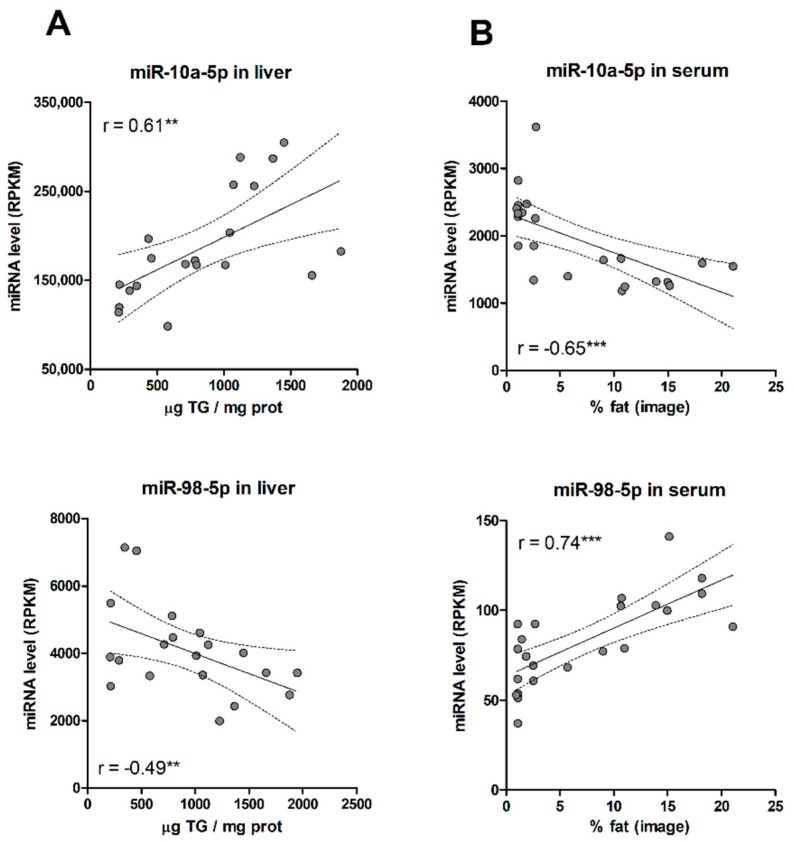
Non-alcoholic fatty liver disease (NAFLD) is the most prevalent form of chronic liver disease worldwide, but a reliable non-invasive method to quantify liver steatosis in primary healthcare is not available. Circulating microRNAs have been proposed as biomarkers of severe/advanced NAFLD (steatohepatitis and fibrosis). However, the use of circulating miRNAs to quantitatively assess the % of liver fat in suspected NAFLD patients has not been investigated. We performed global miRNA sequencing in two sets of samples: human livers from organ donors (n = 20), and human sera from biopsy-proven NAFLD patients (n = 23), both with a wide range of steatosis quantified in their liver biopsies. Partial least squares (PLS) regression combined with recursive feature elimination (RFE) was used to select miRNAs associated with steatosis. Moreover, regression models with only 2 or 3 miRNAs, with high biological relevance, were built. Comprehensive microRNA sequencing of liver and serum samples resulted in two sets of abundantly expressed miRNAs (418 in liver and 351 in serum). Pearson correlation analyses indicated that 18% of miRNAs in liver and 14.5% in serum were significantly associated with the amount of liver fat. PLS-RFE models demonstrated that 50 was the number of miRNAs providing the lowest error in both liver and serum models predicting steatosis. Comparison of the two miRNA subsets showed 19 coincident miRNAs that were ranked according to biological significance (guide/passenger strand, relative abundance in liver and serum, number of predicted lipid metabolism target genes, correlation significance, etc.). Among them, miR-10a-5p, miR-98-5p, miR-19a-3p, miR-30e-5p, miR-32-5p and miR-145-5p showed the highest biological relevance. PLS regression models with serum levels of 2−3 of these miRNAs predicted the % of liver fat with errors <5%.
非酒精性脂肪性肝病(NAFLD)是全球最常见的慢性肝病,但在初级保健中,尚无可靠的非侵入性方法来量化肝脂肪变性。循环 microRNA 已被提议作为严重/晚期 NAFLD(脂肪性肝炎和纤维化)的生物标志物。然而,尚未研究使用循环 microRNA 定量评估疑似 NAFLD 患者肝脏脂肪的%。我们在两组样本中进行了全局 microRNA 测序:器官捐献者的肝脏(n = 20)和活检证实的 NAFLD 患者的血清(n = 23),两者的肝脏活检均有广泛的脂肪变性范围。偏最小二乘(PLS)回归结合递归特征消除(RFE)用于选择与脂肪变性相关的 microRNA。此外,还建立了仅包含 2 或 3 个具有高生物学相关性的 microRNA 的回归模型。对肝和血清样本进行全面 microRNA 测序,产生了两组大量表达的 microRNA(肝脏 418 个,血清 351 个)。Pearson 相关分析表明,肝脏中 18%的 microRNA 和血清中 14.5%的 microRNA与肝脏脂肪量显著相关。PLS-RFE 模型表明,在肝脏和血清模型中,50 个 microRNA 是提供最低预测脂肪变性误差的 microRNA 数量。两个 microRNA 子集的比较显示 19 个一致的 microRNA,这些 microRNA 根据生物学意义(向导/乘客链、在肝脏和血清中的相对丰度、预测脂质代谢靶基因的数量、相关性意义等)进行排序。其中,miR-10a-5p、miR-98-5p、miR-19a-3p、miR-30e-5p、miR-32-5p 和 miR-145-5p 显示出最高的生物学相关性。这些 microRNA 中 2-3 种的血清水平 PLS 回归模型预测肝脏脂肪的%误差<5%。