Barańska Agnieszka, Kanadys Wiesław, Bogdan Magdalena, Stępień Ewa, Barczyński Bartłomiej, Kłak Anna, Augustynowicz Anna, Szajnik Marta, Religioni Urszula
Department of Medical Informatics and Statistics with e-Health Lab, Medical University of Lublin, 20-090 Lublin, Poland.
Specialistic Medical Center Czechow, 20-848 Lublin, Poland.
J Clin Med. 2022 Aug 10;11(16):4676. doi: 10.3390/jcm11164676.
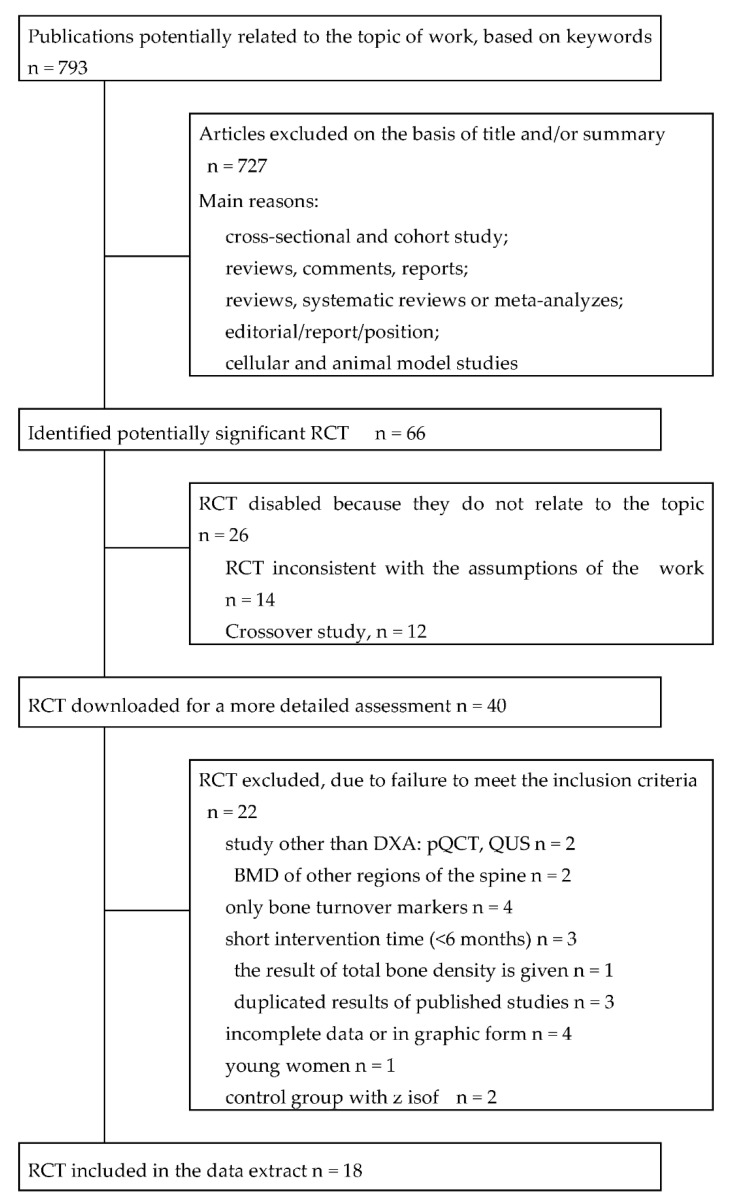
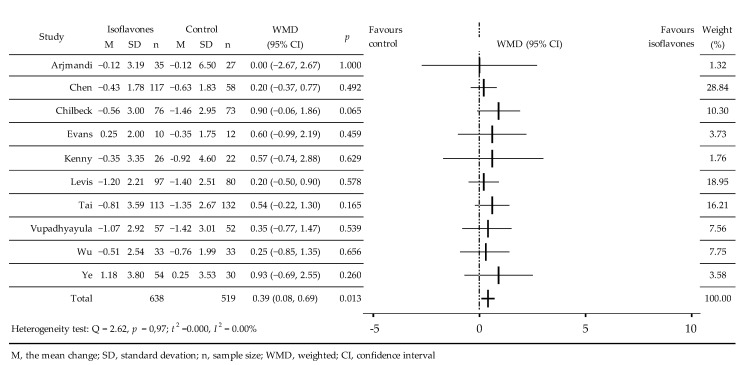
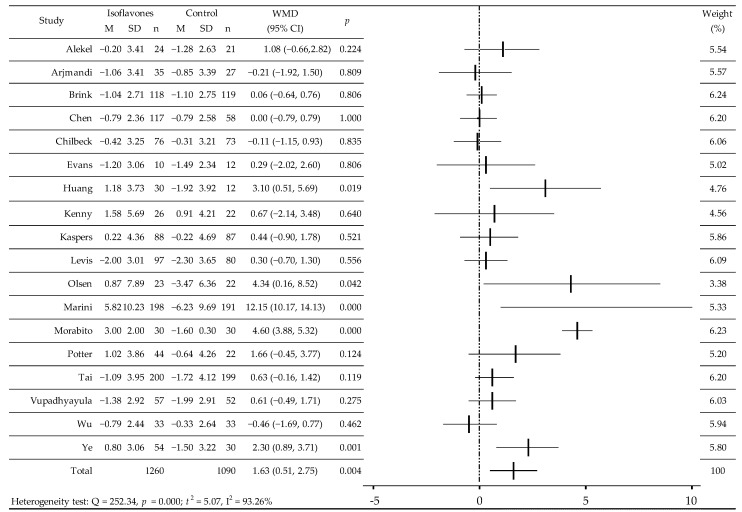
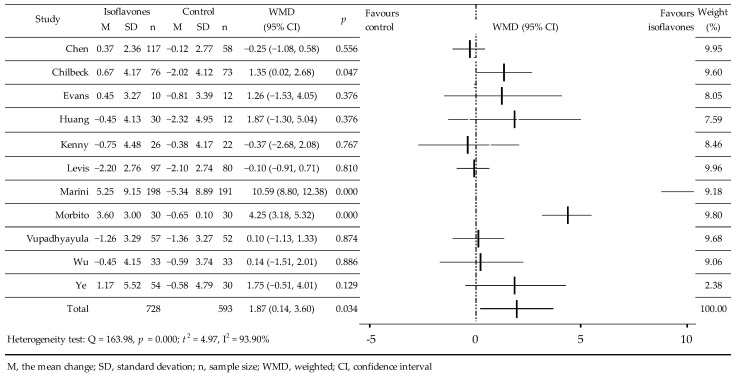
The aim of the report was to determine the effects of soy isoflavones on lumbar spine, femoral neck, and total hip bone mineral density (BMD) in menopausal women. MEDLINE (PubMed), EMBASE, and Cochrane Library databases were searched for articles published in English during 1995-2019. Studies were identified and reviewed for inclusion and exclusion eligibility. Weighted mean differences (WMD) were calculated for each study and were pooled by using the random effects model. Eighteen randomized controlled trials were selected for meta-analysis. Different types of soy phytoestrogens, i.e., genistein extracts, soy isoflavones extracts, soy protein isolate, and foods containing diverse amounts of isoflavones were used in the studies. The analysis showed that daily intake of 106 (range, 40-300) mg of isoflavones for 6-24 months moderately but statistically significantly positively affects BMD, compared with controls: lumbar spine WMD = 1.63 (95% CI: 0.51 to 2.75)%, = 0004; femoral neck WMD = 1.87 (95% CI: 0.14 to 3.60)%, = 0.034; and total hip WMD = 0.39 (95% CI: 0.08 to 0.69)%, = 0.013. Subgroups analyses indicated that the varying effects of isoflavones on BMD across the trials might be associated with intervention duration, racial diversity (Caucasian, Asian), time after menopause, form of supplements (especially genistein), and dose of isoflavones. Our review and meta-analysis suggest that soy isoflavones are effective in slowing down bone loss after menopause.
该报告的目的是确定大豆异黄酮对绝经后女性腰椎、股骨颈和全髋骨矿物质密度(BMD)的影响。检索了MEDLINE(PubMed)、EMBASE和Cochrane图书馆数据库,以查找1995年至2019年期间发表的英文文章。对研究进行识别和审查,以确定其纳入和排除资格。计算每项研究的加权平均差(WMD),并使用随机效应模型进行汇总。选择了18项随机对照试验进行荟萃分析。研究中使用了不同类型的大豆植物雌激素,即染料木黄酮提取物、大豆异黄酮提取物、大豆分离蛋白以及含有不同量异黄酮的食物。分析表明,与对照组相比,每日摄入106(范围为40 - 300)mg异黄酮6 - 24个月对骨矿物质密度有中度但在统计学上显著的正向影响:腰椎WMD = 1.63(95%CI:0.51至2.75)%,P = 0.004;股骨颈WMD = 1.87(95%CI:0.14至3.60)%,P = 0.034;全髋WMD = 0.39(95%CI:0.08至0.69)%,P = 0.013。亚组分析表明,试验中异黄酮对骨矿物质密度的不同影响可能与干预持续时间、种族多样性(白种人、亚洲人)、绝经后时间、补充剂形式(尤其是染料木黄酮)以及异黄酮剂量有关。我们的综述和荟萃分析表明,大豆异黄酮在减缓绝经后骨质流失方面是有效的。