
硅切割废料与蚕沙的高值利用以合成作为锂离子电池负极材料的硅碳复合材料
High-Value Utilization of Silicon Cutting Waste and Excrementum Bombycis to Synthesize Silicon-Carbon Composites as Anode Materials for Li-Ion Batteries.
作者信息
Ji Hengsong, Li Jun, Li Sheng, Cui Yingxue, Liu Zhijin, Huang Minggang, Xu Chun, Li Guochun, Zhao Yan, Li Huaming
机构信息
Institute for Energy Research, Jiangsu University, Zhenjiang 212013, China.
Key Laboratory of Fine Chemical Application Technology of Luzhou, Luzhou 646099, China.
出版信息
Nanomaterials (Basel). 2022 Aug 21;12(16):2875. doi: 10.3390/nano12162875.
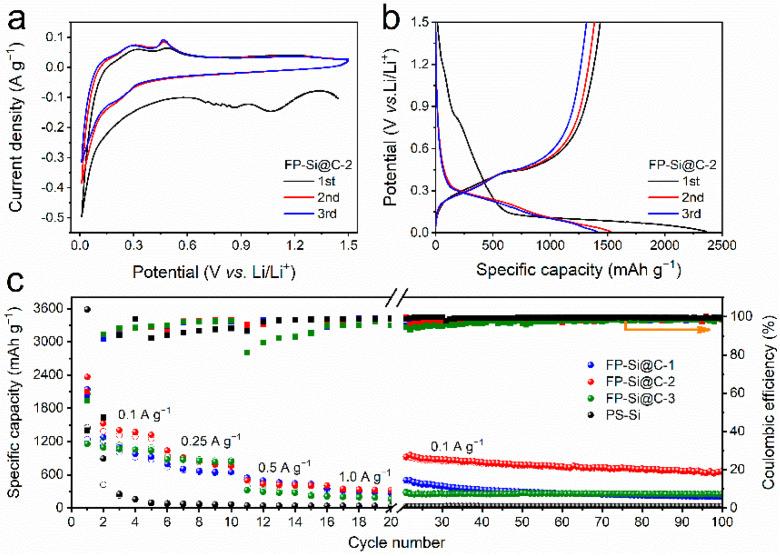
Silicon-based photovoltaic technology is helpful in reducing the cost of power generation; however, it suffers from economic losses and environmental pollution caused by silicon cutting waste. Herein, a hydrothermal method accompanied by heat treatment is proposed to take full advantage of the photovoltaic silicon cutting waste and biomass excrementum bombycis to fabricate flake-like porous Si@C (FP-Si@C) composite anodes for lithium-ion batteries (LIBs). The resulting FP-Si@C composite with a meso-macroporous structure can buffer the severe volume changes and facilitate electrolyte penetration. Meanwhile, the slightly graphitic carbon with high electrical conductivity and mechanical strength tightly surrounds the Si nanoflakes, which not only contributes to the ion/electron transport but also maintains the electrode structural integrity during the repeated lithiation/delithiation process. Accordingly, the synergistic effect of the unique structure of FP-Si@C composite contributes to a high discharge specific capacity of 1322 mAh g at 0.1 A g, superior cycle stability with a capacity retention of 70.8% after 100 cycles, and excellent rate performance with a reversible capacity of 406 mAh g at 1.0 A g. This work provides an easy and cost-effective approach to achieving the high-value application of photovoltaic silicon cutting waste, as well as obtaining high-performance Si-based anodes for LIBs.
硅基光伏技术有助于降低发电成本;然而,它面临着由硅切割废料导致的经济损失和环境污染问题。在此,我们提出一种伴有热处理的水热法,以充分利用光伏硅切割废料和家蚕粪便来制备用于锂离子电池(LIBs)的片状多孔Si@C(FP-Si@C)复合负极。所得具有介孔-大孔结构的FP-Si@C复合材料能够缓冲剧烈的体积变化并促进电解液渗透。同时,具有高电导率和机械强度的轻度石墨化碳紧密围绕着硅纳米片,这不仅有助于离子/电子传输,还能在反复的锂化/脱锂过程中维持电极结构的完整性。因此,FP-Si@C复合材料独特结构的协同效应有助于在0.1 A g下实现1322 mAh g的高放电比容量、在100次循环后容量保持率为70.8%的优异循环稳定性以及在1.0 A g下具有406 mAh g可逆容量的出色倍率性能。这项工作提供了一种简便且经济高效的方法,以实现光伏硅切割废料的高价值应用,并获得用于LIBs的高性能硅基负极。


 Zotero 插件