Åkerlund Elin, Diez-Escudero Anna, Grzeszczak Ana, Persson Cecilia
Division of Biomedical Engineering, Department of Materials Science and Engineering, The Ångström Laboratory, Uppsala University, 752 37 Uppsala, Sweden.
Ortholab, Department of Surgical Sciences, Rudbeck Laboratory, Uppsala University, 752 37 Uppsala, Sweden.
Polymers (Basel). 2022 Aug 13;14(16):3305. doi: 10.3390/polym14163305.
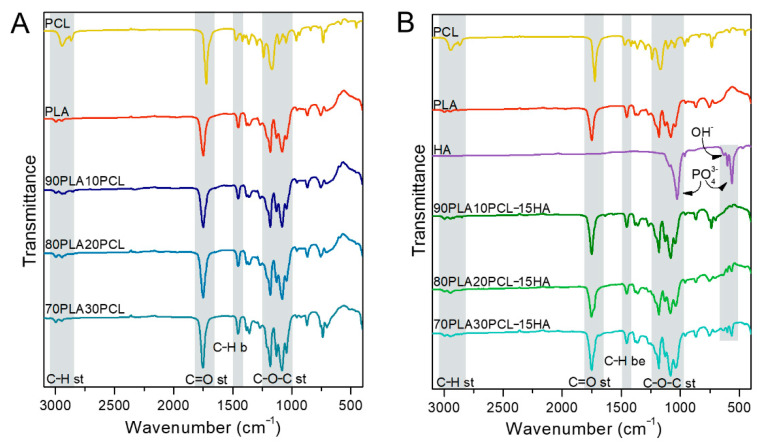
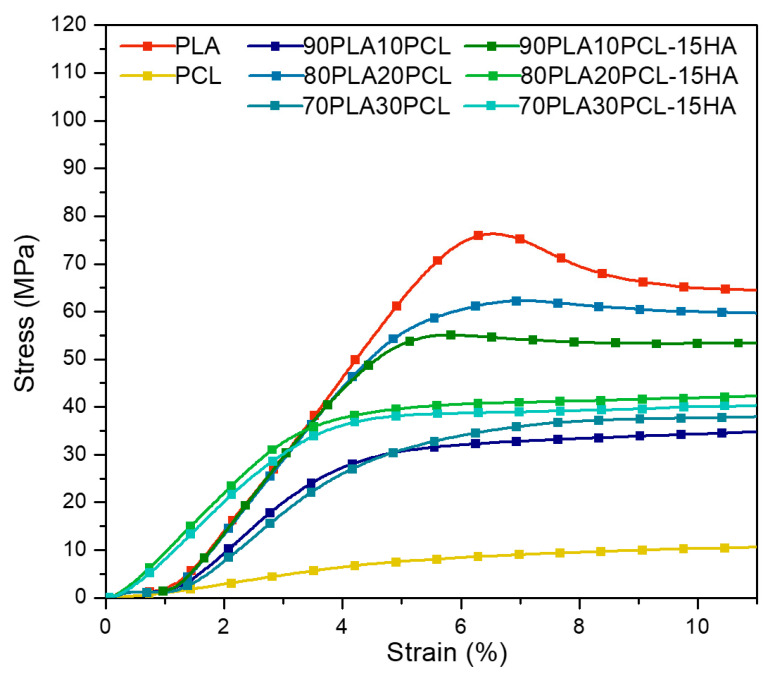
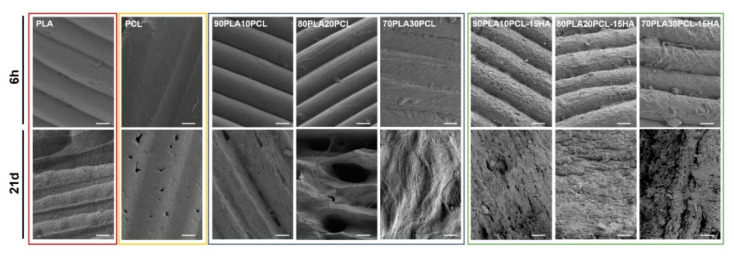
The still-growing field of additive manufacturing (AM), which includes 3D printing, has enabled manufacturing of patient-specific medical devices with high geometrical accuracy in a relatively quick manner. However, the development of materials with specific properties is still ongoing, including those for enhanced bone-repair applications. Such applications seek materials with tailored mechanical properties close to bone tissue and, importantly, that can serve as temporary supports, allowing for new bone ingrowth while the material is resorbed. Thus, controlling the resorption rate of materials for bone applications can support bone healing by balancing new tissue formation and implant resorption. In this regard, this work aimed to study the combination of polylactic acid (PLA), polycaprolactone (PCL) and hydroxyapatite (HA) to develop customized biocompatible and bioresorbable polymer-based composite filaments, through extrusion, for fused filament fabrication (FFF) printing. PLA and PCL were used as supporting polymer matrices while HA was added to enhance the biological activity. The materials were characterized in terms of mechanical properties, thermal stability, chemical composition and morphology. An accelerated degradation study was executed to investigate the impact of degradation on the above-mentioned properties. The results showed that the materials' chemical compositions were not affected by the extrusion nor the printing process. All materials exhibited higher mechanical properties than human trabecular bone, even after degradation with a mass loss of around 30% for the polymer blends and 60% for the composites. It was also apparent that the mineral accelerated the polymer degradation significantly, which can be advantageous for a faster healing time, where support is required only for a shorter time period.
包括3D打印在内的增材制造(AM)这一仍在不断发展的领域,已能够以相对较快的速度制造出具有高几何精度的定制化医疗设备。然而,具有特定性能的材料的研发仍在进行中,包括用于增强骨修复应用的材料。此类应用需要具有接近骨组织的定制机械性能的材料,重要的是,这些材料可以作为临时支撑物,在材料被吸收的同时允许新骨向内生长。因此,控制骨应用材料的吸收速率可以通过平衡新组织形成和植入物吸收来支持骨愈合。在这方面,这项工作旨在研究聚乳酸(PLA)、聚己内酯(PCL)和羟基磷灰石(HA)的组合,通过挤出工艺开发定制的生物相容性和生物可吸收的聚合物基复合长丝,用于熔融长丝制造(FFF)打印。PLA和PCL用作支撑聚合物基体,同时添加HA以增强生物活性。对这些材料的机械性能、热稳定性、化学成分和形态进行了表征。进行了加速降解研究,以研究降解对上述性能的影响。结果表明,材料的化学成分不受挤出和打印工艺的影响。即使在降解后,所有材料的机械性能都高于人松质骨,聚合物共混物的质量损失约为30%,复合材料的质量损失约为60%。还明显的是,矿物质显著加速了聚合物的降解,这对于更快的愈合时间可能是有利的,因为在较短的时间段内只需要支撑。