Division of Hematology & Oncology, Department of Medicine, Case Western Reserve University, Cleveland, OH, United States.
Department of Biochemistry, Case Western Reserve University, Cleveland, OH, United States.
Front Immunol. 2022 Aug 9;13:957157. doi: 10.3389/fimmu.2022.957157. eCollection 2022.
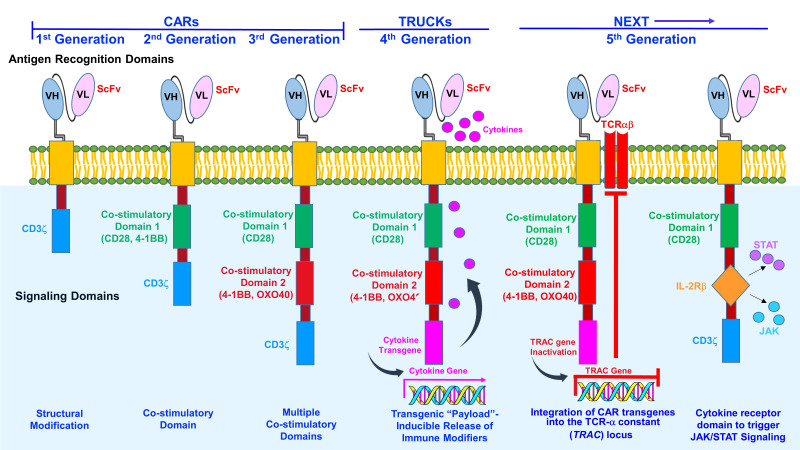
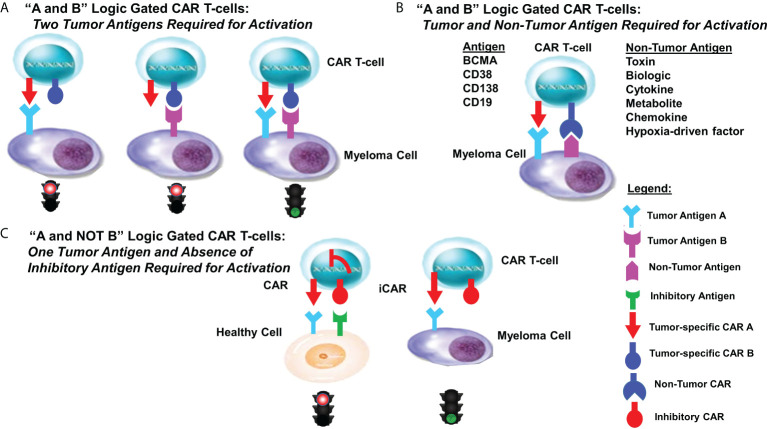
A deeper understanding of basic immunology principles and advances in bioengineering have accelerated the mass production of genetically-reprogrammed T-cells as living drugs to treat human diseases. Autologous and allogeneic cytotoxic T-cells have been weaponized to brandish MHC-independent chimeric antigen receptors (CAR) that specifically engage antigenic regions on tumor cells. Two distinct CAR-based therapeutics designed to target BCMA are now FDA-approved based upon robust, sustained responses in heavily-pretreated multiple myeloma (MM) patients enrolled on the KarMMa and CARTITUDE-1 studies. While promising, CAR T-cells present unique challenges such as antigen escape and T-cell exhaustion. Here, we review novel strategies to design CARs that overcome current limitations. Co-stimulatory signaling regions were added to second-generation CARs to promote IL-2 synthesis, activate T-cells and preclude apoptosis. Third-generation CARs are composed of multiple co-stimulatory signaling units, e.g., CD28, OX40, 4-1BB, to reduce exhaustion. Typically, CAR T-cells incorporate a potent constitutive promoter that maximizes long-term CAR expression but extended CAR activation may also promote T-cell exhaustion. Hypoxia-inducible elements can be incorporated to conditionally drive CAR expression and selectively target MM cells within bone marrow. CAR T-cell survival and activity is further realized by blocking intrinsic regulators of T-cell inactivation. T-Cells Redirected for Universal Cytokine Killing (TRUCKs) bind a specific tumor antigen and produce cytokines to recruit endogenous immune cells. Suicide genes have been engineered into CAR T-cells given the potential for long-term on-target, off-tumor effects. Universal allo-CAR T-cells represent an off-the-shelf source, while logic-gated CAR T-cells are designed to recognize tumor-specific features coupled with Boolean-generated binary gates that then dictate cell-fate decisions. Future generations of CARs should further revitalize immune responses, enhance tumor specificity and reimagine strategies to treat myeloma and other cancers.
对基础免疫学原理的更深入了解和生物工程的进步加速了基因重编程 T 细胞的大规模生产,将其作为治疗人类疾病的活药物。自体和同种异体细胞毒性 T 细胞已被武器化,以挥舞 MHC 非依赖性嵌合抗原受体 (CAR),这些受体特异性结合肿瘤细胞上的抗原区域。两种基于 CAR 的治疗方法已被设计用于靶向 BCMA,现在基于 KarMMa 和 CARTITUDE-1 研究中接受过大量预处理的多发性骨髓瘤 (MM) 患者的强大、持续反应而获得 FDA 批准。虽然有希望,但 CAR T 细胞存在独特的挑战,例如抗原逃逸和 T 细胞衰竭。在这里,我们回顾了设计克服当前限制的 CAR 的新策略。共刺激信号区域被添加到第二代 CAR 中,以促进 IL-2 合成、激活 T 细胞并防止细胞凋亡。第三代 CAR 由多个共刺激信号单元组成,例如 CD28、OX40、4-1BB,以减少衰竭。通常,CAR T 细胞包含一个强大的组成型启动子,最大限度地提高长期 CAR 表达,但延长 CAR 激活也可能促进 T 细胞衰竭。缺氧诱导元件可以被整合,以条件性地驱动 CAR 表达,并选择性地靶向骨髓中的 MM 细胞。通过阻断 T 细胞失活的内在调节剂来进一步实现 CAR T 细胞的存活和活性。通用细胞因子杀伤的 T 细胞重定向 (TRUCKs) 结合特定的肿瘤抗原并产生细胞因子来招募内源性免疫细胞。已经对 CAR T 细胞进行了自杀基因工程,因为存在长期靶标、肿瘤外效应的潜力。通用同种异体 CAR T 细胞代表现成的来源,而逻辑门控 CAR T 细胞旨在识别肿瘤特异性特征,同时结合布尔生成的二进制门,然后决定细胞命运决策。下一代 CAR 应该进一步激活免疫反应,增强肿瘤特异性,并重新构想治疗骨髓瘤和其他癌症的策略。