College of Computer Engineering and Sciences, Prince Sattam Bin Abdulaziz University, AlKharj, Saudi Arabia.
Faculty of Management, Comenius University in Bratislava, Odbojárov 10, 82005 Bratislava 25, Slovakia.
Comput Intell Neurosci. 2022 Aug 16;2022:5267498. doi: 10.1155/2022/5267498. eCollection 2022.
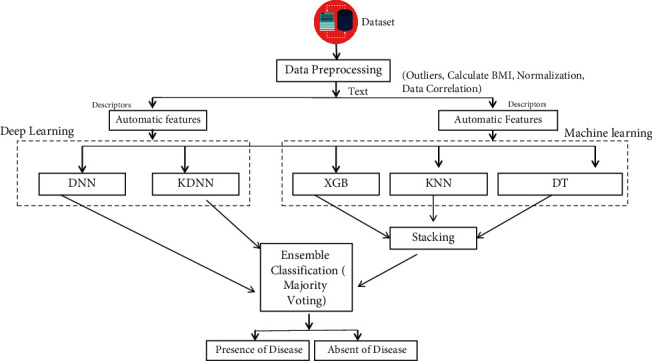
One of the most challenging tasks for clinicians is detecting symptoms of cardiovascular disease as earlier as possible. Many individuals worldwide die each year from cardiovascular disease. Since heart disease is a major concern, it must be dealt with timely. Multiple variables affecting health, such as excessive blood pressure, elevated cholesterol, an irregular pulse rate, and many more, make it challenging to diagnose cardiac disease. Thus, artificial intelligence can be useful in identifying and treating diseases early on. This paper proposes an ensemble-based approach that uses machine learning (ML) and deep learning (DL) models to predict a person's likelihood of developing cardiovascular disease. We employ six classification algorithms to predict cardiovascular disease. Models are trained using a publicly available dataset of cardiovascular disease cases. We use random forest (RF) to extract important cardiovascular disease features. The experiment results demonstrate that the ML ensemble model achieves the best disease prediction accuracy of 88.70%.
对于临床医生来说,最具挑战性的任务之一是尽早发现心血管疾病的症状。全球每年有许多人死于心血管疾病。由于心脏病是一个主要关注点,因此必须及时处理。影响健康的多种变量,如高血压、胆固醇升高、脉搏不规则等,使得心脏病的诊断变得具有挑战性。因此,人工智能可以用于早期识别和治疗疾病。本文提出了一种基于集成的方法,该方法使用机器学习(ML)和深度学习(DL)模型来预测一个人患心血管疾病的可能性。我们使用六种分类算法来预测心血管疾病。使用心血管疾病病例的公共数据集对模型进行训练。我们使用随机森林(RF)来提取重要的心血管疾病特征。实验结果表明,ML 集成模型的疾病预测准确率最高,达到 88.70%。