Department of Statistics, College of Natural and Computational Science, Dilla University, Dilla, Ethiopia.
BMC Pregnancy Childbirth. 2022 Aug 26;22(1):663. doi: 10.1186/s12884-022-04990-8.
Anemia is a serious public health problem that occurs when the blood contains fewer red blood cells than normal. In Ethiopia, the prevalence of anemia in pregnancy increased between 2005 and 2016. The aim of this study was to determine what factors influence the anemia status of pregnant women in Ethiopia.
Anemia status in a sample of 1053 pregnant women was studied using data from Ethiopia's Demographic and Health Survey 2016. Percentages and graphs were used to show the prevalence of anemia. The marginal probability effect was used to determine the contribution of each explanatory variable category to a single response category of anemia level. Ordinal logistic regression models were constructed, and the best-fitting model was selected to reveal significant anemia status variables.
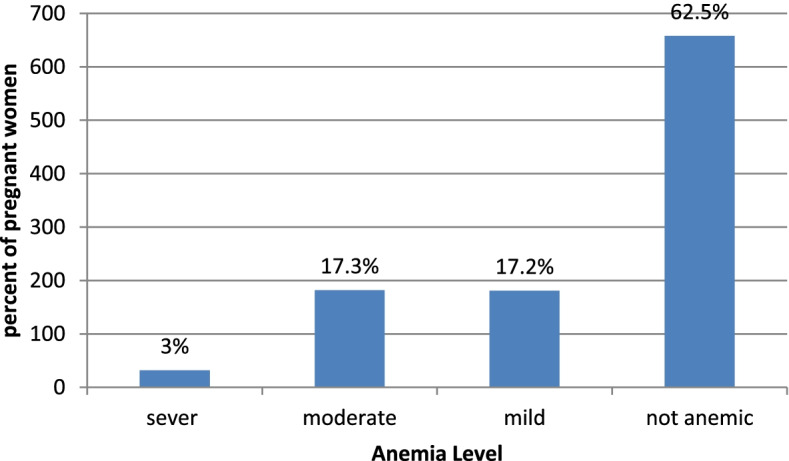
The prevalence of anemia in pregnant women was found to be 37.51% (3.04% severe, 17.28% moderate, and 17.1% mild anemic). The fitted partial proportional odds model revealed that anemia status of pregnant women was significantly associated with region afar (OR = 0.45; CI: 0.21-0.96), antenatal care visits above 4 (OR = 1.58; CI: 1.03-2.43), parity between 1-2 (OR = 0.47;CI: 0.26-0.85), iron taking (OR = 3.68;CI: 2.41-5.64), and higher education (OR = 4.75;CI: 2.29-9.85).
Anemia among pregnant women has been identified as a moderate public health issue in Ethiopia. The study revealed that the prevalence of anemia varied among regions which the highest (65.9%) and the lowest (9%) being from Somali and Addis Ababa, respectively. As a result, it is argued that treatments target iron consumption, maternal education, antenatal visits, and mothers' access to health care.
贫血是一种严重的公共卫生问题,当血液中的红细胞数量少于正常值时就会发生贫血。在埃塞俄比亚,2005 年至 2016 年期间,孕妇贫血的患病率有所增加。本研究旨在确定影响埃塞俄比亚孕妇贫血状况的因素。
利用 2016 年埃塞俄比亚人口与健康调查的数据,对 1053 名孕妇的贫血状况进行了研究。使用百分比和图表显示了贫血的患病率。边际概率效应用于确定每个解释变量类别对单一贫血水平反应类别的贡献。构建有序逻辑回归模型,选择最佳拟合模型来揭示显著的贫血状况变量。
发现孕妇贫血的患病率为 37.51%(严重贫血 3.04%、中度贫血 17.28%、轻度贫血 17.1%)。拟合的部分比例优势模型显示,孕妇的贫血状况与 afar 地区(OR=0.45;CI:0.21-0.96)、产前护理次数超过 4 次(OR=1.58;CI:1.03-2.43)、产次 1-2 次(OR=0.47;CI:0.26-0.85)、服用铁剂(OR=3.68;CI:2.41-5.64)和较高的教育水平(OR=4.75;CI:2.29-9.85)显著相关。
孕妇贫血在埃塞俄比亚被认为是一个中等程度的公共卫生问题。研究表明,贫血的患病率在不同地区有所不同,其中最高(65.9%)和最低(9%)的地区分别为索马里和亚的斯亚贝巴。因此,有人认为应针对铁的摄入、孕产妇教育、产前检查和产妇获得医疗保健的机会开展治疗。