Institute of Genetics and Molecular Medicine, University of Edinburgh, Edinburgh, UK.
MRC Centre for Inflammation Research, Queens Medical Research Institute, University of Edinburgh, Edinburgh, UK.
J Crohns Colitis. 2023 Mar 18;17(2):170-184. doi: 10.1093/ecco-jcc/jjac127.
Epigenetic alterations may provide valuable insights into gene-environment interactions in the pathogenesis of inflammatory bowel disease [IBD].
Genome-wide methylation was measured from peripheral blood using the Illumina 450k platform in a case-control study in an inception cohort (295 controls, 154 Crohn's disease [CD], 161 ulcerative colitis [UC], 28 IBD unclassified [IBD-U)] with covariates of age, sex and cell counts, deconvoluted by the Houseman method. Genotyping was performed using Illumina HumanOmniExpressExome-8 BeadChips and gene expression using the Ion AmpliSeq Human Gene Expression Core Panel. Treatment escalation was characterized by the need for biological agents or surgery after initial disease remission.
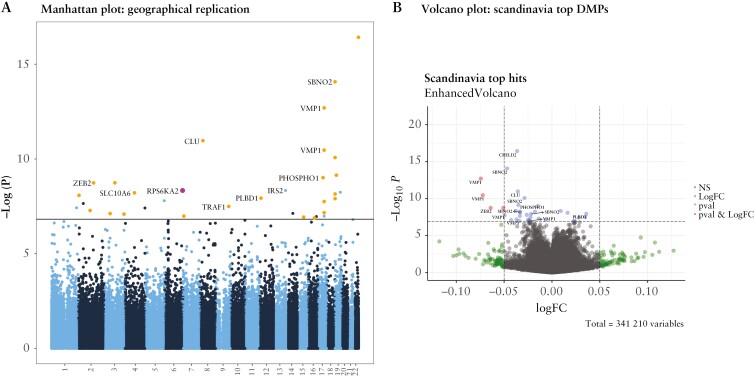
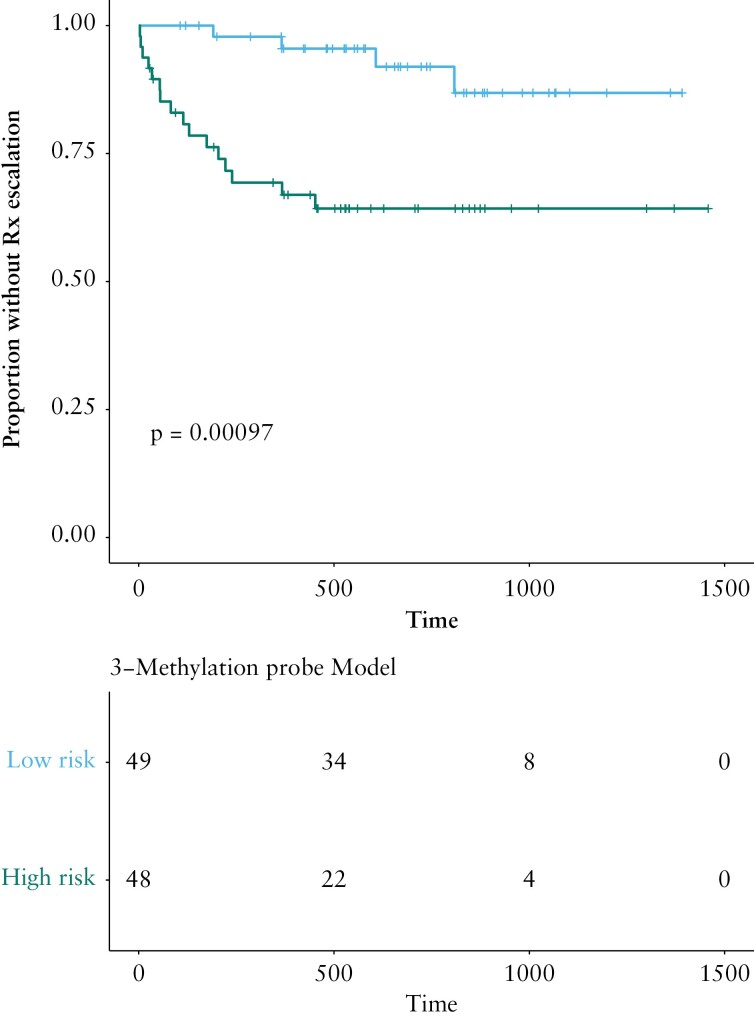
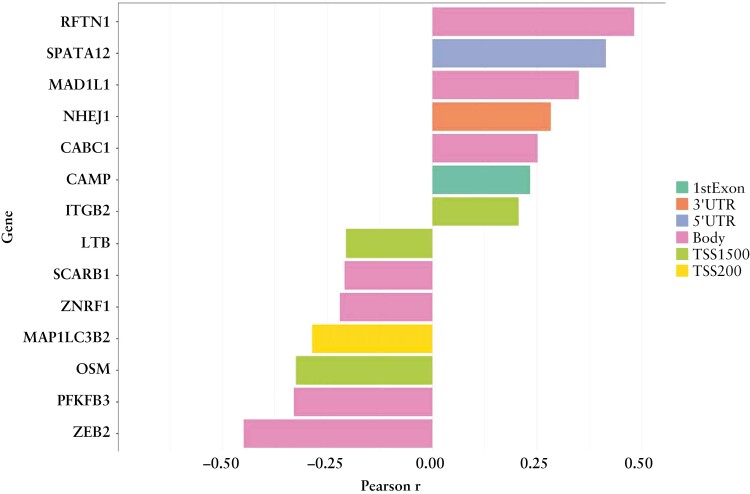
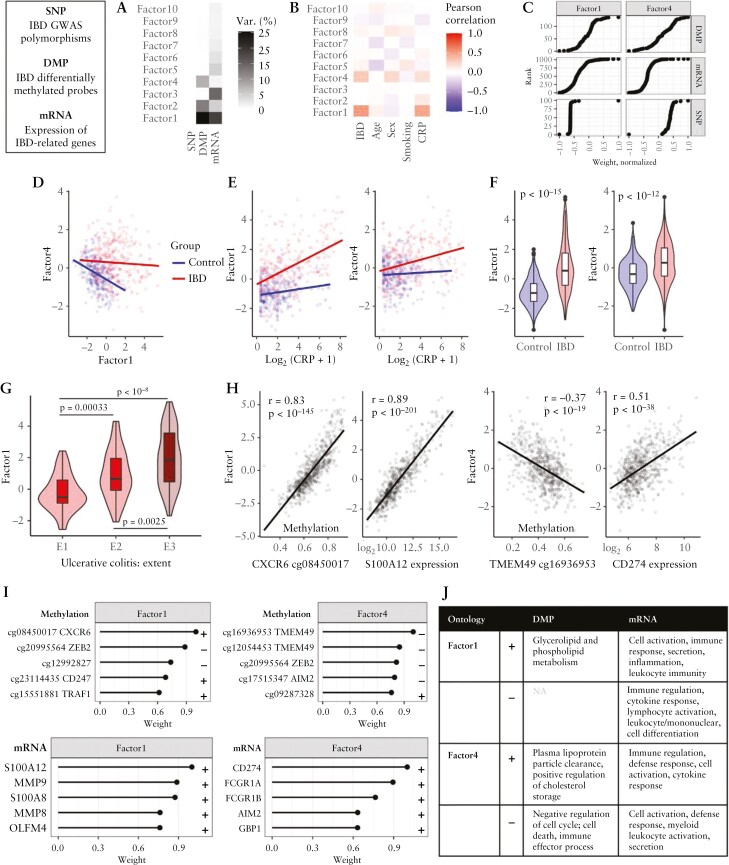
A total of 137 differentially methylated positions [DMPs] were identified in IBD, including VMP1/MIR21 [p = 9.11 × 10⁻¹⁵] and RPS6KA2 [6.43 × 10⁻¹³], with consistency seen across Scandinavia and the UK. Dysregulated loci demonstrate strong genetic influence, notably VMP1 [p = 1.53 × 10⁻¹⁵]. Age acceleration is seen in IBD [coefficient 0.94, p < 2.2 × 10⁻¹⁶]. Several immuno-active genes demonstrated highly significant correlations between methylation and gene expression in IBD, in particular OSM: IBD r = -0.32, p = 3.64 × 10⁻⁷ vs non-IBD r = -0.14, p = 0.77]. Multi-omic integration of the methylome, genome and transcriptome also implicated specific pathways that associate with immune activation, response and regulation at disease inception. At follow-up, a signature of three DMPs [TAP1, TESPA1, RPTOR] were associated with treatment escalation to biological agents or surgery (hazard ratio of 5.19 [CI: 2.14-12.56], logrank p = 9.70 × 10⁻⁴).
These data demonstrate consistent epigenetic alterations at diagnosis in European patients with IBD, providing insights into the pathogenetic importance and translational potential of epigenetic mapping in complex disease.
表观遗传改变可能为炎症性肠病 [IBD] 发病机制中的基因-环境相互作用提供有价值的见解。
在一个起始队列的病例对照研究中(295 名对照、154 名克罗恩病 [CD]、161 名溃疡性结肠炎 [UC]、28 名 IBD 未分类 [IBD-U]),使用 Illumina 450k 平台从外周血中测量全基因组甲基化,该研究具有年龄、性别和细胞计数的协变量,并通过 Houseman 方法进行去卷积。使用 Illumina HumanOmniExpressExome-8 BeadChips 进行基因分型,使用 Ion AmpliSeq Human Gene Expression Core Panel 进行基因表达。治疗升级的特征是在初始疾病缓解后需要使用生物制剂或手术。
在 IBD 中鉴定出 137 个差异甲基化位置 [DMP],包括 VMP1/MIR21 [p=9.11×10⁻¹⁵] 和 RPS6KA2 [6.43×10⁻¹³],在斯堪的纳维亚和英国都具有一致性。失调的基因座表现出强烈的遗传影响,特别是 VMP1 [p=1.53×10⁻¹⁵]。IBD 中存在年龄加速[系数 0.94,p<2.2×10⁻¹⁶]。在 IBD 中,几个免疫活性基因的甲基化与基因表达之间存在高度显著的相关性,特别是 OSM:IBD r = -0.32,p = 3.64×10⁻⁷ 与非 IBD r = -0.14,p = 0.77]。甲基组、基因组和转录组的多组学整合也表明,特定途径与疾病起始时的免疫激活、反应和调节有关。在随访中,三个 DMPs [TAP1、TESPA1、RPTOR]的特征与生物制剂或手术的治疗升级相关(风险比为 5.19 [CI:2.14-12.56],对数秩检验 p=9.70×10⁻⁴)。
这些数据表明,欧洲 IBD 患者在诊断时存在一致的表观遗传改变,为复杂疾病中表观遗传图谱的发病机制重要性和转化潜力提供了见解。