State Key Laboratory of Electroanalytical Chemistry, Changchun Institute of Applied Chemistry, Chinese Academy of Sciences, Changchun, Jilin, 130022, P. R. China.
State Key Laboratory of Luminescence and Applications, Changchun Institute of Optics, Fine Mechanics and Physics, Chinese Academy of Sciences, Changchun, Jilin, 130033, P. R. China.
Adv Sci (Weinh). 2022 Oct;9(30):e2203292. doi: 10.1002/advs.202203292. Epub 2022 Aug 28.
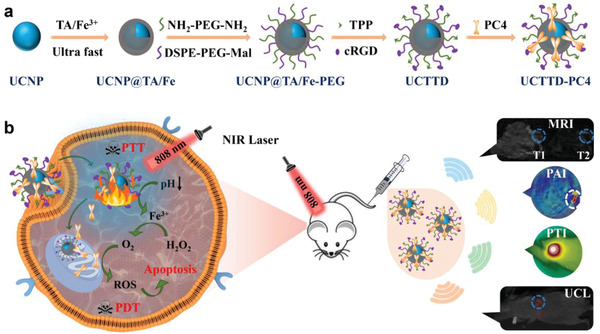
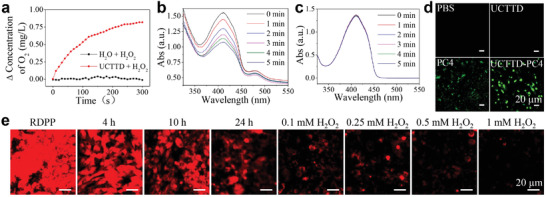
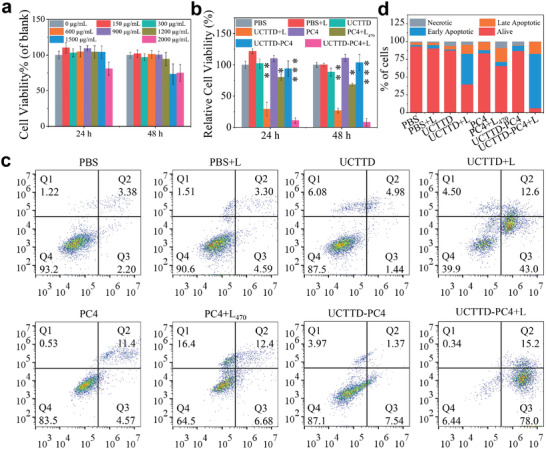
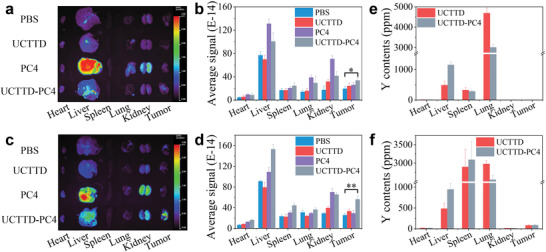
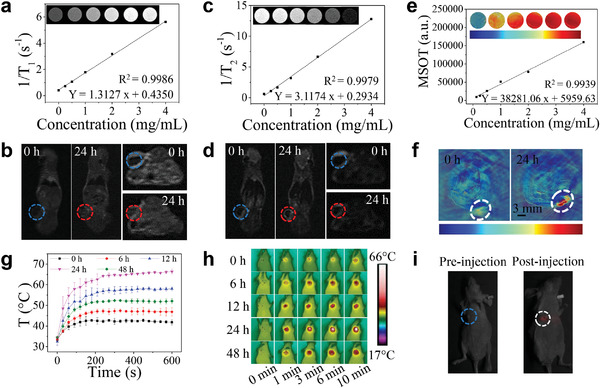
Although synergistic therapy has shown great promise for effective treatment of cancer, the unsatisfactory therapeutic efficacy of photothermal therapy/photodynamic therapy is resulted from the absorption wavelength mismatch, tumor hypoxia, photosensitizer leakage, and inability in intelligent on-demand activation. Herein, based on the characteristics of tumor microenvironment (TME), such as the slight acidity, hypoxia, and overexpression of H O , a TME stimuli-responsive and dual-targeted composite nanoplatform (UCTTD-PC4) is strategically explored by coating a tannic acid (TA)/Fe nanofilm with good biocompatibility onto the upconversion nanoparticles in an ultrafast, green and simple way. The pH-responsive feature of UCTTD-PC4 remains stable during the blood circulation, while rapidly releases Fe in the slightly acidic tumor cells, which results in catalyzing H O to produce O and overcoming the tumor hypoxia. Notably, the emission spectrum of the UCTTD perfectly matches the absorption spectrum of the photosensitizer (perylene probe (PC4)) to achieve the enhanced therapeutic effect triggered by a single laser. This study provides a new strategy for the rational design and development of the safe and efficient single near-infrared laser-triggered synergistic treatment platform for hypoxic cancer under the guidance of multimodal imaging.
尽管协同治疗在癌症的有效治疗方面显示出巨大的前景,但光热疗法/光动力疗法的治疗效果并不理想,这是由于吸收波长不匹配、肿瘤缺氧、光敏剂泄漏以及无法智能按需激活。在此基础上,基于肿瘤微环境(TME)的特点,如微酸性、缺氧和 H2O2过表达,通过超快、绿色、简单的方法,将具有良好生物相容性的单宁酸(TA)/Fe 纳米薄膜包覆在上转换纳米粒子上,从而构建了 TME 刺激响应性和双靶向复合纳米平台(UCTTD-PC4)。UCTTD-PC4 的 pH 响应特性在血液循环过程中保持稳定,而在微酸性肿瘤细胞中迅速释放 Fe,从而催化 H2O2产生 O2,克服肿瘤缺氧。值得注意的是,UCTTD 的发射光谱与光敏剂(苝探针(PC4))的吸收光谱完美匹配,实现了单激光触发的增强治疗效果。本研究为在多模态成像指导下,合理设计和开发安全高效的单近红外激光触发缺氧癌症协同治疗平台提供了新策略。