Medical School of Chinese People's Liberation Army (PLA), Beijing, China.
Department of Nephrology, The First Medical Center, Chinese People's Liberation Army (PLA) General Hospital, Chinese People's Liberation Army (PLA) Institute of Nephrology, State Key Laboratory of Kidney Diseases, National Clinical Research Center for Kidney Diseases, Beijing, China.
Front Endocrinol (Lausanne). 2022 Aug 11;13:866252. doi: 10.3389/fendo.2022.866252. eCollection 2022.
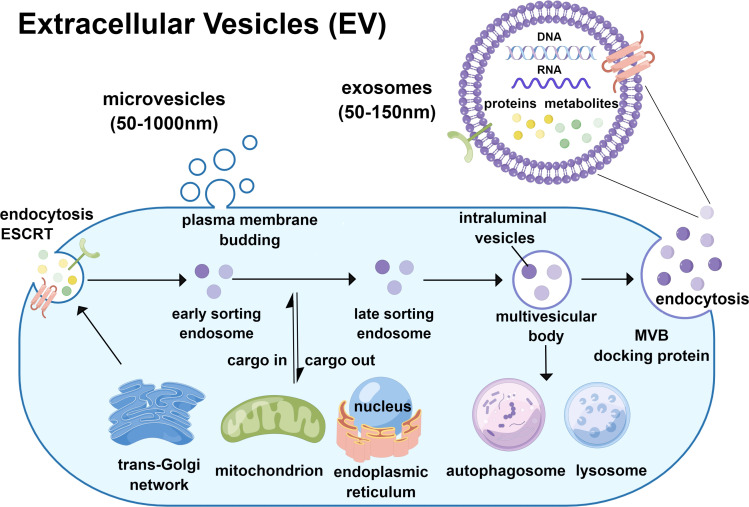
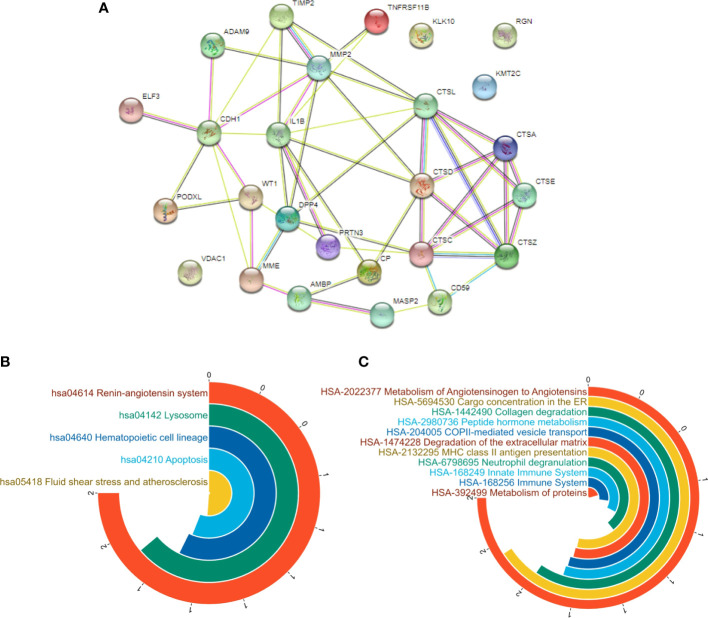
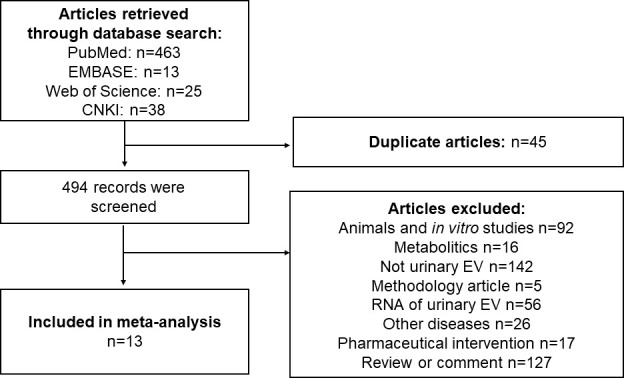
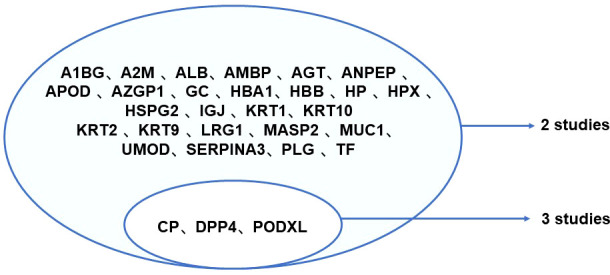
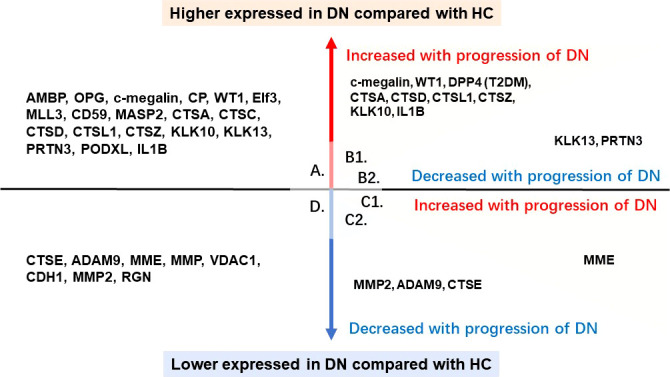
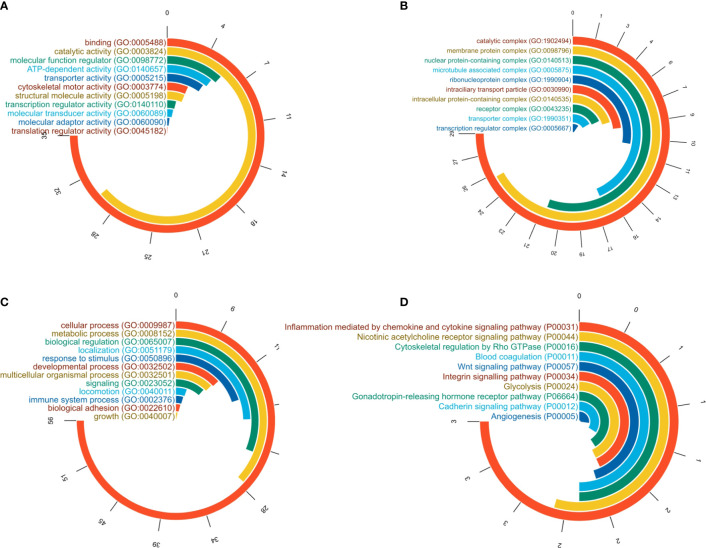
Diabetic nephropathy (DN) is a major microvascular complication of both type 1 and type 2 diabetes mellitus and is the most frequent cause of end-stage renal disease with an increasing prevalence. Presently there is no non-invasive method for differential diagnosis, and an efficient target therapy is lacking. Extracellular vesicles (EV), including exosomes, microvesicles, and apoptotic bodies, are present in various body fluids such as blood, cerebrospinal fluid, and urine. Proteins in EV are speculated to be involved in various processes of disease and reflect the original cells' physiological states and pathological conditions. This systematic review is based on urinary extracellular vesicles studies, which enrolled patients with DN and investigated the proteins in urinary EV. We systematically reviewed articles from the PubMed, Embase, Web of Science databases, and China National Knowledge Infrastructure (CNKI) database until January 4, 2022. The article quality was appraised according to the Newcastle-Ottawa Quality Assessment Scale (NOS). The methodology of samples, isolation and purification techniques of urinary EV, and characterization methods are summarized. Molecular functions, biological processes, and pathways were enriched in all retrievable urinary EV proteins. Protein-protein interaction analysis (PPI) revealed pathways of potential biomarkers. A total of 539 articles were retrieved, and 13 eligible records were enrolled in this systematic review and meta-analysis. And two studies performed mass spectrometry to obtain the proteome profile. Two of them enrolled only T1DM patients, two studies enrolled both patients with T1DM and T2DM, and other the nine studies focused on T2DM patients. In total 988 participants were enrolled, and DN was diagnosed according to UACR, UAER, or decreased GFR. Totally 579 urinary EV proteins were detected and 28 of them showed a potential value to be biomarkers. The results of bioinformatics analysis revealed that urinary EV may participate in DN through various pathways such as angiogenesis, biogenesis of EV, renin-angiotensin system, fluid shear stress and atherosclerosis, collagen degradation, and immune system. Besides that, it is necessary to report results compliant with the guideline of ISEV, in orderto assure repeatability and help for further studies. This systematic review concordance with previous studies and the results of meta-analysis may help to value the methodology details when urinary EV proteins were reported, and also help to deepen the understanding of urinary EV proteins in DN.
糖尿病肾病(DN)是 1 型和 2 型糖尿病的主要微血管并发症,也是发病率不断上升的终末期肾病的最常见原因。目前尚无非侵入性的鉴别诊断方法,也缺乏有效的靶向治疗方法。细胞外囊泡(EV),包括外泌体、微泡和凋亡小体,存在于各种体液中,如血液、脑脊液和尿液。囊泡中的蛋白质被推测参与了疾病的各个过程,并反映了原始细胞的生理状态和病理状况。本系统评价基于尿细胞外囊泡研究,该研究纳入了 DN 患者,并研究了尿 EV 中的蛋白质。我们系统地检索了 PubMed、Embase、Web of Science 数据库和中国知网(CNKI)数据库截至 2022 年 1 月 4 日的文章。根据纽卡斯尔-渥太华质量评估量表(NOS)评估文章质量。总结了样本的方法学、尿 EV 的分离纯化技术和表征方法。所有可检索的尿 EV 蛋白均进行了分子功能、生物过程和途径富集。蛋白质-蛋白质相互作用分析(PPI)揭示了潜在生物标志物的途径。共检索到 539 篇文章,13 篇符合条件的文献纳入本系统评价和荟萃分析。有两项研究进行了质谱分析以获得蛋白质组图谱。其中两项研究仅纳入了 1 型糖尿病患者,两项研究纳入了 1 型和 2 型糖尿病患者,其他 9 项研究则侧重于 2 型糖尿病患者。共纳入 988 名参与者,根据 UACR、UAER 或 GFR 降低诊断为 DN。共检测到 579 种尿 EV 蛋白,其中 28 种具有作为生物标志物的潜在价值。生物信息学分析结果表明,尿 EV 可能通过血管生成、EV 生物发生、肾素-血管紧张素系统、流体切应力和动脉粥样硬化、胶原降解和免疫系统等途径参与 DN。此外,有必要按照 ISEV 的指南报告结果,以确保可重复性并有助于进一步研究。本系统评价与既往研究结果一致,荟萃分析结果可能有助于在报告尿 EV 蛋白时重视方法学细节,并有助于加深对 DN 中尿 EV 蛋白的认识。