Gutensohn Michael, Hartzell Erin, Dudareva Natalia
Division of Plant and Soil Sciences, West Virginia University, Morgantown, WV, United States.
Department of Biochemistry, Purdue University, West Lafayette, IN, United States.
Front Plant Sci. 2022 Aug 10;13:954083. doi: 10.3389/fpls.2022.954083. eCollection 2022.
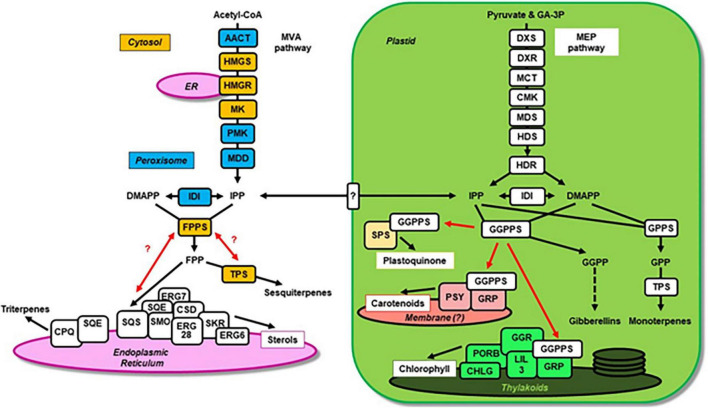
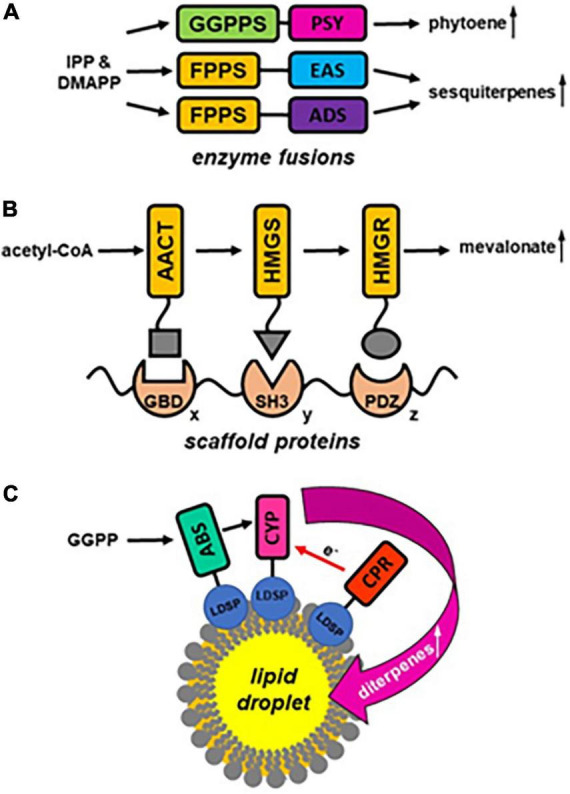
Terpenoids constitute one of the largest and most diverse classes of plant metabolites. While some terpenoids are involved in essential plant processes such as photosynthesis, respiration, growth, and development, others are specialized metabolites playing roles in the interaction of plants with their biotic and abiotic environment. Due to the distinct functions and properties of specific terpenoid compounds, there is a growing interest to introduce or modify their production in plants by metabolic engineering for agricultural, pharmaceutical, or industrial applications. The MVA and MEP pathways and the prenyltransferases providing the general precursors for terpenoid formation, as well as the enzymes of the various downstream metabolic pathways leading to the formation of different groups of terpenoid compounds have been characterized in detail in plants. In contrast, the molecular mechanisms directing the metabolic flux of precursors specifically toward one of several potentially competing terpenoid biosynthetic pathways are still not well understood. The formation of metabolons, multi-protein complexes composed of enzymes catalyzing sequential reactions of a metabolic pathway, provides a promising concept to explain the metabolic channeling that appears to occur in the complex terpenoid biosynthetic network of plants. Here we provide an overview about examples of potential metabolons involved in plant terpenoid metabolism that have been recently characterized and the first attempts to utilize metabolic channeling in terpenoid metabolic engineering. In addition, we discuss the gaps in our current knowledge and in consequence the need for future basic and applied research.
萜类化合物是植物代谢产物中最大且最多样化的类别之一。一些萜类化合物参与植物的基本过程,如光合作用、呼吸作用、生长和发育,而其他一些则是特殊代谢产物,在植物与生物和非生物环境的相互作用中发挥作用。由于特定萜类化合物具有独特的功能和性质,通过代谢工程在植物中引入或改变它们的生产以用于农业、制药或工业应用的兴趣日益浓厚。甲羟戊酸(MVA)和2-C-甲基-D-赤藓糖醇-4-磷酸(MEP)途径以及为萜类化合物形成提供通用前体的异戊烯基转移酶,以及导致不同萜类化合物组形成的各种下游代谢途径的酶,在植物中已得到详细表征。相比之下,指导前体代谢通量具体朝向几种潜在竞争的萜类生物合成途径之一的分子机制仍未得到很好的理解。代谢体的形成,即由催化代谢途径连续反应的酶组成的多蛋白复合物,为解释植物复杂萜类生物合成网络中似乎发生的代谢通道化提供了一个有前景的概念。在这里,我们概述了最近已被表征的参与植物萜类代谢的潜在代谢体的例子,以及在萜类代谢工程中利用代谢通道化的首次尝试。此外,我们讨论了我们当前知识中的差距以及因此对未来基础和应用研究的需求。