Gao Shuang, Zhang Yuanyuan, Liang Kaini, Bi Ran, Du Yanan
Department of Biomedical Engineering, School of Medicine, Tsinghua-Peking Center for Life Sciences, Tsinghua University, Beijing 100084, China.
Stem Cells Int. 2022 Aug 22;2022:8637493. doi: 10.1155/2022/8637493. eCollection 2022.
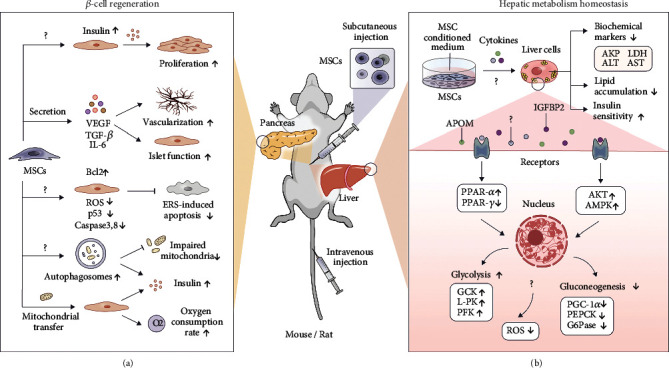
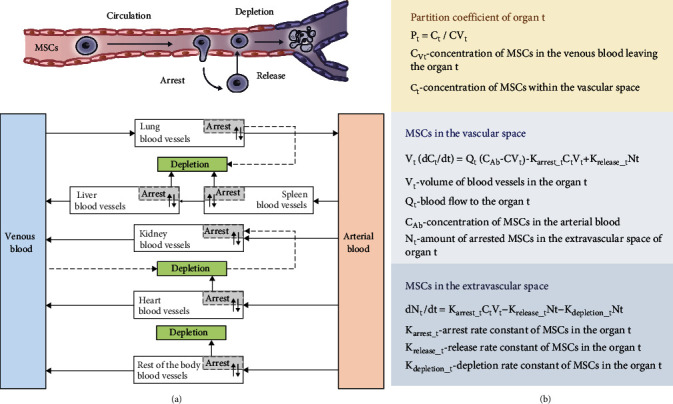
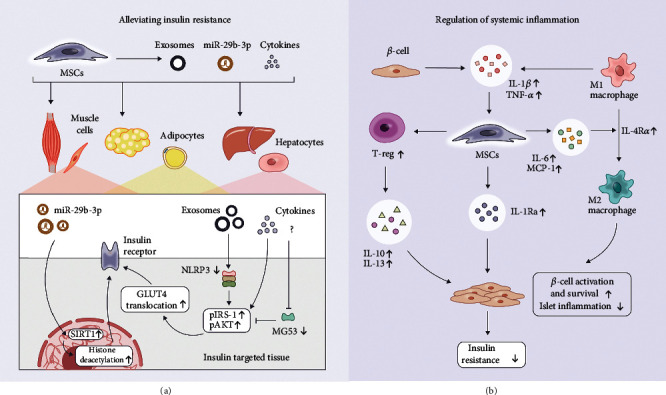
Although plenty of drugs are currently available for type 2 diabetes mellitus (T2DM), a subset of patients still failed to restore normoglycemia. Recent studies proved that symptoms of T2DM patients who are unresponsive to conventional medications could be relieved with mesenchymal stem/stromal cell (MSC) therapy. However, the lack of systematic summary and analysis for animal and clinical studies of T2DM has limited the establishment of standard guidelines in anti-T2DM MSC therapy. Besides, the therapeutic mechanisms of MSCs to combat T2DM have not been thoroughly understood. In this review, we present an overview of the current status of MSC therapy in treating T2DM for both animal studies and clinical studies. Potential mechanisms of MSC-based intervention on multiple pathological processes of T2DM, such as -cell exhaustion, hepatic dysfunction, insulin resistance, and systemic inflammation, are also delineated. Moreover, we highlight the importance of understanding the pharmacokinetics (PK) of transplanted cells and discuss the hurdles in MSC-based T2DM therapy toward future clinical applications.
尽管目前有大量药物可用于治疗2型糖尿病(T2DM),但仍有一部分患者未能恢复正常血糖水平。最近的研究证明,对传统药物无反应的T2DM患者的症状可通过间充质干/基质细胞(MSC)疗法得到缓解。然而,缺乏对T2DM动物和临床研究的系统总结与分析,限制了抗T2DM MSC疗法标准指南的建立。此外,MSC对抗T2DM的治疗机制尚未完全明确。在本综述中,我们概述了MSC疗法在治疗T2DM的动物研究和临床研究中的现状。还阐述了基于MSC的干预对T2DM多种病理过程(如β细胞耗竭、肝功能障碍、胰岛素抵抗和全身炎症)的潜在机制。此外,我们强调了了解移植细胞药代动力学(PK)的重要性,并讨论了基于MSC的T2DM疗法在未来临床应用中面临的障碍。