J Clin Invest. 2022 Sep 1;132(17). doi: 10.1172/JCI162030.
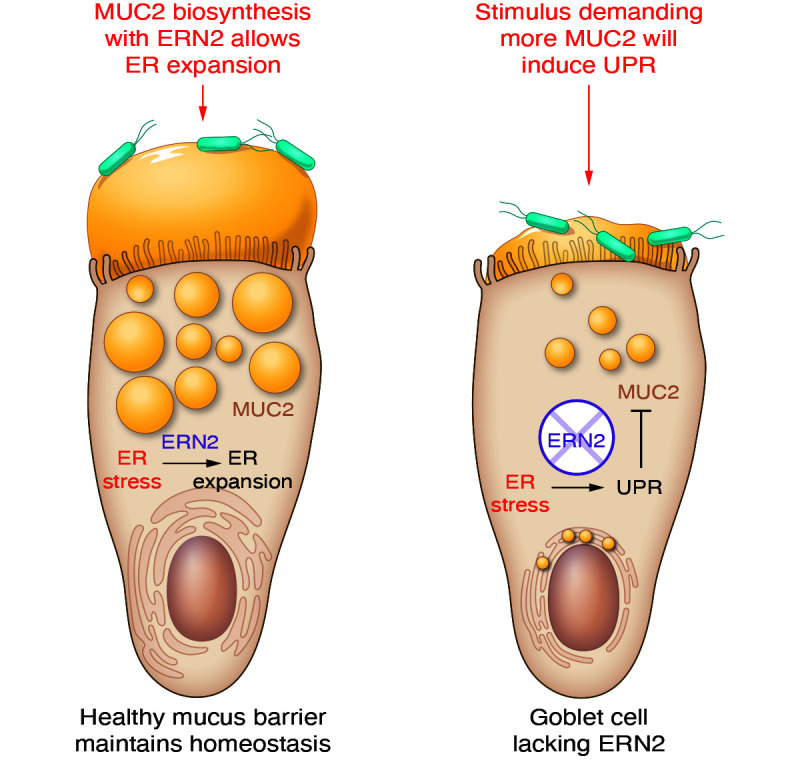
The intestinal tract is protected by epithelium-covering mucus, which is constantly renewed by goblet cells, a specialized type of epithelial cell. Mucus is largely composed of MUC2 mucin, an enormous molecule that poses a high demand on the endoplasmic reticulum (ER) for proper folding and protein assembly, creating a challenge for the secretory machinery in goblet cells. In this issue of the JCI, Grey et al. reveal that the ER resident protein and folding sensor ERN2 (also known as IRE1β) was instrumental for goblet cells to produce sufficient amounts of mucus to form a protective mucus layer. In the absence of ERN2, mucus production was reduced, impairing the mucus barrier, which allowed bacteria to penetrate and cause an epithelial cell stress response. This study emphasizes the importance of a controlled unfolded protein response (UPR) for goblet cell secretion.
肠道被覆盖上皮细胞的黏液所保护,黏液由杯状细胞不断更新,杯状细胞是一种特殊的上皮细胞。黏液主要由 MUC2 粘蛋白组成,这种巨大的分子对内质网(ER)的正确折叠和蛋白质组装要求很高,这给杯状细胞的分泌机制带来了挑战。在本期 JCI 中,Grey 等人揭示了内质网驻留蛋白和折叠传感器 ERN2(也称为 IRE1β)对于杯状细胞产生足够的黏液以形成保护性黏液层至关重要。在缺乏 ERN2 的情况下,黏液生成减少,破坏了黏液屏障,使细菌能够穿透并引起上皮细胞应激反应。这项研究强调了受控的未折叠蛋白反应 (UPR) 对杯状细胞分泌的重要性。