Lee Jongmin, Ding Roger, Christensen Justin, Rosenthal Randy R, Ison Aaron, Gillund Daniel P, Bossert David, Fuerschbach Kyle H, Kindel William, Finnegan Patrick S, Wendt Joel R, Gehl Michael, Kodigala Ashok, McGuinness Hayden, Walker Charles A, Kemme Shanalyn A, Lentine Anthony, Biedermann Grant, Schwindt Peter D D
Sandia National Laboratories, Albuquerque, NM, 87185, USA.
Department of Physics and Astronomy, University of Oklahoma, Norman, OK, 73019, USA.
Nat Commun. 2022 Sep 1;13(1):5131. doi: 10.1038/s41467-022-31410-4.
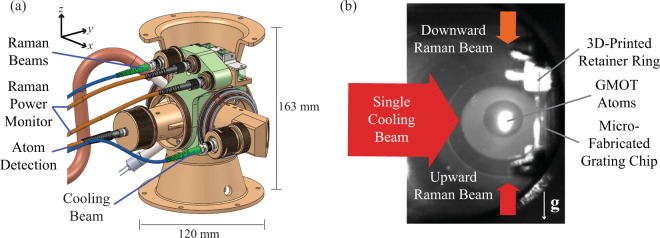
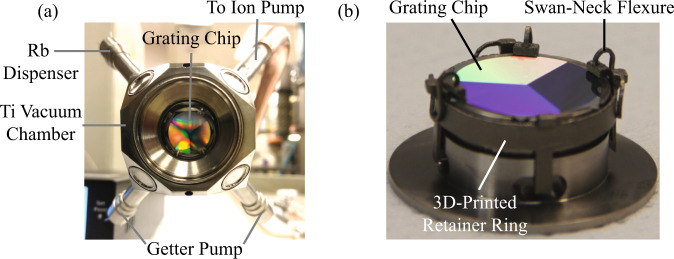
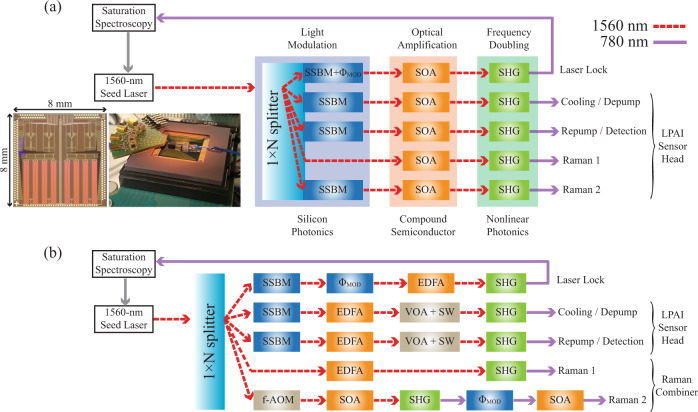
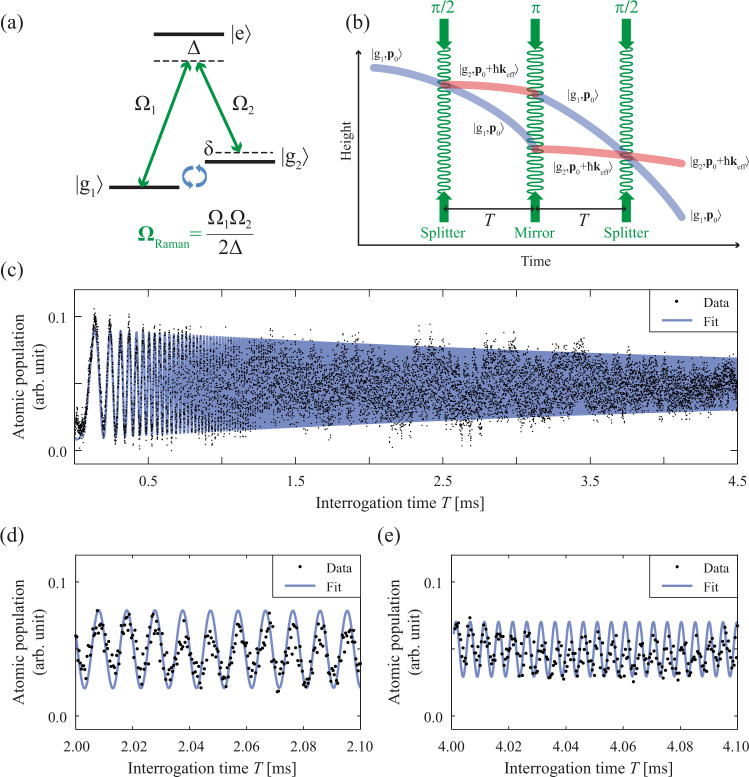
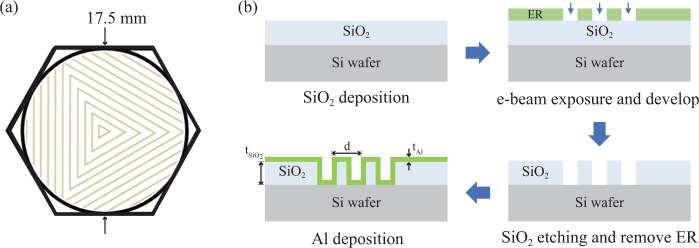
The extreme miniaturization of a cold-atom interferometer accelerometer requires the development of novel technologies and architectures for the interferometer subsystems. Here, we describe several component technologies and a laser system architecture to enable a path to such miniaturization. We developed a custom, compact titanium vacuum package containing a microfabricated grating chip for a tetrahedral grating magneto-optical trap (GMOT) using a single cooling beam. In addition, we designed a multi-channel photonic-integrated-circuit-compatible laser system implemented with a single seed laser and single sideband modulators in a time-multiplexed manner, reducing the number of optical channels connected to the sensor head. In a compact sensor head containing the vacuum package, sub-Doppler cooling in the GMOT produces 15 μK temperatures, and the GMOT can operate at a 20 Hz data rate. We validated the atomic coherence with Ramsey interferometry using microwave spectroscopy, then demonstrated a light-pulse atom interferometer in a gravimeter configuration for a 10 Hz measurement data rate and T = 0-4.5 ms interrogation time, resulting in Δg/g = 2.0 × 10. This work represents a significant step towards deployable cold-atom inertial sensors under large amplitude motional dynamics.
冷原子干涉仪加速度计的极端小型化需要为干涉仪子系统开发新技术和架构。在此,我们描述了几种组件技术和一种激光系统架构,以实现这种小型化。我们开发了一种定制的紧凑型钛真空封装,其中包含一个用于四面体光栅磁光阱(GMOT)的微纳加工光栅芯片,该芯片使用单束冷却光束。此外,我们设计了一种与多通道光子集成电路兼容的激光系统,该系统通过单种子激光器和单边带调制器以时分复用的方式实现,减少了连接到传感器头的光通道数量。在包含真空封装的紧凑型传感器头中,GMOT中的亚多普勒冷却产生15 μK的温度,并且GMOT可以以20 Hz的数据速率运行。我们使用微波光谱法通过拉姆齐干涉测量法验证了原子相干性,然后在重力仪配置中展示了一种光脉冲原子干涉仪,用于10 Hz的测量数据速率和T = 0 - 4.5 ms的询问时间,得到Δg/g = 2.0×10。这项工作代表了朝着在大幅度运动动力学下可部署的冷原子惯性传感器迈出的重要一步。