Zhang Kaixin, Li Yinyin, Huang Tengbo, Li Ziwei
Guangdong Provincial Key Laboratory for Plant Epigenetics, College of Life Sciences and Oceanography, Shenzhen University, Shenzhen, China.
Key Laboratory of Optoelectronic Devices and Systems of Ministry of Education and Guangdong, College of Physics and Optoelectronic Engineering, Shenzhen University, Shenzhen, China.
Front Plant Sci. 2022 Aug 16;13:974598. doi: 10.3389/fpls.2022.974598. eCollection 2022.
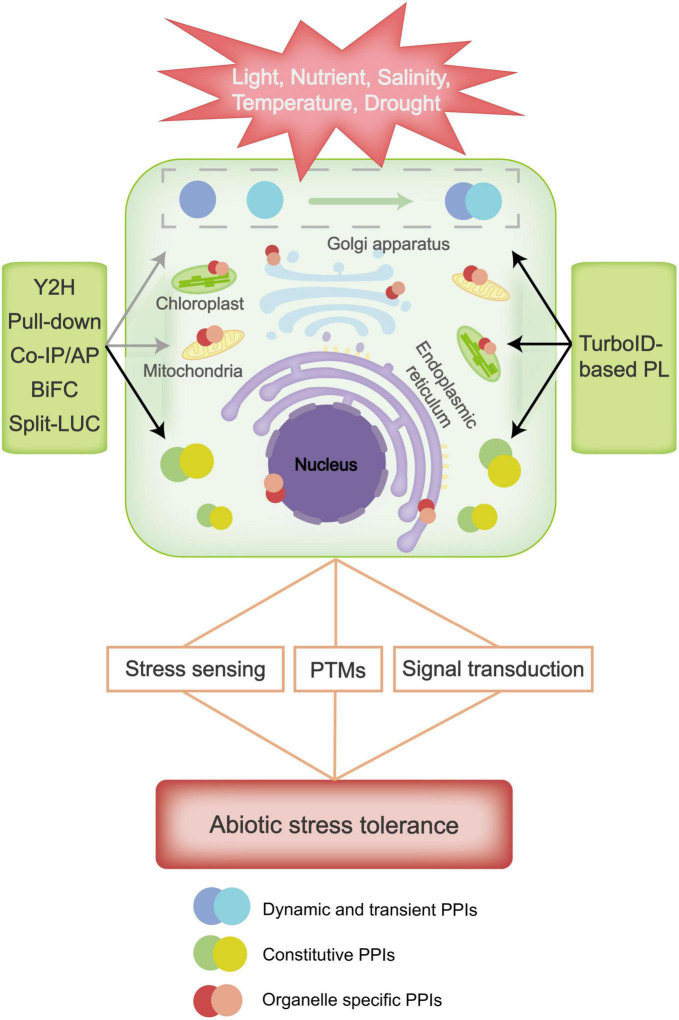
Abiotic stresses are major environmental conditions that reduce plant growth, productivity and quality. Protein-protein interaction (PPI) approaches can be used to screen stress-responsive proteins and reveal the mechanisms of protein response to various abiotic stresses. Biotin-based proximity labeling (PL) is a recently developed technique to label proximal proteins of a target protein. TurboID, a biotin ligase produced by directed evolution, has the advantages of non-toxicity, time-saving and high catalytic efficiency compared to other classic protein-labeling enzymes. TurboID-based PL has been successfully applied in animal, microorganism and plant systems, particularly to screen transient or weak protein interactions, and detect spatially or temporally restricted local proteomes in living cells. This review concludes classic PPI approaches in plant response to abiotic stresses and their limitations for identifying complex network of regulatory proteins of plant abiotic stresses, and introduces the working mechanism of TurboID-based PL, as well as its feasibility and advantages in plant abiotic stress research. We hope the information summarized in this article can serve as technical references for further understanding the regulation of plant adaptation to abiotic stress at the protein level.
非生物胁迫是降低植物生长、生产力和品质的主要环境条件。蛋白质-蛋白质相互作用(PPI)方法可用于筛选胁迫响应蛋白,并揭示蛋白质对各种非生物胁迫的响应机制。基于生物素的邻近标记(PL)是一种最近开发的标记靶蛋白近端蛋白的技术。TurboID是一种通过定向进化产生的生物素连接酶,与其他经典蛋白质标记酶相比,具有无毒、省时和催化效率高的优点。基于TurboID的PL已成功应用于动物、微生物和植物系统,特别是用于筛选瞬时或弱蛋白质相互作用,以及检测活细胞中空间或时间受限的局部蛋白质组。本文综述了植物对非生物胁迫响应中的经典PPI方法及其在识别植物非生物胁迫调控蛋白复杂网络方面的局限性,介绍了基于TurboID的PL的工作机制,以及其在植物非生物胁迫研究中的可行性和优势。我们希望本文总结的信息能够为进一步从蛋白质水平理解植物对非生物胁迫适应的调控提供技术参考。