Department of Neurology, University Hospital Centre Zagreb, Zagreb, Croatia.
Department of Neurology, University of Zagreb, School of Medicine, Zagreb, Croatia.
Eur J Neurol. 2022 Dec;29(12):3633-3646. doi: 10.1111/ene.15538. Epub 2022 Sep 20.
Disorders of the autonomic nervous system (ANS) are common conditions, but it is unclear whether access to ANS healthcare provision is homogeneous across European countries. The aim of this study was to identify neurology-driven or interdisciplinary clinical ANS laboratories in Europe, describe their characteristics and explore regional differences.
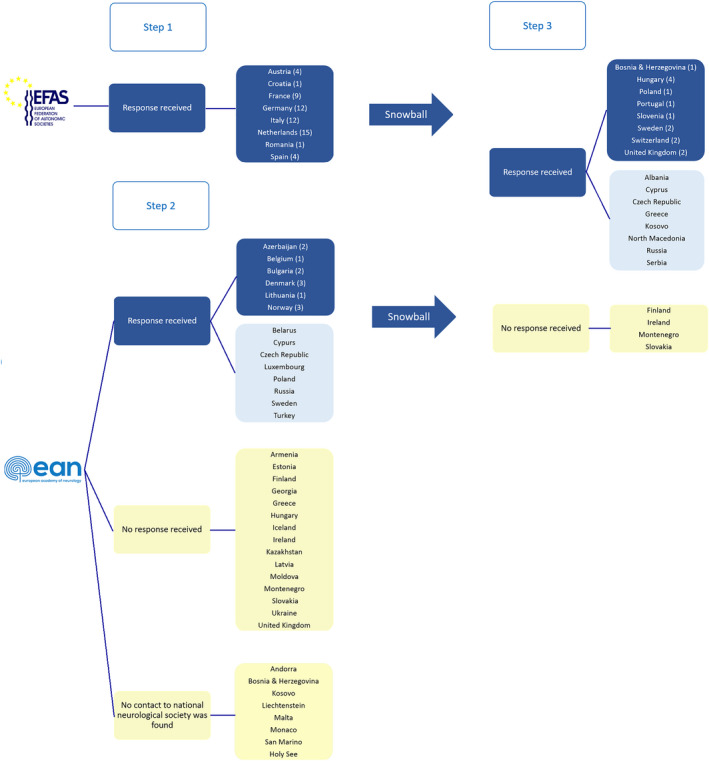
We contacted the European national ANS and neurological societies, as well as members of our professional network, to identify clinical ANS laboratories in each country and invite them to answer a web-based survey.
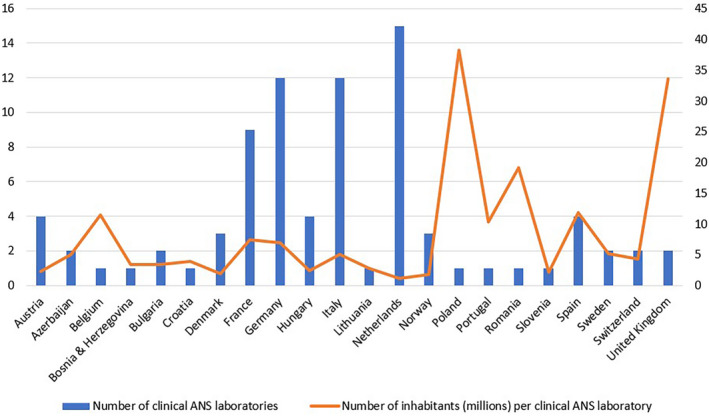
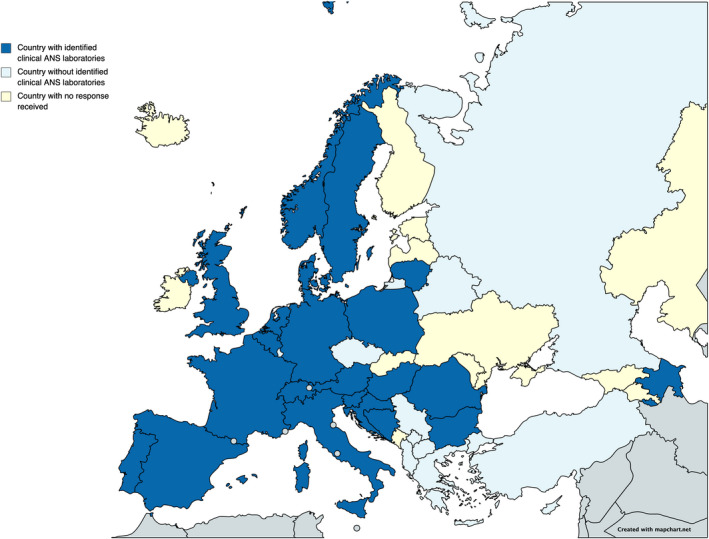
We identified 84 laboratories in 22 countries and 46 (55%) answered the survey. All laboratories perform cardiovascular autonomic function tests, and 83% also perform sweat tests. Testing for catecholamines and autoantibodies are performed in 63% and 56% of laboratories, and epidermal nerve fiber density analysis in 63%. Each laboratory is staffed by a median of two consultants, one resident, one technician and one nurse. The median (interquartile range [IQR]) number of head-up tilt tests/laboratory/year is 105 (49-251). Reflex syncope and neurogenic orthostatic hypotension are the most frequently diagnosed cardiovascular ANS disorders. Thirty-five centers (76%) have an ANS outpatient clinic, with a median (IQR) of 200 (100-360) outpatient visits/year; 42 centers (91%) also offer inpatient care (median 20 [IQR 4-110] inpatient stays/year). Forty-one laboratories (89%) are involved in research activities. We observed a significant difference in the geographical distribution of ANS services among European regions: 11 out of 12 countries from North/West Europe have at least one ANS laboratory versus 11 out of 21 from South/East/Greater Europe (p = 0.021).
This survey highlights disparities in the availability of healthcare services for people with ANS disorders across European countries, stressing the need for improved access to specialized care in South, East and Greater Europe.
自主神经系统(ANS)障碍是常见病症,但尚不清楚在欧洲各国,ANS 医疗服务的可及性是否存在差异。本研究旨在确定欧洲的神经病学驱动或跨学科临床 ANS 实验室,描述其特征并探讨区域差异。
我们联系了欧洲国家的 ANS 和神经学会以及我们专业网络中的成员,以确定每个国家的临床 ANS 实验室,并邀请他们回答在线调查。
我们在 22 个国家中确定了 84 个实验室,其中 46 个(55%)实验室回答了调查。所有实验室均进行心血管自主功能测试,83%的实验室还进行汗液测试。63%的实验室进行儿茶酚胺和自身抗体测试,56%的实验室进行表皮神经纤维密度分析。每个实验室平均有 2 名顾问、1 名住院医师、1 名技术员和 1 名护士。每年平均进行 105 次(49-251 次)直立倾斜试验/实验室。反射性晕厥和神经源性直立性低血压是最常见的心血管 ANS 障碍诊断。35 个中心(76%)设有 ANS 门诊,每年平均有 200 次(100-360 次)门诊就诊;42 个中心(91%)还提供住院治疗(每年平均 20 次[4-110 次]住院治疗)。41 个实验室(89%)参与了研究活动。我们观察到欧洲各地区 ANS 服务的地理分布存在显著差异:12 个北欧/西欧国家中有 11 个至少有一个 ANS 实验室,而 21 个南欧/东欧/大欧洲国家中有 11 个(p=0.021)。
本调查突出了欧洲各国 ANS 障碍患者医疗服务提供的差异,强调了需要改善南欧、东欧和大欧洲的专科护理机会。