Department of Endocrinology, Tongji Hospital, Tongji Medical College, Huazhong University of Science and Technology, Wuhan, China.
Branch of National Clinical Research Center for Metabolic Diseases, Wuhan, China.
Aging Cell. 2022 Oct;21(10):e13704. doi: 10.1111/acel.13704. Epub 2022 Sep 3.
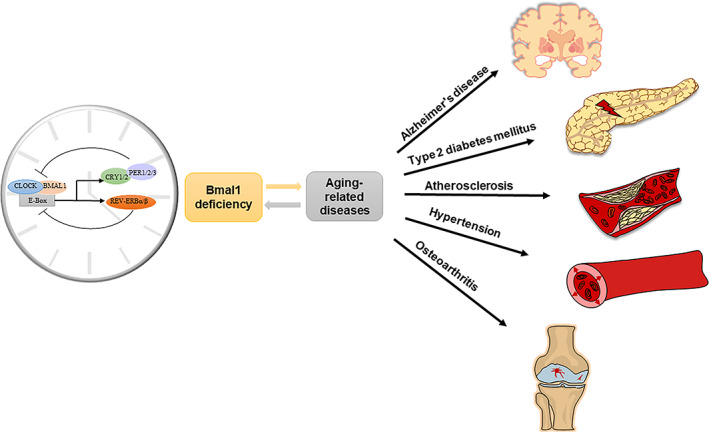
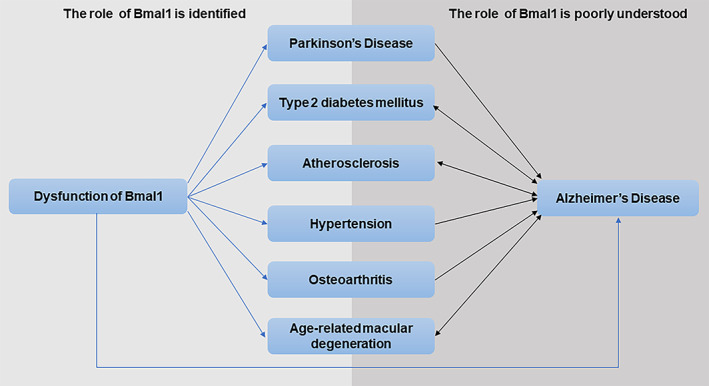
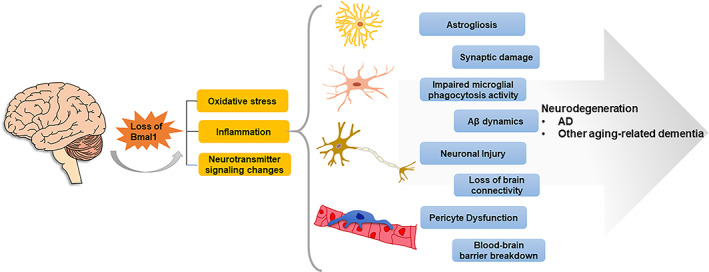
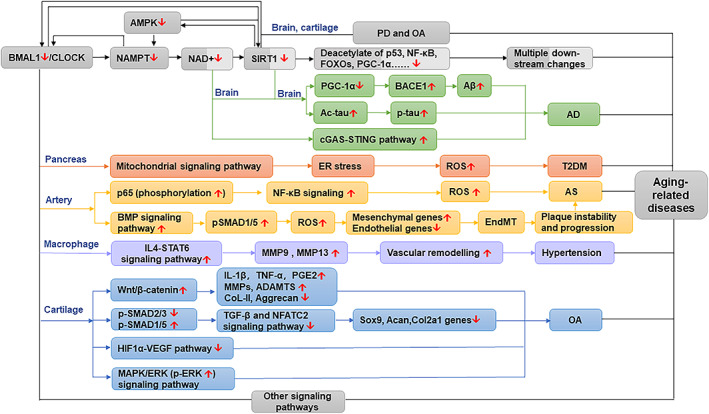
With the aging world population, the prevalence of aging-related disorders is on the rise. Diseases such as Alzheimer's, type 2 diabetes mellitus (T2DM), Parkinson's, atherosclerosis, hypertension, and osteoarthritis are age-related, and most of these diseases are comorbidities or risk factors for AD; however, our understandings of molecular events that regulate the occurrence of these diseases are still not fully understood. Brain and muscle Arnt-like protein-1 (Bmal1) is an irreplaceable clock gene that governs multiple important physiological processes. Continuous research of Bmal1 in AD and associated aging-related diseases is ongoing, and this review picks relevant studies on a detailed account of its role and mechanisms in these diseases. Oxidative stress and inflammation turned out to be common mechanisms by which Bmal1 deficiency promotes AD and associated aging-related diseases, and other Bmal1-dependent mechanisms remain to be identified. Promising therapeutic strategies involved in the regulation of Bmal1 are provided, including melatonin, natural compounds, metformin, d-Ser2-oxyntomodulin, and other interventions, such as exercise, time-restricted feeding, and adiponectin. The establishment of the signaling pathway network for Bmal1 in aging-related diseases will lead to advances in the comprehension of the molecular and cellular mechanisms, shedding light on novel treatments for aging-related diseases and promoting aging-associated brain health.
随着世界人口老龄化,与衰老相关的疾病的患病率正在上升。阿尔茨海默病、2 型糖尿病(T2DM)、帕金森病、动脉粥样硬化、高血压和骨关节炎等疾病与年龄有关,其中大多数疾病是 AD 的共病或危险因素;然而,我们对调节这些疾病发生的分子事件的理解仍不完全清楚。脑和肌肉芳香烃受体核转录因子样蛋白-1(Bmal1)是一种不可或缺的时钟基因,它调控着多种重要的生理过程。目前仍在持续对 AD 及相关衰老相关疾病中的 Bmal1 进行研究,本综述详细阐述了其在这些疾病中的作用和机制的相关研究。氧化应激和炎症被证明是 Bmal1 缺乏促进 AD 及相关衰老相关疾病的共同机制,其他依赖 Bmal1 的机制仍有待确定。提供了涉及 Bmal1 调节的有前景的治疗策略,包括褪黑素、天然化合物、二甲双胍、d-Ser2-oxyntomodulin 以及其他干预措施,如运动、限时进食和脂联素。Bmal1 在衰老相关疾病中的信号通路网络的建立将推动对衰老相关疾病的分子和细胞机制的理解,并为衰老相关疾病的治疗提供新的思路,促进与衰老相关的大脑健康。