• 文献检索
  • 文档翻译
  • 深度研究
  • 学术资讯
  • Suppr Zotero 插件Zotero 插件
  • 邀请有礼
  • 套餐&价格
  • 历史记录
应用&插件
Suppr Zotero 插件Zotero 插件浏览器插件Mac 客户端Windows 客户端微信小程序
定价
高级版会员购买积分包购买API积分包
服务
文献检索文档翻译深度研究API 文档MCP 服务
关于我们
关于 Suppr公司介绍联系我们用户协议隐私条款
关注我们

Suppr 超能文献

核心技术专利:CN118964589B侵权必究
粤ICP备2023148730 号-1Suppr @ 2026

文献检索

告别复杂PubMed语法,用中文像聊天一样搜索,搜遍4000万医学文献。AI智能推荐,让科研检索更轻松。

立即免费搜索

文件翻译

保留排版,准确专业,支持PDF/Word/PPT等文件格式,支持 12+语言互译。

免费翻译文档

深度研究

AI帮你快速写综述,25分钟生成高质量综述,智能提取关键信息,辅助科研写作。

立即免费体验

使用电子放松设备改善危重症患者的不适:E-CHOISIR(重症监护放松系统的电子选择)交叉随机对照试验的结果。

Discomfort improvement for critically ill patients using electronic relaxation devices: results of the cross-over randomized controlled trial E-CHOISIR (Electronic-CHOIce of a System for Intensive care Relaxation).

机构信息

Department of Anaesthesia & Critical Care Medicine, Saint Eloi Montpellier University Hospital, and PhyMedExp, University of Montpellier, INSERM, CNRS, Montpellier, France.

Department of Statistics, CNRS, Institut Montpelliérain Alexander Grothendieck (IMAG), University of Montpellier La Colombière Hospital, University of Montpellier, Montpellier, France.

出版信息

Crit Care. 2022 Sep 3;26(1):263. doi: 10.1186/s13054-022-04136-4.

DOI:10.1186/s13054-022-04136-4
PMID:36057612
原文链接:https://pmc.ncbi.nlm.nih.gov/articles/PMC9440448/
Abstract

PURPOSE

To assess the impact of different electronic relaxation devices on common stressful patient symptoms experienced in intensive care unit (ICU).

METHODS

Sixty critically ill patients were enrolled in four relaxation sessions using a randomized cross-over design: standard relaxation (TV/radio), music therapy (MUSIC-CARE©), and two virtual reality systems using either real motion pictures (DEEPSEN©) or synthetic motion pictures (HEALTHY-MIND©). The goal was to determine which device was the best to reduce overall patient discomfort intensity (0-10 Numeric Rating Scale (NRS); primary endpoint). Secondary endpoints were specific stressful symptoms (pain, anxiety, dyspnea, thirst, and lack of rest feeling) and stress response measured by Analgesia/Nociception Index (ANI). Multivariate mixed-effect analysis was used, taking into account patient characteristics and multiple measurements.

RESULTS

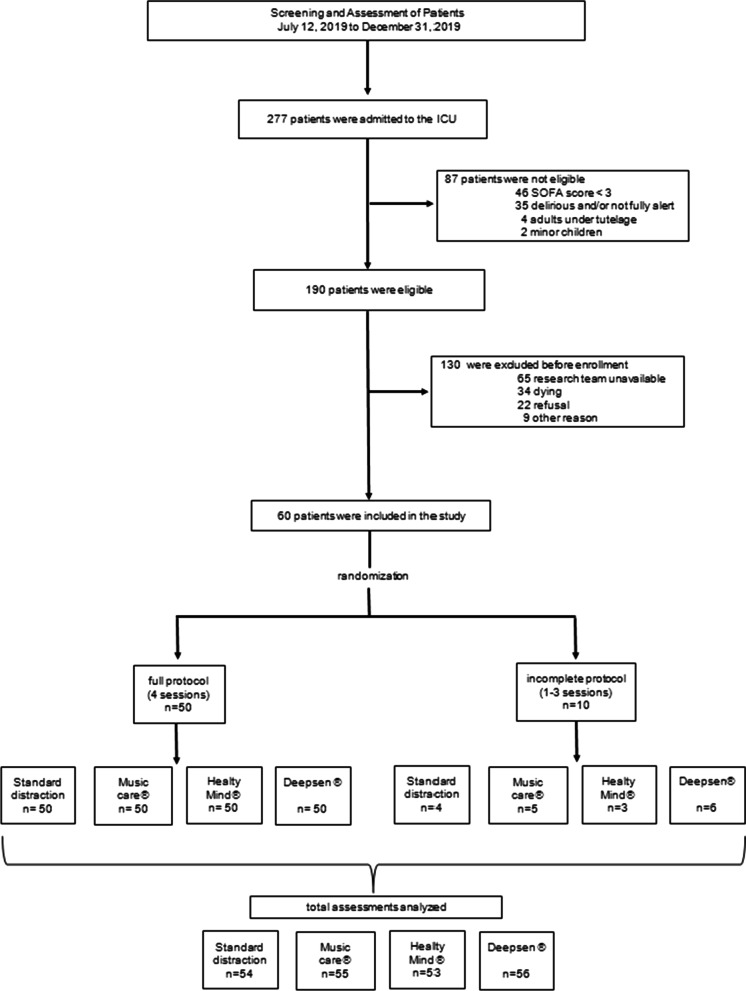
Fifty patients followed the full research protocol, and ten patients did at least one research planned session of relaxation. HEALTHY-MIND© was associated with a significant decrease in overall discomfort, the primary endpoint (median NRS = 4[2-6] vs. 2[0-5]; p = 0.01, mixed-effect model), accompanied by a significant decrease in stress response (increase in ANI, secondary endpoint; p < 0.01). Regarding other secondary endpoints, each of the two virtual reality systems was associated with a decrease in anxiety (p < 0.01), while HEALTHY-MIND© was associated also with a decrease in pain (p = 0.001) and DEEPSEN© with a decrease in lack of rest (p = 0.01). Three incidents (claustrophobia/dyspnea/agitation) were reported among 109 virtual reality sessions. Cybersickness was rare (NRS = 0[0-0]).

CONCLUSION

Electronic relaxation therapy is a promising, safe, and effective non-pharmacological solution that can be used to improve overall discomfort in alert and non-delirious ICU patients. Its effectiveness depends on technical characteristics (virtual reality using a synthetic imagined world versus a real world or music therapy alone without virtual reality), as well as the type of symptoms.

摘要

目的

评估不同电子放松设备对重症监护病房(ICU)常见应激症状的影响。

方法

60 名危重症患者采用随机交叉设计进行 4 次放松:标准放松(电视/收音机)、音乐疗法(MUSIC-CARE©)、使用真实电影(DEEPSEN©)或合成电影(HEALTHY-MIND©)的两种虚拟现实系统。目标是确定哪种设备最能减轻患者整体不适强度(0-10 数字评分量表(NRS);主要终点)。次要终点为特定应激症状(疼痛、焦虑、呼吸困难、口渴和缺乏休息感)和应激反应,采用镇痛/伤害感受指数(ANI)测量。采用多变量混合效应分析,考虑患者特征和多次测量。

结果

50 名患者完成了完整的研究方案,10 名患者至少完成了一次计划中的放松研究。HEALTHY-MIND©与整体不适的显著降低相关,这是主要终点(中位数 NRS=4[2-6] vs. 2[0-5];p=0.01,混合效应模型),同时应激反应显著降低(ANI 增加,次要终点;p<0.01)。关于其他次要终点,两种虚拟现实系统中的每一种都与焦虑的降低相关(p<0.01),而 HEALTHY-MIND©还与疼痛的降低相关(p=0.001),DEEPSEN©与缺乏休息的降低相关(p=0.01)。109 次虚拟现实治疗中报告了 3 例事件(幽闭恐惧症/呼吸困难/烦躁不安)。电子游戏病很少见(NRS=0[0-0])。

结论

电子放松疗法是一种有前途、安全且有效的非药物解决方案,可用于改善警觉且无谵妄的 ICU 患者的整体不适。其有效性取决于技术特征(使用合成想象世界的虚拟现实与真实世界或不使用虚拟现实的音乐疗法)以及症状类型。

https://cdn.ncbi.nlm.nih.gov/pmc/blobs/f42c/9440525/10f99c64eb5c/13054_2022_4136_Fig2_HTML.jpg
https://cdn.ncbi.nlm.nih.gov/pmc/blobs/f42c/9440525/71446c401618/13054_2022_4136_Fig1_HTML.jpg
https://cdn.ncbi.nlm.nih.gov/pmc/blobs/f42c/9440525/10f99c64eb5c/13054_2022_4136_Fig2_HTML.jpg
https://cdn.ncbi.nlm.nih.gov/pmc/blobs/f42c/9440525/71446c401618/13054_2022_4136_Fig1_HTML.jpg
https://cdn.ncbi.nlm.nih.gov/pmc/blobs/f42c/9440525/10f99c64eb5c/13054_2022_4136_Fig2_HTML.jpg

相似文献

1
Discomfort improvement for critically ill patients using electronic relaxation devices: results of the cross-over randomized controlled trial E-CHOISIR (Electronic-CHOIce of a System for Intensive care Relaxation).使用电子放松设备改善危重症患者的不适:E-CHOISIR(重症监护放松系统的电子选择)交叉随机对照试验的结果。
Crit Care. 2022 Sep 3;26(1):263. doi: 10.1186/s13054-022-04136-4.
2
Self-reported symptom experience of critically ill cancer patients receiving intensive care.接受重症监护的危重症癌症患者的自我报告症状体验。
Crit Care Med. 2001 Feb;29(2):277-82. doi: 10.1097/00003246-200102000-00010.
3
Usage of immersive virtual reality as a relaxation method in an intensive care unit.沉浸式虚拟现实在重症监护病房作为一种放松方法的应用。
Enferm Intensiva (Engl Ed). 2024 Apr-Jun;35(2):107-113. doi: 10.1016/j.enfie.2023.08.005. Epub 2023 Aug 28.
4
Effects of immersive virtual reality on sensory overload in a random sample of critically ill patients.沉浸式虚拟现实对危重症患者随机样本中感觉超负荷的影响。
Front Med (Lausanne). 2023 Oct 4;10:1268659. doi: 10.3389/fmed.2023.1268659. eCollection 2023.
5
The effect of music on discomfort experienced by intensive care unit patients during turning: a randomized cross-over study.音乐对重症监护病房患者翻身时不适感受的影响:一项随机交叉研究。
Int J Nurs Pract. 2010 Apr;16(2):125-31. doi: 10.1111/j.1440-172X.2010.01819.x.
6
Palliative care in the ICU: relief of pain, dyspnea, and thirst--a report from the IPAL-ICU Advisory Board.重症监护病房的姑息治疗:缓解疼痛、呼吸困难和口渴——IPAL-ICU咨询委员会的报告
Intensive Care Med. 2014 Feb;40(2):235-248. doi: 10.1007/s00134-013-3153-z. Epub 2013 Nov 26.
7
Decreasing delirium through music listening (DDM) in critically ill, mechanically ventilated older adults in the intensive care unit: a two-arm, parallel-group, randomized clinical trial.通过音乐聆听降低重症监护病房中机械通气的老年危重症患者的谵妄发生率(DDM):一项双臂、平行组、随机临床试验。
Trials. 2022 Jul 19;23(1):576. doi: 10.1186/s13063-022-06448-w.
8
Virtual reality vs. Kalinox® for management of pain in intensive care unit after cardiac surgery: a randomized study.虚拟现实与Kalinox®用于心脏手术后重症监护病房疼痛管理的比较:一项随机研究。
Ann Intensive Care. 2021 May 13;11(1):74. doi: 10.1186/s13613-021-00866-w.
9
[Effects of music therapy in intensive care unit without sedation in weaning patients versus non-ventilated patients].[音乐疗法对重症监护病房中撤机患者与未通气患者在无镇静状态下的影响]
Ann Fr Anesth Reanim. 2007 Jan;26(1):30-8. doi: 10.1016/j.annfar.2006.09.002. Epub 2006 Nov 3.
10
Long-term consequences of an intensive care unit stay in older critically ill patients: design of a longitudinal study.老年危重症患者入住重症监护病房的长期后果:一项纵向研究的设计。
BMC Geriatr. 2011 Sep 2;11:52. doi: 10.1186/1471-2318-11-52.

引用本文的文献

1
Effect of a virtual reality program on patient comfort in the surgical intensive care unit of a French university hospital: study protocol for a monocentric, prospective, superiority, randomised controlled trial-ZION study.虚拟现实程序对法国大学医院外科重症监护病房患者舒适度的影响:一项单中心、前瞻性、优效性、随机对照试验(ZION研究)的研究方案
BMJ Open. 2025 Jul 17;15(7):e101243. doi: 10.1136/bmjopen-2025-101243.
2
Thirst in ICU Patients: A Scoping Review.重症监护病房患者的口渴:一项范围综述。
Cureus. 2025 May 15;17(5):e84144. doi: 10.7759/cureus.84144. eCollection 2025 May.
3
The use and effect of virtual reality as a non-pharmacological intervention for behavioural and psychological symptoms of dementia: a systematic review and meta-analysis.

本文引用的文献

1
Effects on health-related quality of life of interventions affecting survival in critically ill patients: a systematic review.影响危重症患者生存的干预措施对健康相关生活质量的影响:系统评价。
Crit Care. 2022 May 6;26(1):126. doi: 10.1186/s13054-022-03993-3.
2
Intensive care-related loss of quality of life and autonomy at 6 months post-discharge: Does COVID-19 really make things worse?出院后6个月时与重症监护相关的生活质量和自主性丧失:新冠疫情真的会使情况更糟吗?
Crit Care. 2022 Apr 4;26(1):94. doi: 10.1186/s13054-022-03958-6.
3
Intensive Care Unit-Specific Virtual Reality for Critically Ill Patients With COVID-19: Multicenter Randomized Controlled Trial.
虚拟现实作为痴呆症行为和心理症状的非药物干预措施的应用及效果:一项系统评价和荟萃分析。
Age Ageing. 2025 May 3;54(5). doi: 10.1093/ageing/afaf117.
4
Prevalence, risk factors, and treatment methods of thirst in critically ill patients: A systematic review and meta-analysis.危重症患者口渴的患病率、危险因素及治疗方法:一项系统评价和荟萃分析
PLoS One. 2025 Mar 18;20(3):e0315500. doi: 10.1371/journal.pone.0315500. eCollection 2025.
5
Extended reality in anesthesia: a narrative review.麻醉中的扩展现实:一项叙述性综述。
Korean J Anesthesiol. 2025 Apr;78(2):105-117. doi: 10.4097/kja.24687. Epub 2025 Jan 15.
6
The occurrence mechanism, assessment, and non-pharmacological treatment of dyspnea.呼吸困难的发生机制、评估及非药物治疗
Med Rev (2021). 2024 Apr 22;4(5):395-412. doi: 10.1515/mr-2024-0006. eCollection 2024 Oct.
7
Immersive Technologies in Healthcare: An In-Depth Exploration of Virtual Reality and Augmented Reality in Enhancing Patient Care, Medical Education, and Training Paradigms.沉浸式技术在医疗保健中的应用:深入探讨虚拟现实和增强现实在提升患者护理、医学教育和培训模式方面的应用。
J Prim Care Community Health. 2024 Jan-Dec;15:21501319241293311. doi: 10.1177/21501319241293311.
8
Pain Management Strategies in Intensive Care Unit: Challenges and Best Practice.重症监护病房的疼痛管理策略:挑战与最佳实践
Galen Med J. 2024 Apr 29;13:e3264. doi: 10.31661/gmj.v12i.3264. eCollection 2024.
9
Immersive Virtual Reality Use in Medical Intensive Care: Mixed Methods Feasibility Study.沉浸式虚拟现实技术在医学重症监护中的应用:混合方法可行性研究。
JMIR Serious Games. 2024 Aug 9;12:e62842. doi: 10.2196/62842.
10
From bedside to recovery: exercise therapy for prevention of post-intensive care syndrome.从床边到康复:运动疗法预防重症监护后综合征
J Intensive Care. 2024 Feb 29;12(1):11. doi: 10.1186/s40560-024-00724-4.
针对 COVID-19 危重症患者的重症监护室特定虚拟现实:多中心随机对照试验。
J Med Internet Res. 2022 Jan 31;24(1):e32368. doi: 10.2196/32368.
4
Virtual reality and hypnosis for anxiety and pain management in intensive care units: A prospective randomised trial among cardiac surgery patients.虚拟现实与催眠用于重症监护病房的焦虑和疼痛管理:一项针对心脏手术患者的前瞻性随机试验。
Eur J Anaesthesiol. 2022 Jan 1;39(1):58-66. doi: 10.1097/EJA.0000000000001633.
5
The effect of opioids on gastrointestinal function in the ICU.ICU 中阿片类药物对胃肠道功能的影响。
Crit Care. 2021 Oct 24;25(1):370. doi: 10.1186/s13054-021-03793-1.
6
Comparing the Relaxing Effects of Different Virtual Reality Environments in the Intensive Care Unit: Observational Study.比较不同虚拟现实环境在重症监护病房的放松效果:观察性研究。
JMIR Perioper Med. 2019 Nov 15;2(2):e15579. doi: 10.2196/15579.
7
A Psychometric Analysis Update of Behavioral Pain Assessment Tools for Noncommunicative, Critically Ill Adults.针对无交流能力的危重症成年患者的行为疼痛评估工具的心理测量分析更新
AACN Adv Crit Care. 2019 Dec 15;30(4):365-387. doi: 10.4037/aacnacc2019952.
8
The SOFA score-development, utility and challenges of accurate assessment in clinical trials.SOFA 评分的发展、在临床试验中准确评估的效用和挑战。
Crit Care. 2019 Nov 27;23(1):374. doi: 10.1186/s13054-019-2663-7.
9
Immersive Virtual Reality as an Adjunctive Non-opioid Analgesic for Pre-dominantly Latin American Children With Large Severe Burn Wounds During Burn Wound Cleaning in the Intensive Care Unit: A Pilot Study.沉浸式虚拟现实作为重症监护病房中大面积严重烧伤的主要为拉丁裔儿童进行烧伤创面清创时的辅助非阿片类镇痛药:一项试点研究。
Front Hum Neurosci. 2019 Aug 8;13:262. doi: 10.3389/fnhum.2019.00262. eCollection 2019.
10
Post-intensive care syndrome: its pathophysiology, prevention, and future directions.重症监护后综合征:其病理生理学、预防及未来方向。
Acute Med Surg. 2019 Apr 25;6(3):233-246. doi: 10.1002/ams2.415. eCollection 2019 Jul.