Department of Forestry and Environmental Resources, North Carolina State University, Raleigh, North Carolina, 27695, United States.
Environmental Interventions Unit, Infectious Disease Division, icddr,b, Dhaka, 1212, Bangladesh.
Int J Hyg Environ Health. 2022 Aug;245:114031. doi: 10.1016/j.ijheh.2022.114031. Epub 2022 Sep 1.
Household-level sanitation interventions have had limited effects on child health or environmental contamination, potentially due to low community coverage. Higher community-level coverage with safely managed sanitation can reduce opportunities for disease transmission.
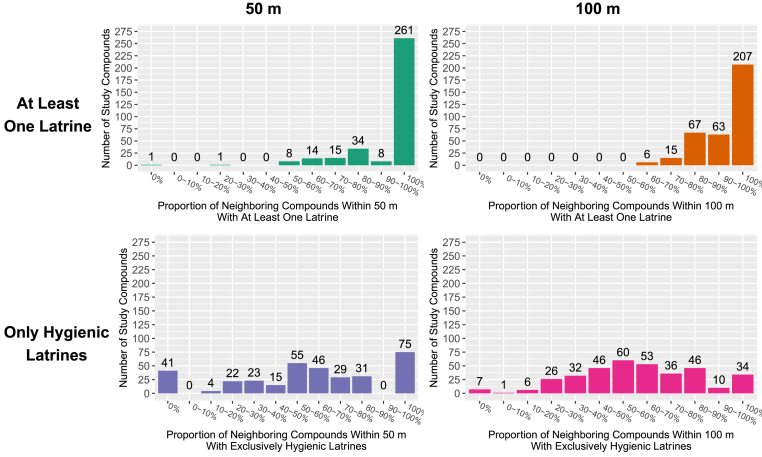
We estimated associations between community sanitation coverage, environmental fecal contamination, and child health among 360 compounds in the control arm of the WASH Benefits trial in rural Bangladesh (NCT01590095). In each compound, we enumerated E. coli in environmental samples and recorded the 7-day prevalence of caregiver-reported diarrheal disease and acute respiratory infections (ARI) in children under five. We observed indicators of latrine access and quality among all neighboring compounds within 100 m of study compounds. We defined community coverage as the proportion of neighboring compounds with (1) at least one latrine, and (2) exclusively hygienic latrines (improved facility observed to safely contain feces), within both 50 m and 100 m of study compounds. We assessed effect modification by population density and season.
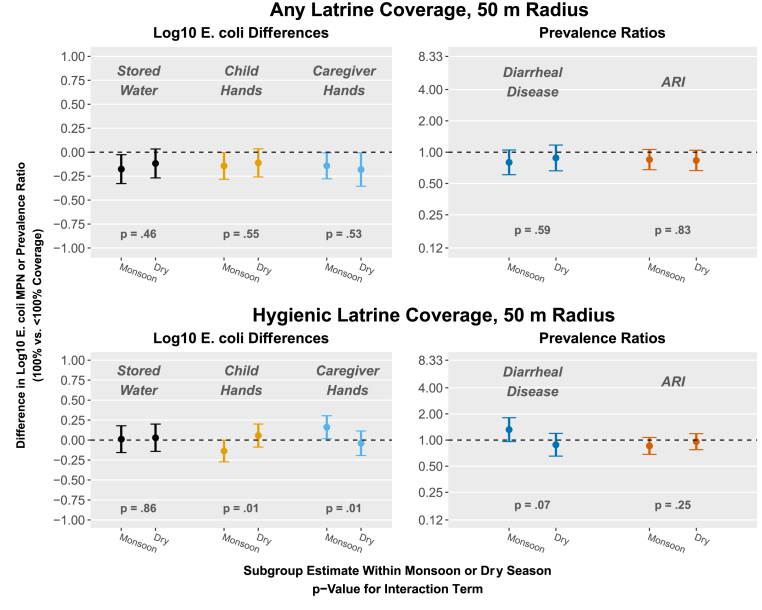
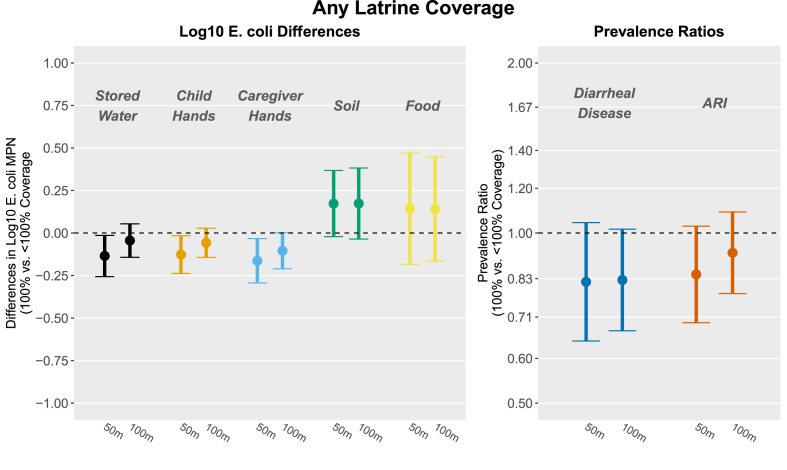
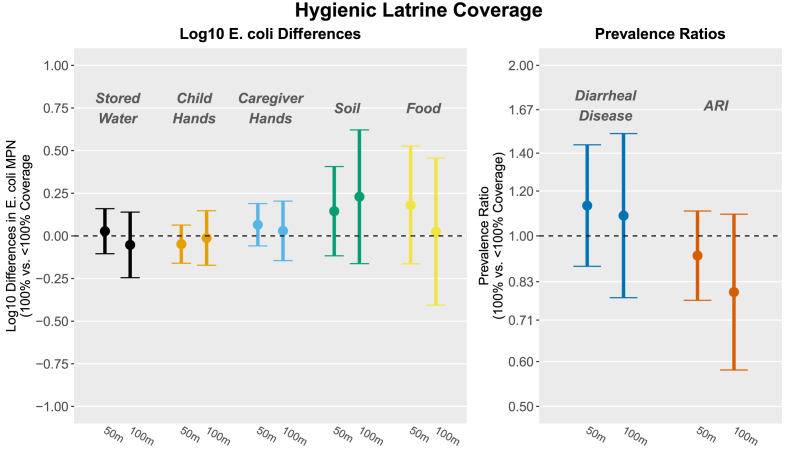
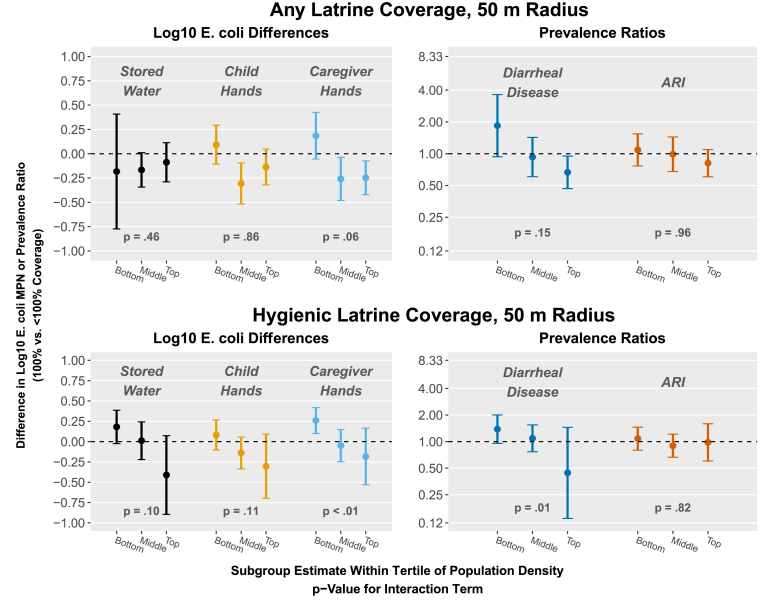
Adjusted for confounders, study compounds surrounded by 100% coverage of at least one latrine per compound within 50 m had slightly lower logE. coli counts in stored water (Δlog = -0.13, 95% CI -0.26, -0.01), child hand rinses (Δlog = -0.13, 95% CI -0.24, -0.02), and caregiver hand rinses (Δlog = -0.16, 95% CI -0.29, -0.03) and marginally lower prevalence of diarrheal disease (prevalence ratio [PR] = 0.82, 95% CI 0.64, 1.04) and ARI (PR = 0.84, 95% CI 0.69, 1.03) compared to compounds surrounded by <100% coverage. Effects were similar but less pronounced at 100 m. At higher population densities, community latrine coverage was associated with larger reductions in E. coli on child and caregiver hands and prevalence of diarrheal disease. Coverage with exclusively hygienic latrines was not associated with any outcome.
Higher community sanitation coverage was associated with reduced fecal contamination and improved child health, with stronger effects at highly local scales (50m) and at high population densities. Our findings indicate that the relationship between community sanitation coverage, environmental contamination, and child health varies by definition of coverage, distance, and population density. This work highlights significant uncertainty around how to best measure sanitation coverage and the expected health effects of increasing sanitation coverage using a specific metric. Better understanding of community-level sanitation access is needed to inform policy for implementing sanitation systems that effectively protect community health.
家庭环境卫生干预措施对儿童健康或环境卫生污染的影响有限,这可能是由于社区覆盖率较低。更高的社区安全管理卫生设施覆盖率可以减少疾病传播的机会。
我们在孟加拉国农村的 WASH Benefits 试验(NCT01590095)的对照组中,对 360 个化合物的社区卫生覆盖情况、环境粪便污染和儿童健康之间的关系进行了估计。在每个化合物中,我们对环境样本中的大肠杆菌进行了计数,并记录了五岁以下儿童中 caregiver 报告的腹泻病和急性呼吸道感染(ARI)的 7 天患病率。我们观察了距离研究化合物 100 米范围内所有相邻化合物的厕所使用情况和质量指标。我们将社区覆盖率定义为在研究化合物的 50 米和 100 米范围内,有(1)至少一个厕所,以及(2)完全卫生厕所(观察到的改良设施可安全容纳粪便)的相邻化合物的比例。我们评估了人口密度和季节的调节作用。
调整混杂因素后,在 50 米范围内,每个化合物周围的社区覆盖率达到 100%,至少有一个厕所,化合物周围的储水、儿童手冲洗和 caregiver 手冲洗样本中的大肠杆菌 log 计数略有降低(Δlog = -0.13,95%置信区间-0.26,-0.01),腹泻病(患病率比 [PR] = 0.82,95%置信区间 0.64,1.04)和 ARI(PR = 0.84,95%置信区间 0.69,1.03)的患病率也略有降低,与覆盖率<100%的化合物相比。在 100 米处,效果相似,但不那么明显。在人口密度较高的地区,社区厕所覆盖率与儿童和护理人员手上的大肠杆菌减少以及腹泻病的患病率降低有关。完全卫生的厕所覆盖率与任何结果都没有关系。
更高的社区卫生设施覆盖率与减少粪便污染和改善儿童健康有关,在高度局部(50 米)和人口密度较高的地区效果更明显。我们的研究结果表明,社区卫生设施覆盖率、环境污染和儿童健康之间的关系因覆盖率、距离和人口密度的定义而有所不同。这一工作突出了在使用特定指标衡量卫生设施覆盖率和预期提高卫生设施覆盖率对健康影响方面存在的巨大不确定性。需要更好地了解社区一级的卫生设施获取情况,为实施有效保护社区健康的卫生系统提供政策信息。