Gordon Rebecca, Cheeseman Nic, Rockowitz Sarah, Stevens Laura M, Flowe Heather D
School of Education and Social Sciences, University of the West of Scotland, Glasgow, United Kingdom.
International Development Department, University of Birmingham, Edgbaston, United Kingdom.
Front Glob Womens Health. 2022 Aug 18;3:857345. doi: 10.3389/fgwh.2022.857345. eCollection 2022.
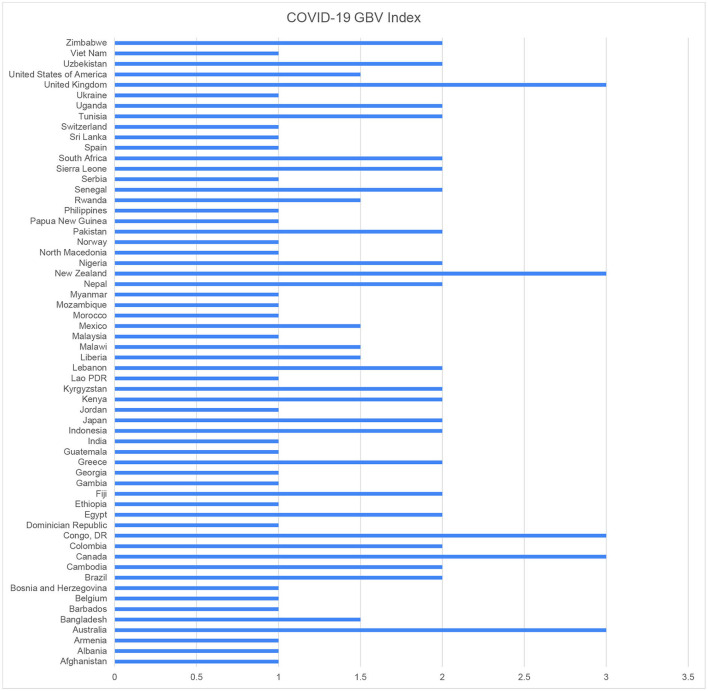
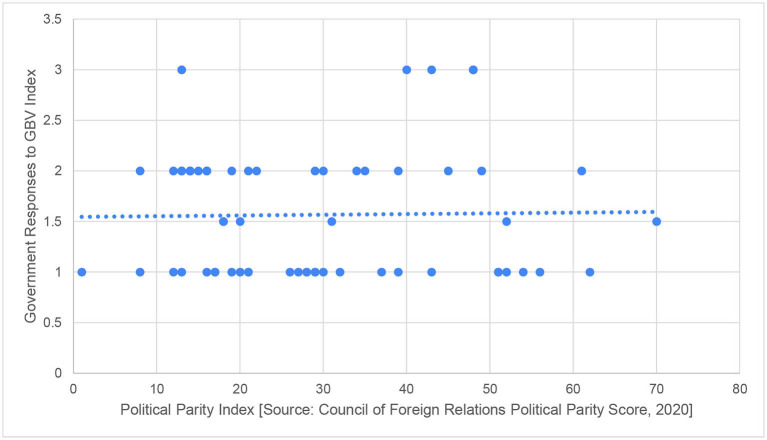
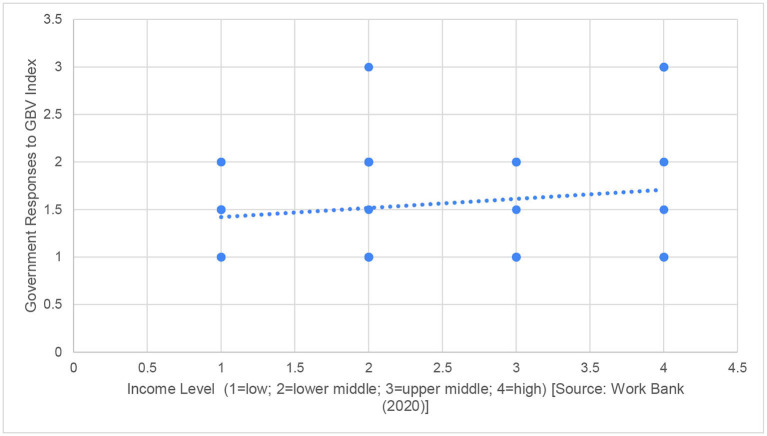
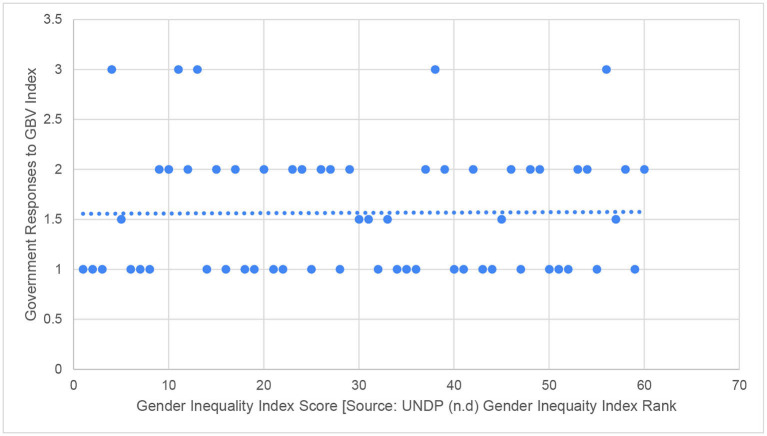
Gender-based violence (GBV) significantly and substantially threatens women's health. The COVID-19 pandemic has exacerbated existing risks and patterns of GBV. The impact of COVID-19 on GBV is not inevitable, however, and can be mediated by the policies of governments. In this study we developed the to systematically examine how countries ( = 60) performed in response to the pandemic with respect to the government 1) enacting specific national-level GBV policy; 2) making dedicated COVID-19 specific funding available; and 3) adapting existing GBV responses to COVID-19 related restrictions and challenges. Most countries ( = 33) delivered fewer than two policy responses. We also performed rapid case study analyses to investigate what might contribute to countries having more comprehensive government policy. We find that civil society organizations played a key role in facilitating GBV policy during the pandemic, especially if they are well-funded and well-connected to the government, and if the country has a high-level government official responsible for gender issues.
基于性别的暴力(GBV)对妇女健康构成了重大且实质性的威胁。新冠疫情加剧了GBV现有的风险和模式。然而,新冠疫情对GBV的影响并非不可避免,政府政策可以起到调节作用。在本研究中,我们开发了[具体内容未给出],以系统地考察60个国家在应对疫情时,在政府方面的以下表现:1)制定具体的国家级GBV政策;2)提供专门针对新冠疫情的资金;3)使现有的GBV应对措施适应与新冠疫情相关的限制和挑战。大多数国家(33个)采取的政策应对措施少于两项。我们还进行了快速案例研究分析,以探究哪些因素可能促使各国拥有更全面的政府政策。我们发现,民间社会组织在疫情期间促进GBV政策方面发挥了关键作用,特别是当它们资金充足且与政府联系紧密时,以及当该国设有负责性别问题的高级政府官员时。