Phiri Million, Lemba Musonda, Chomba Chrispin, Kanyamuna Vincent
Department of Population Studies, School of Humanities and Social Sciences, University of Zambia, Lusaka, Zambia.
Department of Demography and Population Studies, Schools of Public Health and Social Sciences, University of the Witwatersrand, Johannesburg, South Africa.
Humanit Soc Sci Commun. 2022;9(1):295. doi: 10.1057/s41599-022-01312-3. Epub 2022 Aug 27.
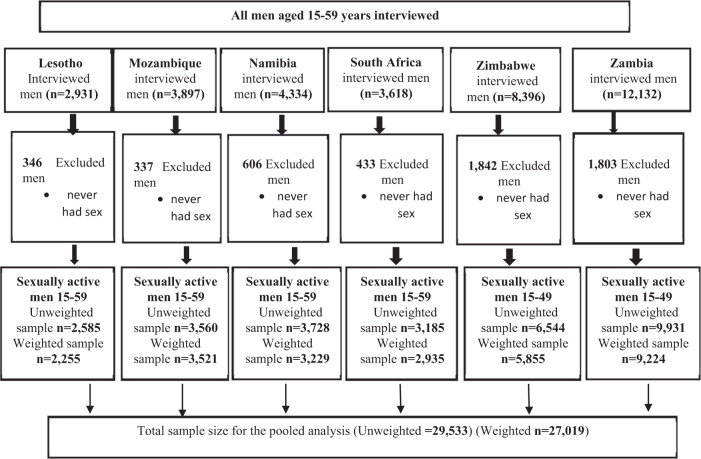
Sub-Saharan Africa (SSA), particularly Southern and East Africa, has the highest AIDS deaths and HIV-infected people in the world. Even though considerable effort has been made over the years to study HIV transmission risk behaviours of different population groups in SSA, there is little evidence of studies that have looked at pooled effects of associated HIV risk factors among men, particularly in Southern Africa. Thus, this study sought to fill this gap in knowledge by investigating the variations in HIV risk behaviours among men in the region. The study analysed cross-sectional data based on the most recent country Demographic and Health Survey (DHS) for six countries, namely Lesotho, Mozambique, Namibia, South Africa, Zambia and Zimbabwe. The study employed multivariate logistic regression models on a pooled dataset and individual country data to examine the relative risk of education and other factors on HIV risk behaviour indicators. It considered: (i) condom use during high risk-sex, (ii) multiple sexual partnerships, and (iii) HIV testing among men aged 15-59 years. Findings show that the proportion of men who engaged in HIV transmission risk behaviour was high in Southern Africa. Two-thirds of men reported non-use of a condom during last sex with most recent partners while 22% engaged in multiple sexual partnerships. The percentage of men who used condoms during sex with most recent partners ranged from 18% in Mozambique to 58% in Namibia. Age, residence, marital status and household wealth status were associated with HIV risk factors in the region. The study has established country variations in terms of how individual factors influence HIV transmission risk behaviour among men. Results show that the level of education was associated with increased use of condoms, only in Zambia and Mozambique. Delay in starting a sexual debut was associated with reduced odds of having multiple sexual partnerships in the region. Suggesting the need to strengthen comprehensive sexuality education among young men in school, to promote social behaviour change during adolescence age. The study presents important results to inform direct health policy, programme and government action to address HIV prevalence in the Southern region of Africa.
撒哈拉以南非洲地区(SSA),尤其是南部和东部非洲,是世界上艾滋病死亡人数最多和艾滋病毒感染者最多的地区。尽管多年来人们付出了巨大努力来研究SSA不同人群的艾滋病毒传播风险行为,但几乎没有证据表明有研究关注过男性中相关艾滋病毒风险因素的综合影响,特别是在南部非洲。因此,本研究旨在通过调查该地区男性艾滋病毒风险行为的差异来填补这一知识空白。该研究分析了基于六个国家(即莱索托、莫桑比克、纳米比亚、南非、赞比亚和津巴布韦)最新的国家人口与健康调查(DHS)的横断面数据。该研究在汇总数据集和各个国家的数据上采用多元逻辑回归模型,以检验教育和其他因素对艾滋病毒风险行为指标的相对风险。研究考虑了:(i)高危性行为期间使用避孕套的情况,(ii)多个性伴侣情况,以及(iii)15至59岁男性中的艾滋病毒检测情况。研究结果表明,南部非洲从事艾滋病毒传播风险行为的男性比例很高。三分之二的男性报告在与最近的性伴侣最后一次性行为时未使用避孕套,而22%的男性有多个性伴侣。在与最近的性伴侣发生性行为时使用避孕套的男性比例从莫桑比克的18%到纳米比亚的58%不等。年龄、居住地点、婚姻状况和家庭财富状况与该地区的艾滋病毒风险因素相关。该研究确定了各个因素在影响男性艾滋病毒传播风险行为方面的国家差异。结果表明,仅在赞比亚和莫桑比克,教育水平与避孕套使用增加有关。在该地区,延迟首次性行为与拥有多个性伴侣的几率降低有关。这表明有必要加强对在校青年男性的全面性教育,以促进青春期的社会行为改变。该研究提出了重要结果,为直接的卫生政策、项目及政府行动提供信息,以应对非洲南部地区的艾滋病毒流行情况。