Nicholson Gareth, Bennett Tim, Thomas Aaron, Pollitt Lysander, Hopkinson Mike, Crespo Rubén, Robinson Tom, Price Rob J
Carnegie School of Sport, Leeds Beckett University, Leeds, United Kingdom.
Leeds United Football Club, Leeds, United Kingdom.
Front Sports Act Living. 2022 Aug 17;4:982796. doi: 10.3389/fspor.2022.982796. eCollection 2022.
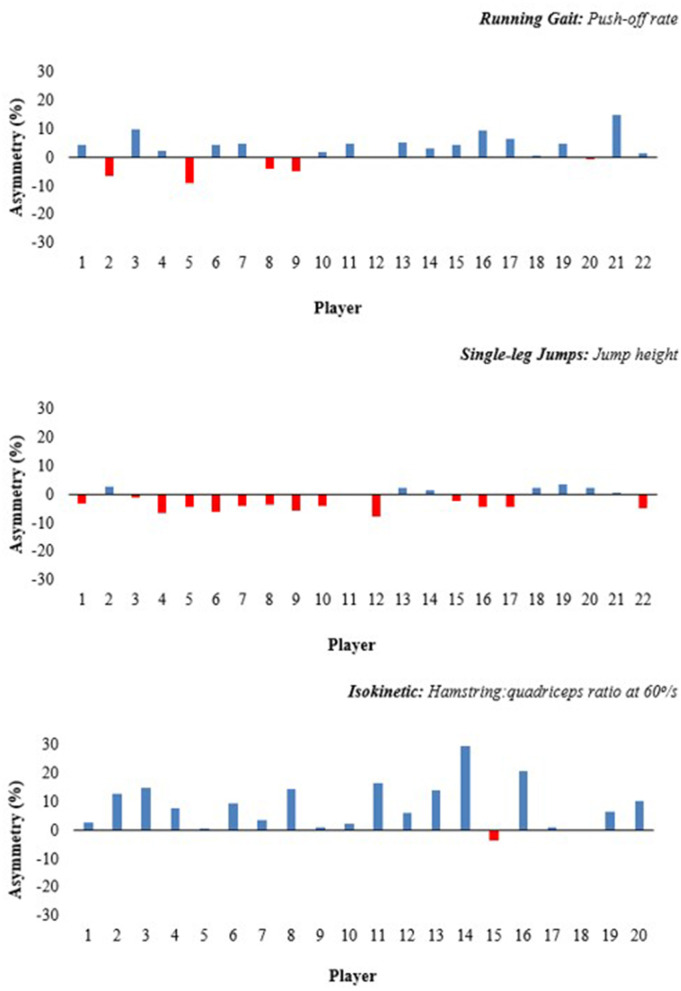
The aims of this study were: (1) to quantify interlimb asymmetries in EPL soccer players in the context of kicking limb preference and (2) to establish the relationship between interlimb asymmetries and measures of physical performance. Twenty-two players (age: 21.8 ± 4.4 years) from an EPL club performed a running gait assessment (20 km/h) and unilateral countermovement jumps, a CoD assessment (modified 505 test), and an isokinetic knee extension/flexion protocol using each leg. Asymmetries were quantified using the percentage difference method and Pearson's correlations were used to quantify the association between variables. Players displayed the greatest level of asymmetry in isokinetic strength measures (5.9-12.7%) and lower levels of asymmetry in gait (1.6-7.7%), jump (0.9-7.0%) and CoD (1.9-3.5%) assessments. The influence of the preferred kicking limb was most evident in the isokinetic assessment with the players showing dominance in the preferred limb for knee flexor strength and in the non-preferred limb for knee extensor strength. These manifested in the asymmetry values calculated for the hamstring:quadricep (H:Q) ratios at 60°/s (8.80 ± 7.82%) and 240°/s (11.22 ± 7.04%) and in the functional H:Q ratio (12.67 ± 8.25%). The asymmetry values for peak extensor moment at 240°/s showed a significant correlation (ρ = -0.55, = 0.034) with 10 m time in the CoD assessment. These findings provide benchmark asymmetry data for soccer practitioners and reveal that kicking limb preferences may bring about interlimb differences in the H:Q ratio which raises important considerations in the design of testing batteries and injury reduction interventions.
(1)在踢球肢体偏好的背景下量化英超联赛(EPL)足球运动员的肢体间不对称性;(2)建立肢体间不对称性与身体表现指标之间的关系。来自一家英超俱乐部的22名球员(年龄:21.8±4.4岁)进行了跑步步态评估(20公里/小时)和单侧反向移动跳跃、变向(CoD)评估(改良505测试),并使用每条腿进行了等速膝关节伸展/屈曲测试。使用百分比差异法量化不对称性,并使用皮尔逊相关性来量化变量之间的关联。球员在等速力量测试中表现出最大程度的不对称性(5.9 - 12.7%),而在步态(1.6 - 7.7%)、跳跃(0.9 - 7.0%)和变向(1.9 - 3.5%)评估中不对称程度较低。在等速评估中,偏好踢球肢体的影响最为明显,球员在优势肢体的屈膝力量方面表现出优势,而在非优势肢体的伸膝力量方面表现出优势。这体现在60°/秒(8.80±7.82%)和240°/秒(11.22±7.04%)时计算的腘绳肌:股四头肌(H:Q)比值的不对称值以及功能性H:Q比值(12.67±8.25%)中。240°/秒时伸肌峰值力矩的不对称值与变向评估中的10米用时显示出显著相关性(ρ = -0.55,P = 0.034)。这些发现为足球从业者提供了基准不对称数据,并揭示了踢球肢体偏好可能导致H:Q比值的肢体间差异,这在测试组合设计和减少损伤干预措施中提出了重要考虑因素。