Faculty of Sport Sciences, Çukurova University, Adana, Turkey.
Faculty of Sport Sciences, Erciyes University, Kayseri, Turkey.
PeerJ. 2024 Sep 26;12:e18148. doi: 10.7717/peerj.18148. eCollection 2024.
Tennis requires movement abilities in changing playing situations. This article investigates the relationship between lower extremity strength asymmetry ratio and linear and multidimensional running performances in female tennis players.
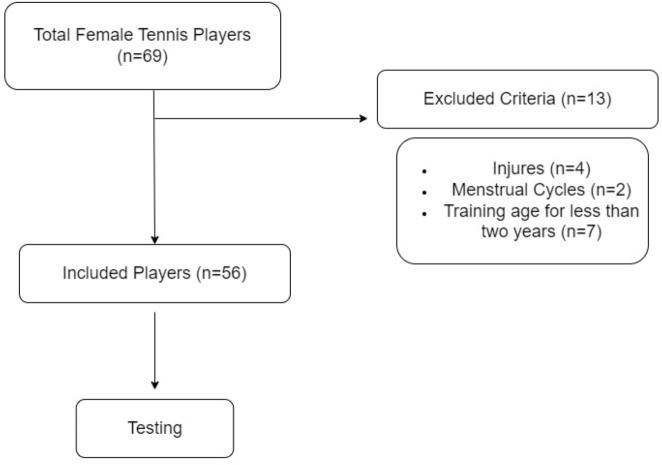
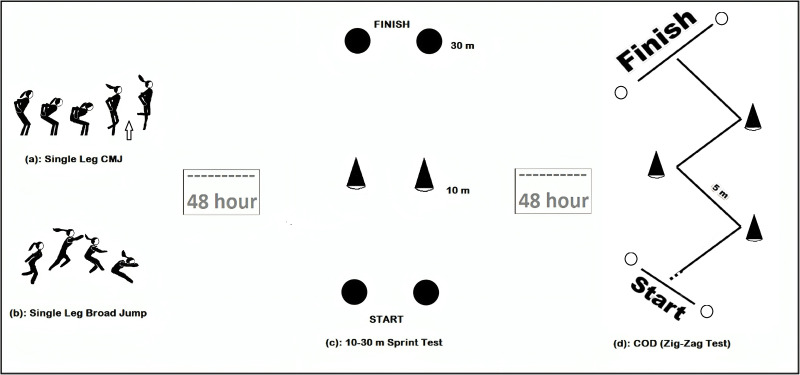
A total of 56 female tennis players, with a mean age of 15.44 ± 0.50 years, participated in the study-the research design involved three sessions at 48-hour intervals. In the first session, athletes performed dominant and non-dominant countermovement jump (CMJ) and board jump (BJ) tests. The second (sec) session included 10-meter (-m) and 30-m linear running performance tests, while the final session assessed multidimensional running performance with a change of direction (COD) test. The relationship between CMJ and BJ asymmetry ratios and linear and multidimensional running performances was analysed using the Pearson correlation coefficient. Bilateral asymmetry rates in linear and multidimensional running performance were determined through linear regression analysis.
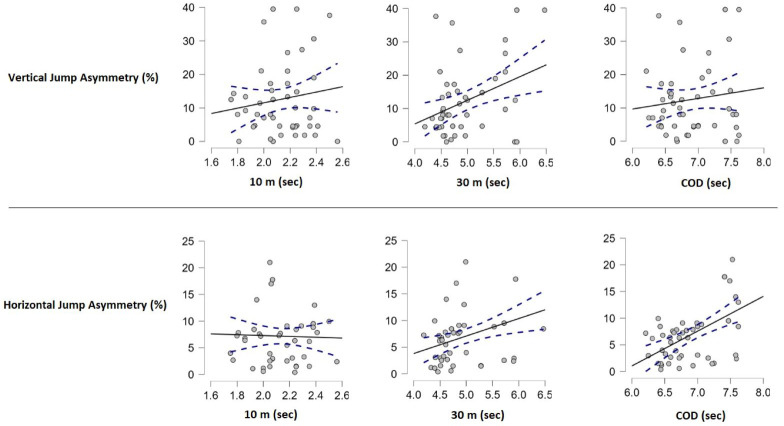
The dominant CMJ recorded 17.56 ± 3.47 cm, while BJ was 130.23 ± 21.76 cm, and the non-dominant CMJ measured 16.79 ± 4.51 cm with a BJ of 147.52 ± 30.97 cm. The athletes had a CMJ asymmetry rate of 12.67 ± 11.29% and a BJ asymmetry rate of 7.19 ± 5.28%. A relationship was seen between the CMJ asymmetry rate and 30-m running performance ( = 0.368, < 0.05). There was no correlation between BJ asymmetry rate and 10-m running performance. Significant correlations were found between 30-m ( = 0.364) and COD ( = 0.529) running performances ( < 0.05).
It can be said that the CMJ asymmetry ratio may negatively affect 30-m and the BJ asymmetry ratio may negatively affect 30-m and COD performance.
网球需要在不断变化的比赛情况下具备运动能力。本文研究了下肢力量不对称比率与女性网球运动员直线和多维跑动表现之间的关系。
共有 56 名女性网球运动员参与了这项研究,平均年龄为 15.44 ± 0.50 岁。研究设计包括三次间隔 48 小时的测试。在第一次测试中,运动员进行了主导和非主导的反向跳跃(CMJ)和蹬板跳跃(BJ)测试。第二次测试包括 10 米(-m)和 30 米直线跑步表现测试,而最后一次测试使用变向(COD)测试评估多维跑步表现。通过 Pearson 相关系数分析 CMJ 和 BJ 不对称比率与直线和多维跑步表现之间的关系。通过线性回归分析确定直线和多维跑步表现的双侧不对称率。
主导 CMJ 记录为 17.56 ± 3.47 cm,而 BJ 为 130.23 ± 21.76 cm,非主导 CMJ 测量为 16.79 ± 4.51 cm,BJ 为 147.52 ± 30.97 cm。运动员的 CMJ 不对称率为 12.67 ± 11.29%,BJ 不对称率为 7.19 ± 5.28%。CMJ 不对称率与 30 米跑步表现之间存在关系(=0.368,<0.05)。BJ 不对称率与 10 米跑步表现之间没有相关性。30 米(=0.364)和 COD(=0.529)跑步表现之间存在显著相关性(<0.05)。
可以说 CMJ 不对称率可能会对 30 米跑表现产生负面影响,而 BJ 不对称率可能会对 30 米跑和 COD 表现产生负面影响。