Morgado-Cáceres Pablo, Liabeuf Gianella, Calle Ximena, Briones Lautaro, Riquelme Jaime A, Bravo-Sagua Roberto, Parra Valentina
Advanced Center of Chronic Diseases (ACCDiS), Facultad de Ciencias Químicas y Farmacéuticas e Instituto de Nutrición y Tecnología de los Alimentos (INTA), Universidad de Chile, Santiago, Chile.
Departamento de Bioquímica y Biología Molecular y Departamento de Química Farmacológica y Toxicológica, Facultad de Ciencias Químicas y Farmacéuticas, Universidad de Chile, Santiago, Chile.
Front Cell Dev Biol. 2022 Aug 19;10:946678. doi: 10.3389/fcell.2022.946678. eCollection 2022.
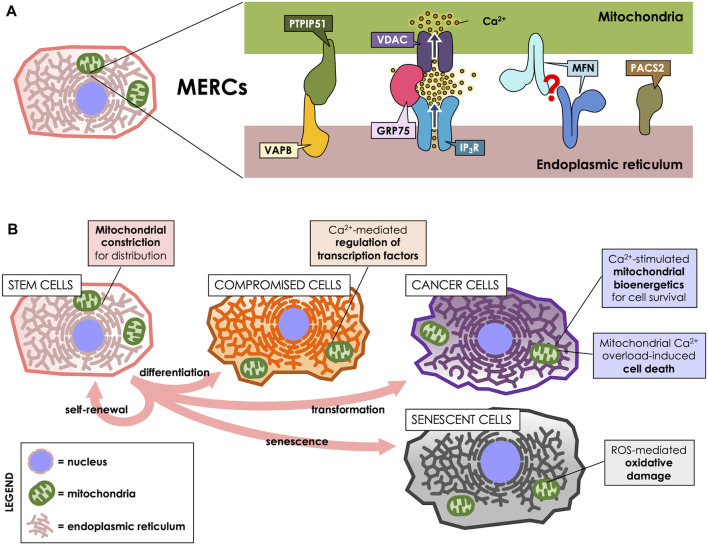
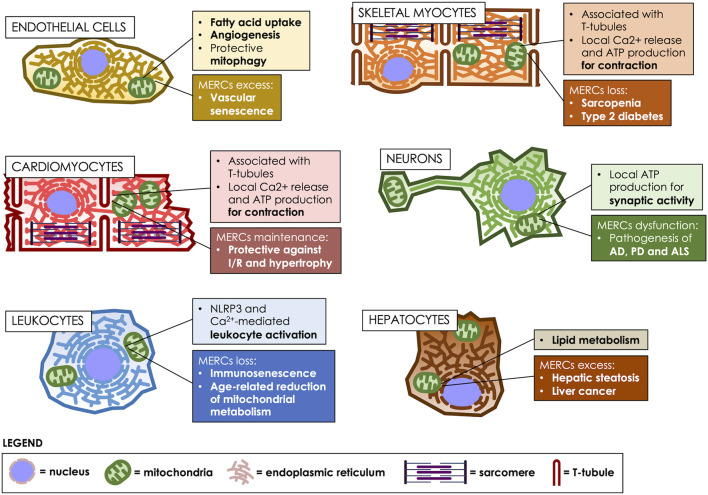
The complex physiology of eukaryotic cells requires that a variety of subcellular organelles perform unique tasks, even though they form highly dynamic communication networks. In the case of the endoplasmic reticulum (ER) and mitochondria, their functional coupling relies on the physical interaction between their membranes, mediated by domains known as mitochondria-ER contacts (MERCs). MERCs act as shuttles for calcium and lipid transfer between organelles, and for the nucleation of other subcellular processes. Of note, mounting evidence shows that they are heterogeneous structures, which display divergent behaviors depending on the cell type. Furthermore, MERCs are plastic structures that remodel according to intra- and extracellular cues, thereby adjusting the function of both organelles to the cellular needs. In consonance with this notion, the malfunction of MERCs reportedly contributes to the development of several age-related disorders. Here, we integrate current literature to describe how MERCs change, starting from undifferentiated cells, and their transit through specialization, malignant transformation (i.e., dedifferentiation), and aging/senescence. Along this journey, we will review the function of MERCs and their relevance for pivotal cell types, such as stem and cancer cells, cardiac, skeletal, and smooth myocytes, neurons, leukocytes, and hepatocytes, which intervene in the progression of chronic diseases related to age.
真核细胞复杂的生理学特性要求多种亚细胞器执行独特的任务,即便它们形成了高度动态的通讯网络。就内质网(ER)和线粒体而言,它们的功能耦合依赖于其膜之间的物理相互作用,这种相互作用由称为线粒体-内质网接触(MERC)的结构域介导。MERC充当细胞器之间钙和脂质转移的通道,以及其他亚细胞过程的成核位点。值得注意的是,越来越多的证据表明它们是异质性结构,其行为因细胞类型而异。此外,MERC是可塑性结构,可根据细胞内和细胞外信号进行重塑,从而根据细胞需求调节两个细胞器的功能。与此观点一致,据报道MERC的功能失调会导致几种与年龄相关的疾病的发生。在此,我们整合当前文献,描述MERC如何从未分化细胞开始发生变化,以及它们在细胞分化、恶性转化(即去分化)和衰老/老化过程中的转变。在这个过程中,我们将回顾MERC的功能及其与关键细胞类型的相关性,例如干细胞和癌细胞、心肌细胞、骨骼肌细胞和平滑肌细胞、神经元、白细胞和肝细胞,这些细胞类型参与与年龄相关的慢性疾病的进展。