Gire Catherine, Berbis Julie, Dequin Marion, Marret Stéphane, Muller Jean-Baptiste, Saliba Elie, Tosello Barthélémy
Department of Neonatal Medicine, Assistance Publique Hopitaux de Marseille, Marseille, France.
EA3279, Faculty of Medicine, Self-Perceived Health Assessment Research Unit, Marseille, France.
Front Pediatr. 2022 Aug 19;10:936130. doi: 10.3389/fped.2022.936130. eCollection 2022.
Preterm infants are at risk of neurodevelopmental impairments. At present, proton magnetic resonance spectroscopy (1H-MRS) is currently used to evaluate brain metabolites in asphyxiated term infants. The purpose of this study was to identify in the preterm EPIRMEX cohort any correlations between (1H-MRS) metabolites ratio at term equivalent age (TEA) and neurodevelopmental outcomes at 2 years.
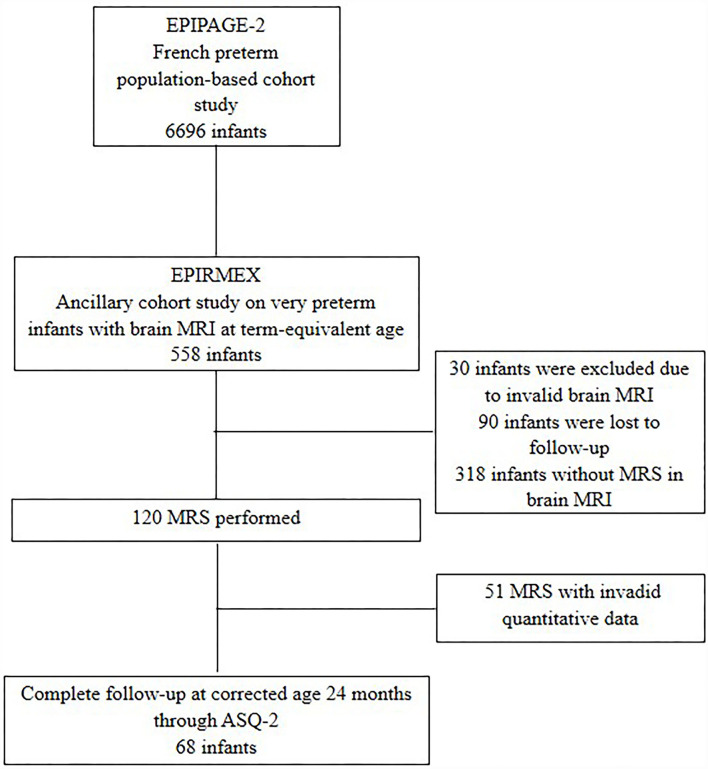
Our study included EPIRMEX eligible patients who were very preterm infants (gestational age at birth ≤32 weeks) and who underwent a brain MRI at TEA and H-MRS using a monovoxel technique. The volumes of interest (VOI) were periventricular white matter posterior area and basal ganglia. The ratio of N Acetyl Aspartate (NAA) to Cho (Choline), NAA to Cr (creatine), Cho to Cr, and Lac (Lactate) to Cr were measured. Neurodevelopment was assessed at 24 months TEA with ASQ (Ages and Stages Questionnaire).
A total of 69 very preterm infants had a 1H-MRS at TEA. In white matter there was a significant correlation between a reduction in the NAA/Cho ratio and a total ASQ and/or abnormal communication score, and an increase in the Lac/Cr ratio and an abnormality of fine motor skills. In the gray nuclei there was a trend correlation between the reduction in the NAA/Cho ratio and sociability disorders; and the increase in the Lac/Cr ratio and an anomaly in problem-solving.
Using NAA as a biomarker, the vulnerability of immature oligodendrocytes in preterm children at TEA was correlated to neurodevelopment at 2 years. Similarly, the presence of lactate at TEA was associated with abnormal neurodevelopment at 2 years in the preterm brain.
早产儿有神经发育受损的风险。目前,质子磁共振波谱(1H-MRS)用于评估足月窒息婴儿的脑代谢物。本研究的目的是在早产EPIRMEX队列中确定足月等效年龄(TEA)时的(1H-MRS)代谢物比率与2岁时神经发育结局之间的任何相关性。
我们的研究纳入了符合EPIRMEX标准的极早产儿(出生胎龄≤32周),这些婴儿在TEA时接受了脑部MRI检查,并使用单体素技术进行了H-MRS检查。感兴趣区域(VOI)为脑室周围白质后部区域和基底神经节。测量了N-乙酰天门冬氨酸(NAA)与胆碱(Cho)的比率、NAA与肌酸(Cr)的比率、Cho与Cr的比率以及乳酸(Lac)与Cr的比率。在TEA 24个月时用ASQ(年龄与阶段问卷)评估神经发育情况。
共有69例极早产儿在TEA时进行了1H-MRS检查。在白质中,NAA/Cho比率降低与ASQ总分和/或沟通异常评分之间存在显著相关性,Lac/Cr比率升高与精细运动技能异常之间存在显著相关性。在灰质核中,NAA/Cho比率降低与社交障碍之间存在趋势相关性;Lac/Cr比率升高与解决问题异常之间存在趋势相关性。
以NAA作为生物标志物,TEA时早产儿童未成熟少突胶质细胞的脆弱性与2岁时的神经发育相关。同样,TEA时乳酸的存在与早产脑2岁时的异常神经发育有关。