Torrecillas Miriam, Gumucio Victor Daniel, Padullés Ariadna, Tubau Fe, Marco Daniel, Shaw Evelyn, Fernández-Huerta Miguel, Maisterra Krystel, Grau Inmaculada, Petito Melanie Maria, Berbel Dàmaris, Puig-Asensio Mireia, Pérez Xosé Luis, Domínguez Ma Ángeles, Sabater Joan, Ardanuy Carmen, Càmara Jordi
Microbiology Department, Hospital Universitari de Bellvitge, University of Barcelona, IDIBELL, Barcelona, Spain.
Intensive Care Unit, Hospital Universitari de Bellvitge, University of Barcelona, IDIBELL, Barcelona, Spain.
Infect Prev Pract. 2022 Dec;4(4):100241. doi: 10.1016/j.infpip.2022.100241. Epub 2022 Aug 28.
During early stages of COVID-19 pandemic, antimicrobials were commonly prescribed.
To describe clinical, microbiological and antimicrobial use changes in bloodstream infections (BSI) of ICU patients during the first wave of COVID-19 pandemic compared to pre-COVID-19 era.
Observational cohort study of patients admitted to ICU of Bellvitge University Hospital was conducted during the COVID-19 pandemic (March-June 2020) and before COVID-19 pandemic (March-June 2019). Differences in clinical characteristics, antimicrobial consumption and incidence and aetiology of BSI were measured.
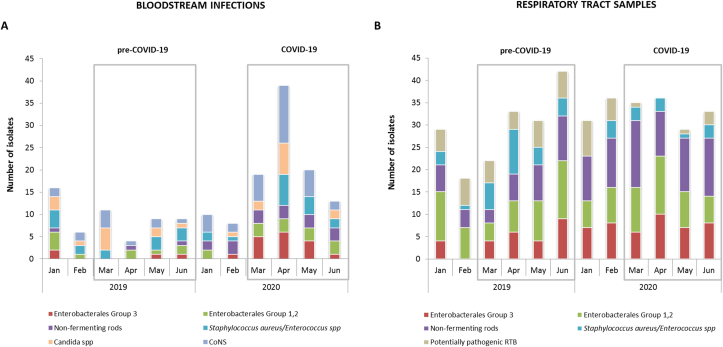
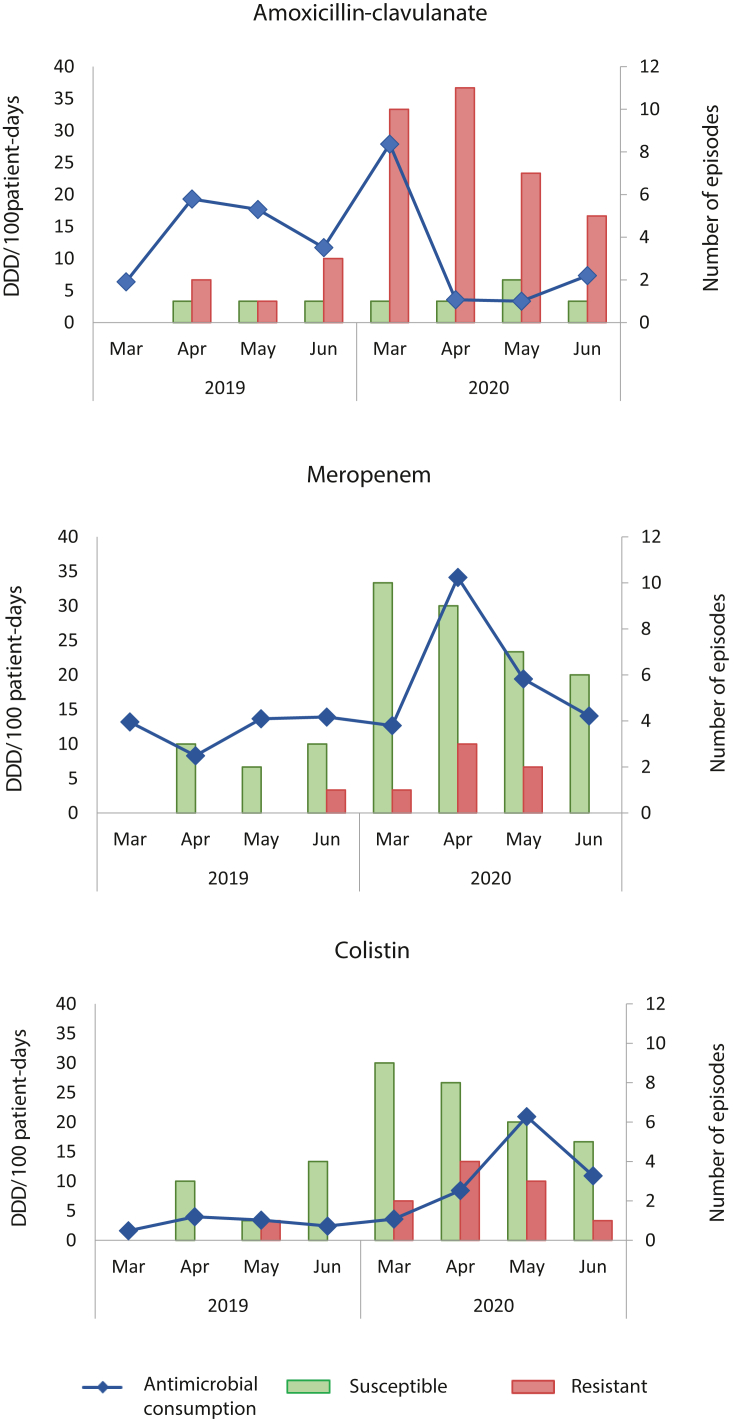
COVID-19 patients had significantly less comorbidities with obesity the only risk factor that increased in frequency. COVID-19 patients more frequently required invasive supportive care measures, had longer median ICU stay and higher mortality rates. The incidence of BSIs was higher in COVID-19 period (RR 3.2 [95%CI 2.2-4.7]), occurred in patients who showed prolonged median ICU stay (21days) and was associated with high mortality rate (47%). The highest increases in the aetiological agents were observed for AmpC-producing bacteria (RR 11.1 [95%CI 2.6-47.9]) and non-fermenting rods (RR 7.0 [95%CI 1.5-31.4]). The emergence of bacteraemia caused by Gram-negative rods resistant to amoxicillin-clavulanate, which was used as empirical therapy during early stages of the pandemic, led to an escalation towards broader-spectrum antimicrobials such as meropenem and colistin which was also associated with the emergence of resistant isolates.
The epidemiological shift towards resistant phenotypes in critically ill COVID-19 patients was associated with the selective use of antimicrobials. Our study provides evidence of the impact of empirical therapy on the selection of bacteria and their consequences on BSI over the subsequent months.
在新冠疫情早期阶段,抗菌药物的处方很常见。
描述与新冠疫情前时代相比,新冠疫情第一波期间重症监护病房(ICU)患者血流感染(BSI)的临床、微生物学和抗菌药物使用变化。
对巴塞罗那贝尔维特大学医院ICU收治的患者进行观察性队列研究,研究时间为新冠疫情期间(2020年3月至6月)和新冠疫情之前(2019年3月至6月)。测量临床特征、抗菌药物消耗以及BSI的发生率和病因学方面的差异。
新冠患者的合并症显著较少,肥胖是唯一频率增加的风险因素。新冠患者更频繁地需要侵入性支持治疗措施,ICU中位住院时间更长,死亡率更高。新冠疫情期间BSI的发生率更高(相对风险3.2 [95%置信区间2.2 - 4.7]),发生在ICU中位住院时间延长(21天)的患者中,并且与高死亡率(47%)相关。产AmpC酶细菌(相对风险11.1 [95%置信区间2.6 - 47.9])和非发酵菌(相对风险7.0 [95%置信区间1.5 - 31.4])的病原体增加最为明显。在疫情早期用作经验性治疗的阿莫西林 - 克拉维酸耐药革兰氏阴性杆菌引起的菌血症的出现,导致了向美罗培南和黏菌素等更广谱抗菌药物的升级,这也与耐药菌株的出现有关。
重症新冠患者向耐药表型的流行病学转变与抗菌药物的选择性使用有关。我们的研究提供了证据,证明经验性治疗对细菌选择的影响及其在随后几个月对BSI的后果。