Student Research Committee, Kashan University of Medical Sciences, Kashan, Iran.
Cancer Immunology Project (CIP), Universal Scientific Education and Research Network (USERN), Tehran, Iran.
Cell Mol Biol Lett. 2022 Sep 5;27(1):73. doi: 10.1186/s11658-022-00375-z.
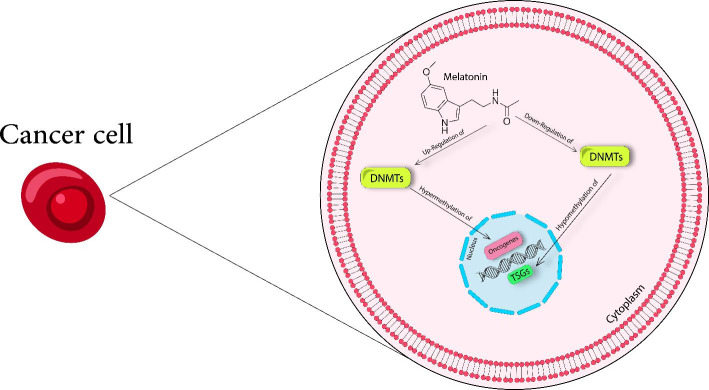
Melatonin is an important naturally occurring hormone in mammals. Melatonin-mediated biological effects include the regulation of circadian rhythms, which is important for optimal human health. Also, melatonin has a broad range of immunoenhancing actions. Moreover, its oncostatic properties, especially regarding breast cancer, involve a variety cancer-inhibitory processes and are well documented. Due to their promising effects on the prognosis of cancer patients, anti-cancer drugs with epigenetic actions have attracted a significant amount of attention in recent years. Epigenetic modifications of cancers are categorized into three major processes including non-coding RNAs, histone modification, and DNA methylation. Hence, the modification of the latter epigenetic event is currently considered an effective strategy for treatment of cancer patients. Thereby, this report summarizes the available evidence that investigated melatonin-induced effects in altering the status of DNA methylation in different cancer cells and models, e.g., malignant glioma and breast carcinoma. Also, we discuss the role of artificial light at night (ALAN)-mediated inhibitory effects on melatonin secretion and subsequent impact on global DNA methylation of cancer cells.
褪黑素是哺乳动物体内一种重要的天然激素。褪黑素介导的生物学效应包括对昼夜节律的调节,这对人类健康至关重要。此外,褪黑素具有广泛的免疫增强作用。此外,其抗肿瘤特性,特别是在乳腺癌方面,涉及多种抗癌抑制过程,并有充分的文献记载。由于其对癌症患者预后的影响,近年来具有表观遗传作用的抗癌药物引起了广泛关注。癌症的表观遗传修饰可分为非编码 RNA、组蛋白修饰和 DNA 甲基化三个主要过程。因此,目前认为改变后一种表观遗传事件是治疗癌症患者的有效策略。因此,本报告总结了现有的证据,这些证据研究了褪黑素在改变不同癌细胞和模型(例如恶性神经胶质瘤和乳腺癌)中 DNA 甲基化状态方面的作用。此外,我们还讨论了夜间人工光(ALAN)对褪黑素分泌的抑制作用及其对癌细胞全基因组 DNA 甲基化的后续影响。