Department of Cardiology, Longhua Hospital, Shanghai University of Traditional Chinese Medicine, Shanghai, China.
J Transl Med. 2022 Sep 5;20(1):399. doi: 10.1186/s12967-022-03614-1.
Peripheral biomarkers are increasingly vital non-invasive methods for monitoring coronary artery disease (CAD) progression. Their superiority in early detection, prognosis evaluation and classified diagnosis is becoming irreplaceable. Nevertheless, they are still less explored. This study aimed to determine and validate the diagnostic and therapeutic values of differentially expressed immune-related genes (DE-IRGs) in CAD.
We downloaded clinical information and RNA sequence data from the GEO database. We used R software, GO, KEGG and Cytoscape to analyze and visualize the data. A LASSO method was conducted to identify key genes for diagnostic model construction. The ssGSEA analysis was used to investigate the differential immune cell infiltration. Besides, we constructed CAD mouse model (low-density lipoprotein receptor deficient mice with high fat diet) to discover the correlation between the screened genes and severe CAD progress. We further uncovered the role of IL13RA1 might play in atherosclerosis.
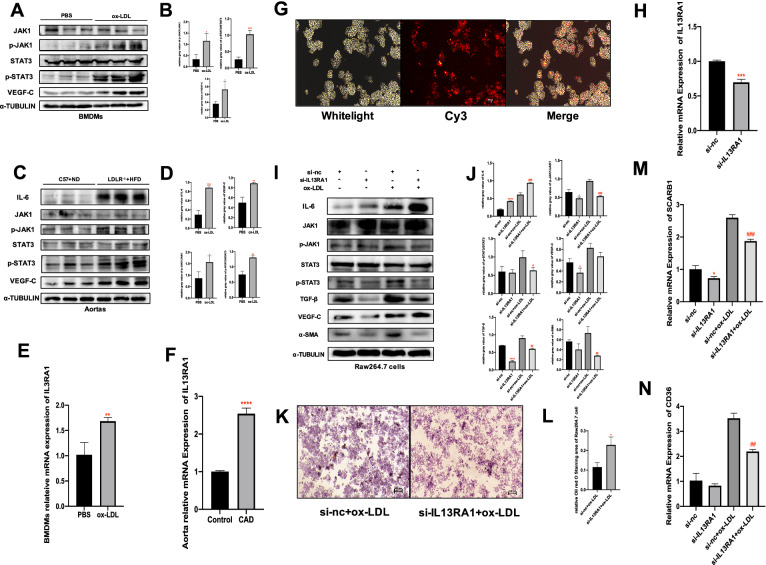
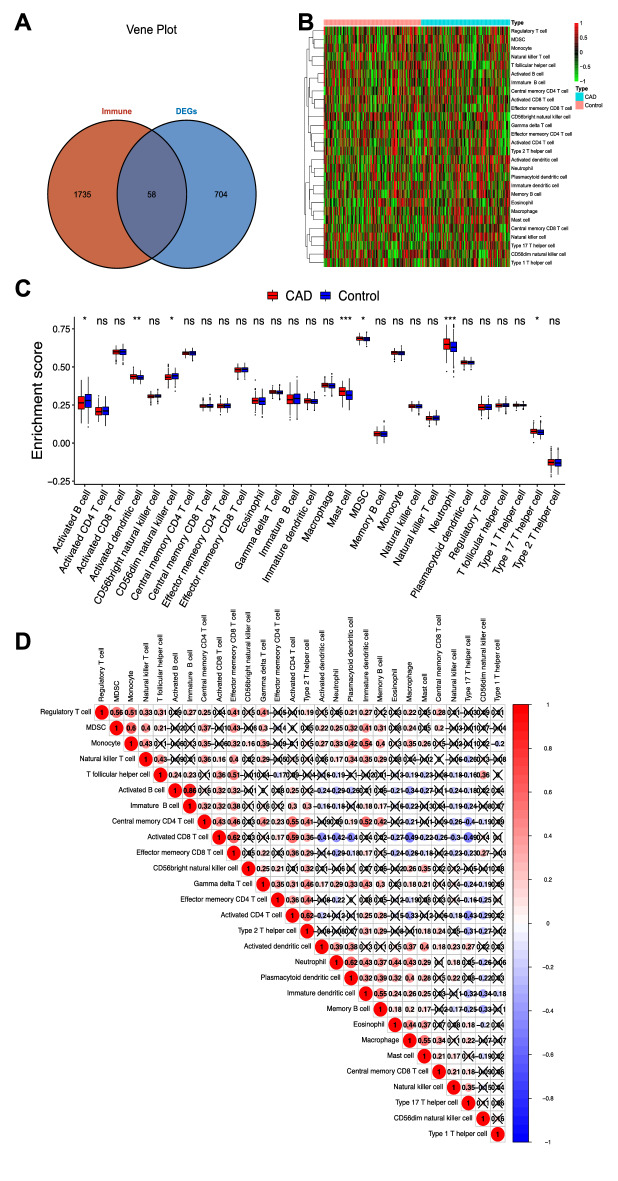
A total of 762 differential genes were identified between the peripheral blood of 218 controls and 199 CAD patients, which were significantly associated with infection, immune response and neural activity. 58 DE-IRGs were obtained by overlapping the differentially expressed genes(DEGs) and immune-related genes downloaded from ImmpDb database. Through LASSO regression, CCR9, CER1, CSF2, IL13RA1, INSL5, MBL2, MMP9, MSR1, NTS, TNFRSF19, CXCL2, HTR3C, IL1A, and NR4A2 were distinguished as peripheral biomarkers of CAD with eligible diagnostic capabilities in the training set (AUC = 0.968) and test set (AUC = 0.859). The ssGSEA analysis showed that the peripheral immune cells had characteristic distribution in CAD and also close relationship with specific DE-IRGs. RT-qPCR test showed that CCR9, CSF2, IL13RA1, and NTS had a significant correlation with LDLR mice. IL13RA1 knocked down in RAW264.7 cell lines decreased SCARB1 and ox-LDL-stimulated CD36 mRNA expression, TGF-β, VEGF-C and α-SMA protein levels and increased the production of IL-6, with downregulation of JAK1/STAT3 signal pathway.
We constructed a diagnostic model of advanced-stage CAD based on the screened 14 DE-IRGs. We verified 4 genes of them to have a strong correlation with CAD, and IL13RA1 might participate in the inflammation, fibrosis, and cholesterol efflux process of atherosclerosis by regulating JAK1/STAT3 pathway.
外周生物标志物是监测冠状动脉疾病(CAD)进展的越来越重要的非侵入性方法。它们在早期检测、预后评估和分类诊断方面的优势是不可替代的。然而,它们的研究仍然较少。本研究旨在确定和验证差异表达免疫相关基因(DE-IRGs)在 CAD 中的诊断和治疗价值。
我们从 GEO 数据库中下载临床信息和 RNA 序列数据。我们使用 R 软件、GO、KEGG 和 Cytoscape 对数据进行分析和可视化。使用 LASSO 方法识别诊断模型构建的关键基因。ssGSEA 分析用于研究差异免疫细胞浸润。此外,我们构建了 CAD 小鼠模型(载脂蛋白 E 基因敲除小鼠给予高脂饮食),以发现筛选基因与严重 CAD 进展之间的关系。我们进一步揭示了 IL13RA1 在动脉粥样硬化中的作用。
我们从 218 名对照者和 199 名 CAD 患者的外周血中鉴定出 762 个差异基因,这些基因与感染、免疫反应和神经活动显著相关。通过重叠从 ImmpDb 数据库下载的差异表达基因(DEGs)和免疫相关基因,获得了 58 个 DE-IRGs。通过 LASSO 回归,CCR9、CER1、CSF2、IL13RA1、INSL5、MBL2、MMP9、MSR1、NTS、TNFRSF19、CXCL2、HTR3C、IL1A 和 NR4A2 被鉴定为 CAD 的外周生物标志物,在训练集(AUC=0.968)和测试集(AUC=0.859)中具有合格的诊断能力。ssGSEA 分析表明,外周免疫细胞在 CAD 中有特征性分布,并且与特定的 DE-IRGs 密切相关。RT-qPCR 检测显示,CCR9、CSF2、IL13RA1 和 NTS 与 LDLR 小鼠有显著相关性。在 RAW264.7 细胞系中敲低 IL13RA1 可降低 SCARB1 和 ox-LDL 刺激的 CD36 mRNA 表达、TGF-β、VEGF-C 和 α-SMA 蛋白水平,并增加 IL-6 的产生,同时下调 JAK1/STAT3 信号通路。
我们基于筛选出的 14 个 DE-IRGs 构建了晚期 CAD 的诊断模型。我们验证了其中 4 个基因与 CAD 有很强的相关性,IL13RA1 可能通过调节 JAK1/STAT3 通路参与动脉粥样硬化的炎症、纤维化和胆固醇流出过程。