Department of Molecular, Cell and Cancer Biology; Worcester, Massachusetts, USA.
RNA Therapeutics Institute; Worcester, Massachusetts, USA.
CRISPR J. 2022 Oct;5(5):685-701. doi: 10.1089/crispr.2022.0058. Epub 2022 Sep 7.
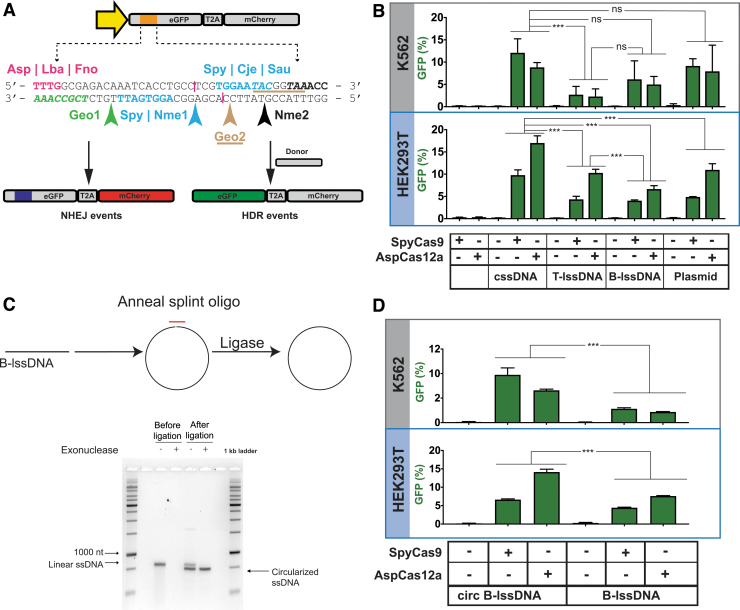
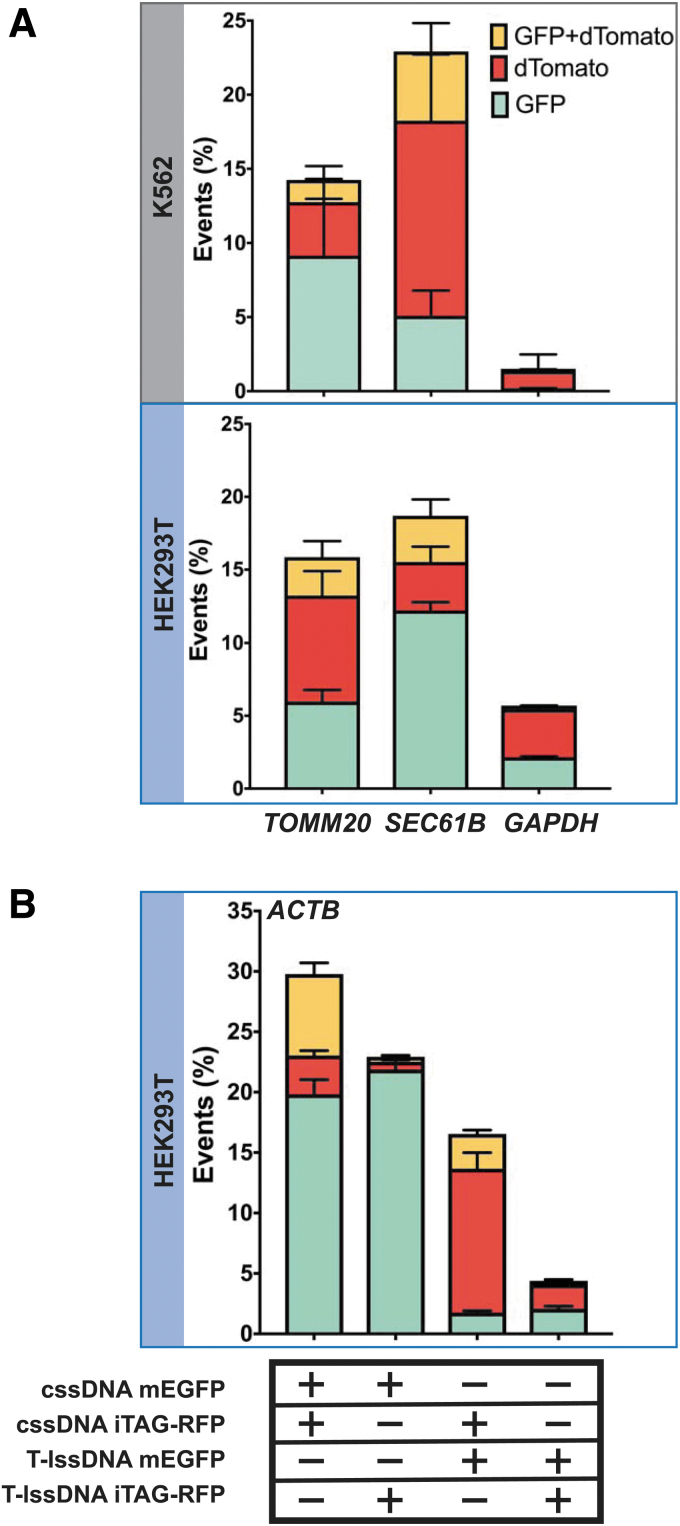
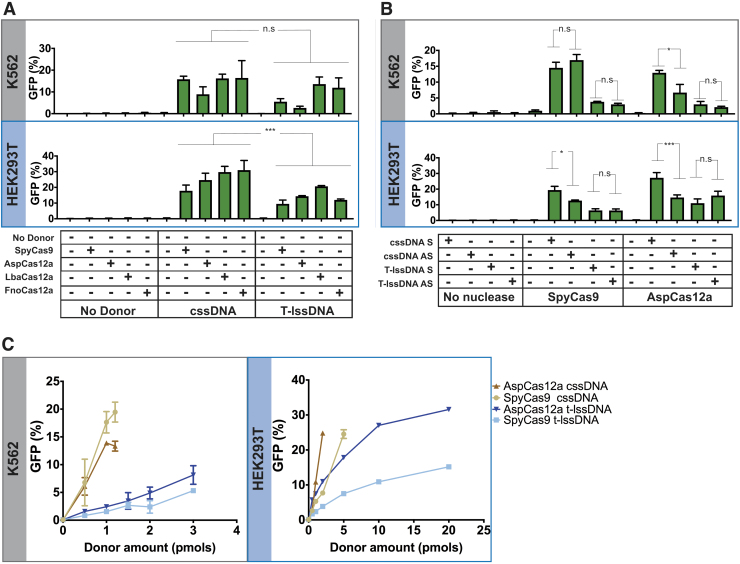
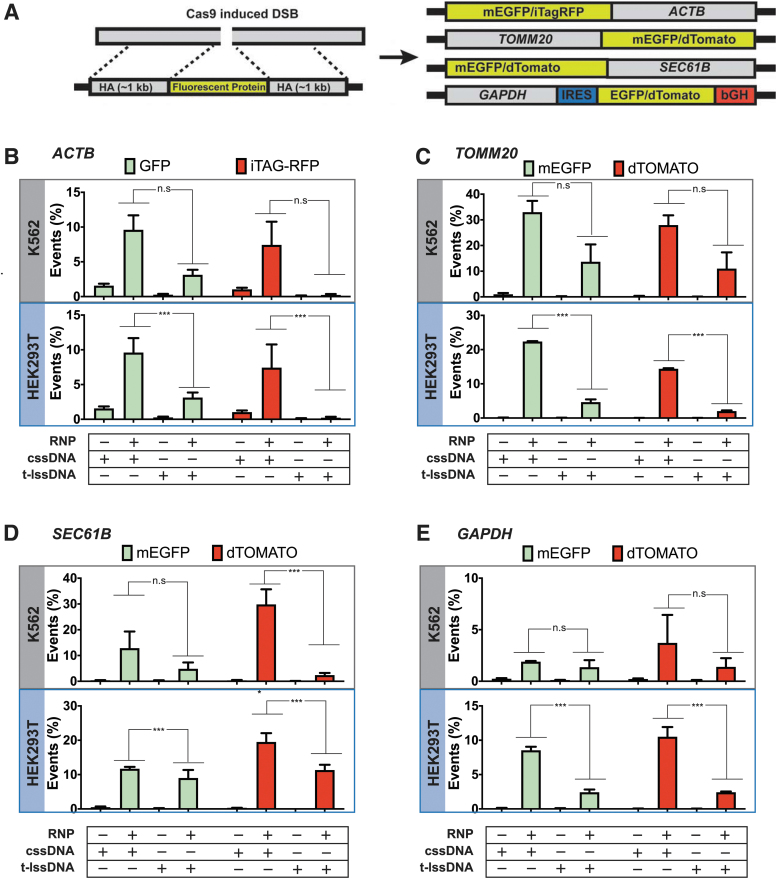
While genome editing has been revolutionized by the advent of CRISPR-based nucleases, difficulties in achieving efficient, nuclease-mediated, homology-directed repair (HDR) still limit many applications. Commonly used DNA donors such as plasmids suffer from low HDR efficiencies in many cell types, as well as integration at unintended sites. In contrast, single-stranded DNA (ssDNA) donors can produce efficient HDR with minimal off-target integration. In this study, we describe the use of ssDNA phage to efficiently and inexpensively produce long circular ssDNA (cssDNA) donors. These cssDNA donors serve as efficient HDR templates when used with Cas9 or Cas12a, with integration frequencies superior to linear ssDNA (lssDNA) donors. To evaluate the relative efficiencies of imprecise and precise repair for a suite of different Cas9 or Cas12a nucleases, we have developed a modified traffic light reporter (TLR) system (TLR-multi-Cas variant 1 [MCV1]) that permits side-by-side comparisons of different nuclease systems. We used this system to assess editing and HDR efficiencies of different nuclease platforms with distinct DNA donor types. We then extended the analysis of DNA donor types to evaluate efficiencies of fluorescent tag knockins at endogenous sites in HEK293T and K562 cells. Our results show that cssDNA templates produce efficient and robust insertion of reporter tags. Targeting efficiency is high, allowing production of biallelic integrants using cssDNA donors. cssDNA donors also outcompete lssDNA donors in template-driven repair at the target site. These data demonstrate that circular donors provide an efficient, cost-effective method to achieve knockins in mammalian cell lines.
虽然基于 CRISPR 的核酸酶的出现彻底改变了基因组编辑,但在实现高效、核酸酶介导的同源定向修复(HDR)方面仍然存在困难,这限制了许多应用。在许多细胞类型中,常用的 DNA 供体(如质粒)的 HDR 效率较低,并且容易整合到非预期的位点。相比之下,单链 DNA(ssDNA)供体可以产生高效的 HDR,并且最小化脱靶整合。在这项研究中,我们描述了使用 ssDNA 噬菌体来高效且廉价地产生长的环状 ssDNA(cssDNA)供体。当与 Cas9 或 Cas12a 一起使用时,这些 cssDNA 供体作为高效的 HDR 模板,整合频率优于线性 ssDNA(lssDNA)供体。为了评估不同 Cas9 或 Cas12a 核酸酶的不精确和精确修复的相对效率,我们开发了一种改良的红绿灯报告器(TLR)系统(TLR-多 Cas 变体 1 [MCV1]),允许对不同的核酸酶系统进行并排比较。我们使用该系统评估了不同核酸酶平台与不同 DNA 供体类型的编辑和 HDR 效率。然后,我们扩展了 DNA 供体类型的分析,以评估在 HEK293T 和 K562 细胞中内源位点的荧光标记 knockin 的效率。我们的结果表明,cssDNA 模板可高效且稳健地插入报告标记。靶向效率高,允许使用 cssDNA 供体产生双等位基因整合子。cssDNA 供体在目标位点的模板驱动修复中也优于 lssDNA 供体。这些数据表明,环状供体为在哺乳动物细胞系中实现 knockin 提供了一种高效、经济有效的方法。