Vanderbilt Translational and Clinical Research Center Cardiology Division Vanderbilt University Medical Center Nashville TN.
Department of Biostatistics Boston University School of Public Health Boston MA.
J Am Heart Assoc. 2022 Sep 20;11(18):e026670. doi: 10.1161/JAHA.122.026670. Epub 2022 Sep 8.
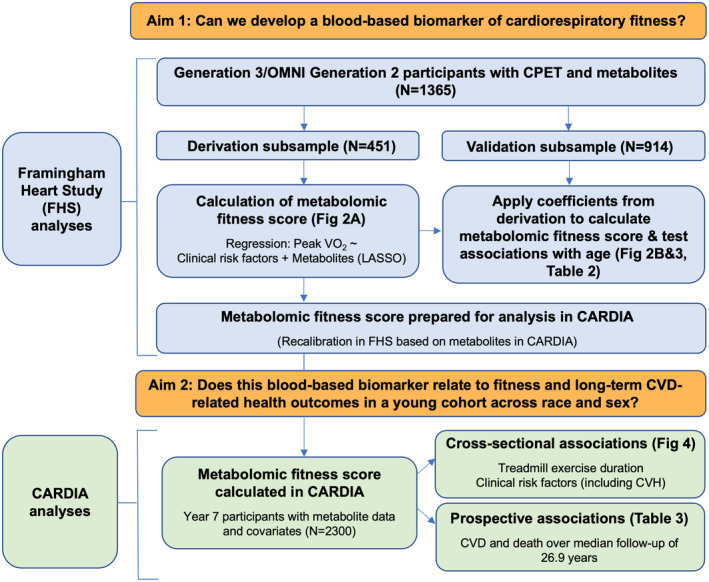
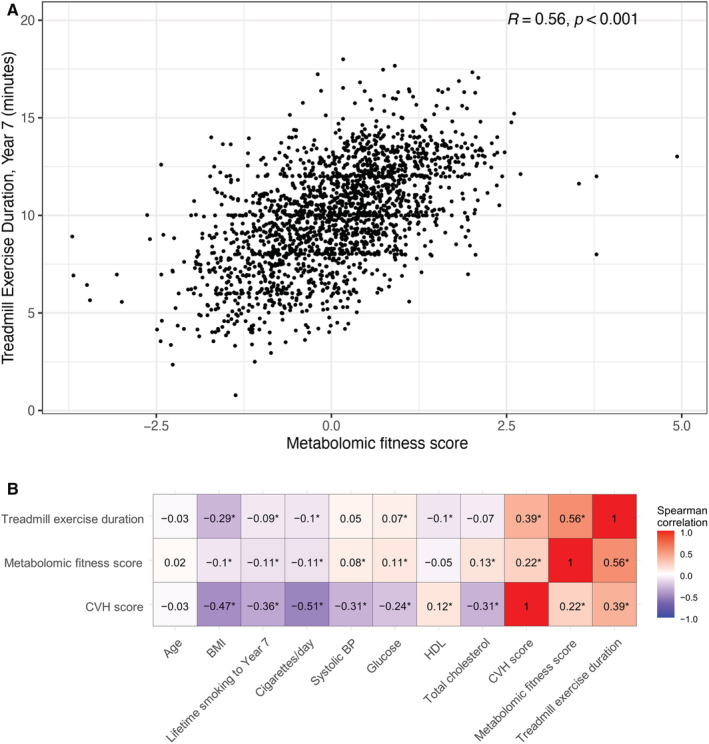
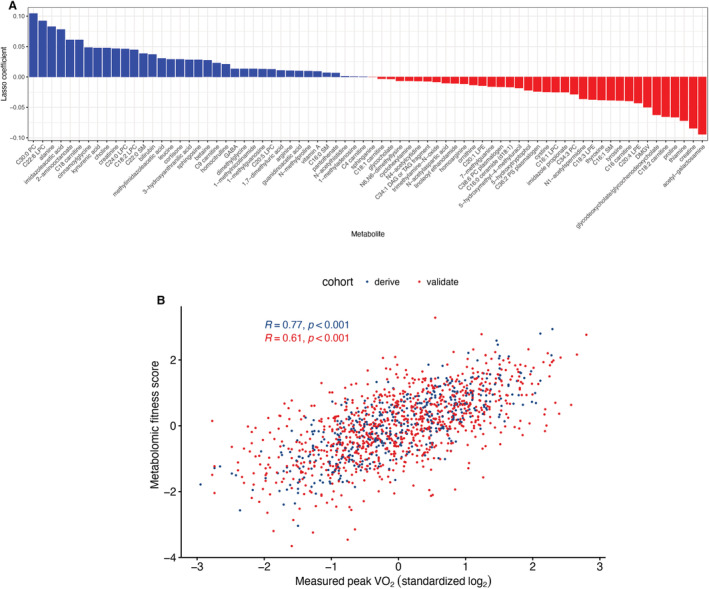
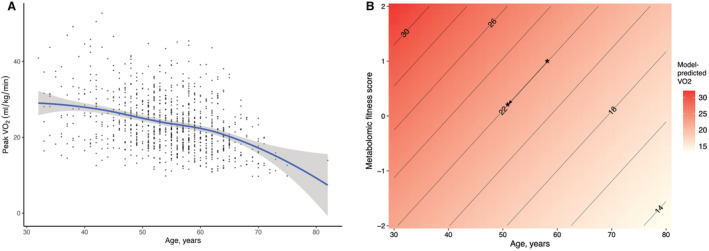
Background Cardiorespiratory fitness is a powerful predictor of health outcomes that is currently underused in primary prevention, especially in young adults. We sought to develop a blood-based biomarker of cardiorespiratory fitness that is easily translatable across populations. Methods and Results Maximal effort cardiopulmonary exercise testing for quantification of cardiorespiratory fitness (by peak oxygen uptake) and profiling of >200 metabolites at rest were performed in the FHS (Framingham Heart Study; 2016-2019). A metabolomic fitness score was derived/validated in the FHS and was associated with long-term outcomes in the younger CARDIA (Coronary Artery Risk Development in Young Adults) study. In the FHS (derivation, N=451; validation, N=914; age 54±8 years, 53% women, body mass index 27.7±5.3 kg/m), we used LASSO (least absolute shrinkage and selection operator) regression to develop a multimetabolite score to predict peak oxygen uptake (correlation with peak oxygen uptake =0.77 in derivation, 0.61 in validation; both <0.0001). In a linear model including clinical risk factors, a ≈1-SD higher metabolomic fitness score had equivalent magnitude of association with peak oxygen uptake as a 9.2-year age increment. In the CARDIA study (N=2300, median follow-up 26.9 years, age 32±4 years, 44% women, 44% Black individuals), a 1-SD higher metabolomic fitness score was associated with a 44% lower risk for mortality (hazard ratio [HR], 0.56 [95% CI, 0.47-0.68]; <0.0001) and 32% lower risk for cardiovascular disease (HR, 0.68 [95% CI, 0.55-0.84]; =0.0003) in models adjusted for age, sex, and race, which remained robust with adjustment for clinical risk factors. Conclusions A blood-based biomarker of cardiorespiratory fitness largely independent of traditional risk factors is associated with long-term risk of cardiovascular disease and mortality in young adults.
心肺适能是健康结果的有力预测指标,但在初级预防中尤其是在年轻人中尚未得到充分利用。我们试图开发一种易于在人群中转化的基于血液的心肺适能生物标志物。
在弗雷明汉心脏研究(FHS;2016-2019 年)中进行了最大努力心肺运动测试以量化心肺适能(通过峰值摄氧量)并在休息时对>200 种代谢物进行分析。在 FHS 中得出/验证了代谢组学适应度评分,并与较年轻的 CARDIA(年轻人冠状动脉风险发展)研究中的长期结果相关。在 FHS 中(推导,N=451;验证,N=914;年龄 54±8 岁,53%为女性,体重指数 27.7±5.3kg/m),我们使用 LASSO(最小绝对收缩和选择算子)回归来开发多代谢物评分来预测峰值摄氧量(与峰值摄氧量的相关性在推导中为 0.77,在验证中为 0.61;均<0.0001)。在包括临床危险因素的线性模型中,代谢组学适应度评分每增加一个标准差与峰值摄氧量的关联程度与 9.2 年的年龄增长相当。在 CARDIA 研究中(N=2300,中位随访时间为 26.9 年,年龄 32±4 岁,44%为女性,44%为黑人),代谢组学适应度评分每增加一个标准差,死亡风险降低 44%(风险比[HR],0.56[95%CI,0.47-0.68];<0.0001),心血管疾病风险降低 32%(HR,0.68[95%CI,0.55-0.84];=0.0003),在调整年龄、性别和种族的模型中,在调整临床危险因素后仍然稳健。
一种独立于传统危险因素的基于血液的心肺适能生物标志物与年轻人的心血管疾病和死亡率的长期风险相关。