Becher Gabrielle, Conner Sophia, Ingram Jennifer A, Stephen Karen E, McInnes Alison C, Heald Adrian H, Riley Paul A, Davies Mark, Domenech Arnau, Kasujee Ismail
West Glasgow Ambulatory Care Hospital, NHS Greater Glasgow and Clyde, Glasgow, Scotland, UK.
Department of Dermatology, The Princess Alexandra Hospital NHS Trust, Harlow, England, UK.
Dermatol Ther (Heidelb). 2022 Oct;12(10):2343-2354. doi: 10.1007/s13555-022-00800-3. Epub 2022 Sep 9.
As with most medicines historically, clinicians prescribing tildrakizumab have relied on information derived from registration studies undertaken in a prospective controlled clinical trial setting. More recently, clinicians, policymakers, and commissioners increasingly rely on real-world data to inform both policy and practice.
A retrospective real-world data study was undertaken at four specialist dermatology departments in the United Kingdom. All adult patients treated with tildrakizumab for moderate-to-severe plaque psoriasis were included, with data being collected for 122 patients.
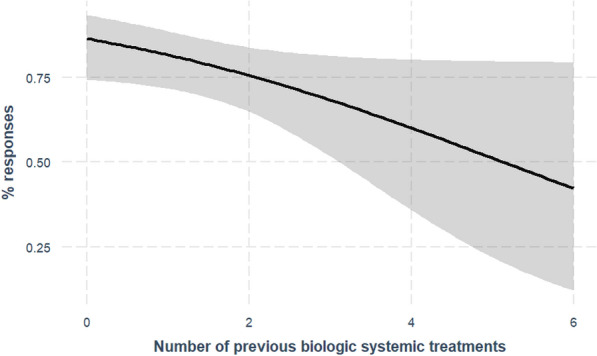
Psoriatic patients on tildrakizumab tended to be overweight (median body mass index of 32 (range 19-59) (n = 61); 26/68 (38%) < 90 kg, 32/68 (47%) between 90 and 120 kg, and 10/68 (15%) > 120 kg). The study population had high levels of comorbidities (83/116, 72%), multiple special sites (39/117, 33%), and histories of biological treatments (81/100, 81%). Most patients (61/80, 76%) initiated on tildrakizumab were switched from another biological treatment. Tildrakizumab was effective, with 91/122 (75%) patients remaining on treatment for the duration of the study-a median of 12 months per patient (range 1-29 months)-and achieving a change in median Psoriasis Area and Severity Index (PASI) from 12 to 0.35 and in Dermatology Life Quality Index (DLQI) from 20 to 0. The response rate was 57/66 (86%) when tildrakizumab was used as the first- or second-line biologic compared to 19/31 (61%) when used as the third- to seventh-line. Thirty-three (78.6%) patients over 90 kg of weight received the 200-mg dose of tildrakizumab. All but one (n = 8) patient with body weight over 120 kg maintained response over time. There was one treatment discontinuation; a patient who had a local sensitivity reaction.
In UK clinical practice, tildrakizumab was well tolerated and effective at doses of 100 mg or 200 mg in a range of patient phenotypes.
与历史上的大多数药物一样,开具替拉珠单抗处方的临床医生一直依赖于在前瞻性对照临床试验环境中进行的注册研究所得出的信息。最近,临床医生、政策制定者和医疗服务提供者越来越依赖真实世界数据来为政策和实践提供依据。
在英国的四个专科皮肤科部门进行了一项回顾性真实世界数据研究。纳入了所有接受替拉珠单抗治疗中度至重度斑块状银屑病的成年患者,共收集了122例患者的数据。
接受替拉珠单抗治疗的银屑病患者往往超重(中位体重指数为32(范围19 - 59)(n = 61);68例中有26例(38%)体重<90kg,32例(47%)体重在90至120kg之间,10例(15%)体重>120kg)。研究人群合并症水平较高(116例中有83例,72%),有多个特殊部位受累(117例中有39例,33%),且有生物治疗史(100例中有81例,81%)。大多数开始使用替拉珠单抗治疗的患者(80例中有61例,76%)是从另一种生物治疗转换而来。替拉珠单抗是有效的,122例患者中有91例(75%)在研究期间持续接受治疗,每位患者的中位治疗时间为12个月(范围1 - 29个月),银屑病面积和严重程度指数(PASI)中位数从12降至0.35,皮肤病生活质量指数(DLQI)从20降至0。当替拉珠单抗用作一线或二线生物制剂时,缓解率为57/66(86%),而用作三线至七线时为19/31(61%)。体重超过90kg的33例(78.6%)患者接受了200mg剂量的替拉珠单抗。除1例(n = 8)体重超过120kg的患者外,所有患者随时间推移均维持缓解。有1例治疗中断,是一名出现局部过敏反应的患者。
在英国临床实践中,替拉珠单抗在一系列患者表型中,100mg或200mg剂量下耐受性良好且有效。