Vaccine Rollout Task Force, Public Health Agency of Canada, Ottawa, ON, Canada.
Centre for Population Health Data, Statistics Canada, Ottawa, ON, Canada.
BMC Public Health. 2022 Sep 8;22(1):1708. doi: 10.1186/s12889-022-14090-z.
By July 2021, Canada had received enough COVID-19 vaccines to fully vaccinate every eligible Canadian. However, despite the availability of vaccines, some eligible individuals remain unvaccinated. Differences in vaccination uptake can be driven by health inequalities which have been exacerbated and amplified by the pandemic. This study aims to assess inequalities in COVID-19 vaccination uptake and intent in adults 18 years or older across Canada by identifying sociodemographic factors associated with non-vaccination and low vaccination intent using data drawn from the June to August 2021 Canadian Community Health Survey (CCHS).
The CCHS is an annual cross-sectional and nationally representative survey conducted by Statistics Canada, which collects health-related information. Since September 2020, questions about the COVID-19 pandemic are asked. Adjusted logistic regression models were fitted to examine associations between vaccination uptake or intent and sociodemographic and health related variables. Region, age, gender, level of education, Indigenous status, visible minority status, perceived health status, and having a regular healthcare provider were considered as predictors, among other factors.
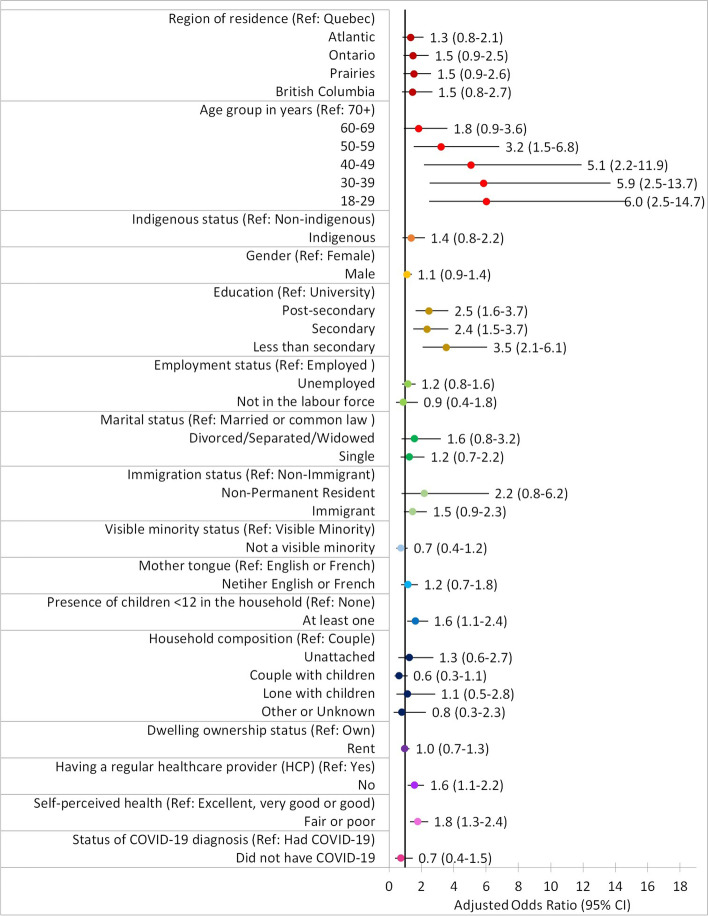
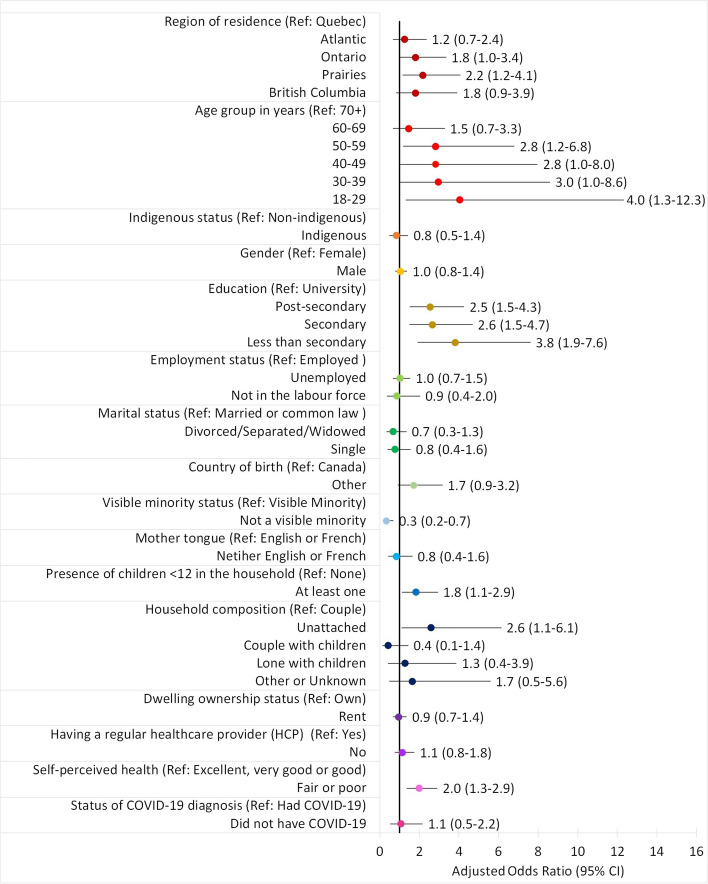
The analysis included 9,509 respondents. The proportion of unvaccinated was 11%. Non-vaccination was associated with less than university education (aOR up to 3.5, 95% CI 2.1-6.1), living with children under 12 years old (aOR 1.6, 95% CI 1.1-2.4), not having a regular healthcare provider (aOR 1.6, 95% CI 1.1-2.2), and poor self-perceived health (aOR 1.8, 95% CI 1.3-2.4). Only 5% of the population had low intention to get vaccinated. Being unlikely to get vaccinated was associated with the Prairies region (aOR 2.2, 95% CI 1.2-4.1), younger age groups (aOR up to 4.0, 95% CI 1.3-12.3), less than university education (aOR up to 3.8, 95% CI 1.9-7.6), not being part of a visible minority group (aOR 3.0, 95% CI 1.4-6.4), living with children under 12 years old (aOR 1.8, 95% CI 1.1-2.9), unattached individuals (aOR 2.6, 95% CI 1.1-6.1), and poor self-perceived health (aOR 2.0, 95% CI 1.3-2.9).
Disparities were observed in vaccination uptake and intent among various sociodemographic groups. Awareness of inequalities in COVID-19 vaccination uptake and intent is needed to determine the vaccination barriers to address in vaccination promotion strategies.
截至 2021 年 7 月,加拿大已收到足够数量的 COVID-19 疫苗,足以对所有符合条件的加拿大人进行全面接种。然而,尽管疫苗供应充足,但仍有一些符合条件的人未接种疫苗。疫苗接种率的差异可能是由健康不平等造成的,而这种不平等在大流行期间加剧和放大了。本研究旨在通过确定与未接种疫苗和低疫苗接种意愿相关的社会人口统计学因素,评估加拿大 18 岁及以上成年人 COVID-19 疫苗接种率和意愿的不平等,使用的数据来自 2021 年 6 月至 8 月的加拿大社区健康调查(CCHS)。
CCHS 是由加拿大统计局进行的一项年度横断面和全国代表性调查,收集与健康相关的信息。自 2020 年 9 月以来,一直询问有关 COVID-19 大流行的问题。使用调整后的逻辑回归模型来检查疫苗接种率或意愿与社会人口统计学和健康相关变量之间的关联。考虑了区域、年龄、性别、教育水平、原住民身份、少数族裔身份、自我感知的健康状况以及是否有常规医疗保健提供者等因素。
分析包括 9509 名受访者。未接种疫苗的比例为 11%。未接种疫苗与接受大学以下教育(优势比最高可达 3.5,95%CI 2.1-6.1)、与 12 岁以下儿童同住(优势比 1.6,95%CI 1.1-2.4)、没有常规医疗保健提供者(优势比 1.6,95%CI 1.1-2.2)和自我感知健康状况不佳(优势比 1.8,95%CI 1.3-2.4)有关。只有 5%的人口有低接种意愿。不太可能接种疫苗与草原地区(优势比 2.2,95%CI 1.2-4.1)、年轻年龄组(优势比最高可达 4.0,95%CI 1.3-12.3)、接受大学以下教育(优势比最高可达 3.8,95%CI 1.9-7.6)、不属于少数族裔群体(优势比 3.0,95%CI 1.4-6.4)、与 12 岁以下儿童同住(优势比 1.8,95%CI 1.1-2.9)、未婚个体(优势比 2.6,95%CI 1.1-6.1)和自我感知健康状况不佳(优势比 2.0,95%CI 1.3-2.9)有关。
在不同的社会人口统计学群体中观察到疫苗接种率和意愿存在差异。需要了解 COVID-19 疫苗接种率和意愿方面的不平等情况,以确定在疫苗推广策略中需要解决的疫苗接种障碍。