Department of Veterinary Medicine and Animal Science, University of Milan, St. dell'Università 6, 26900 Lodi, Italy.
The Institute for Learning and Teaching, Colorado State University, Fort Collins, CO 80523, USA.
Parasitology. 2022 Dec;149(14):1842-1861. doi: 10.1017/S0031182022001160. Epub 2022 Aug 16.
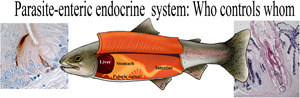
Most individual fish in wild and farmed populations can be infected with parasites. Fish intestines can harbour protozoans, myxozoans and helminths, which include several species of digeneans, cestodes, nematodes and acanthocephalans. Enteric parasites often induce inflammation of the intestine; the pathogen provokes changes in the host physiology, which will be genetically selected for if they benefit the parasite. The host response to intestinal parasites involves neural, endocrine and immune systems and interaction among these systems is coordinated by hormones, chemokines, cytokines and neurotransmitters including peptides. Intestinal fish parasites have effects on the components of the enteric nervous and endocrine systems; mechanical/chemical changes impair the activity of these systems, including gut motility and digestion. Investigations on the role of the neuroendocrine system in response to fish intestinal parasites are very few. This paper provides immunohistochemical and ultrastructural data on effects of parasites on the enteric nervous system and the enteric endocrine system in several fish–parasite systems. Emphasis is on the occurrence of 21 molecules including cholecystokinin-8, neuropeptide Y, enkephalins, galanin, vasoactive intestinal peptide and serotonin in infected tissues.
大多数野生和养殖种群中的个体鱼类都可能感染寄生虫。鱼类肠道可能寄生原生动物、粘孢子虫和蠕虫,包括几种复殖吸虫、绦虫、线虫和棘头虫。肠道寄生虫通常会引起肠道炎症;病原体引起宿主生理变化,如果这些变化对寄生虫有益,就会被遗传选择。宿主对肠道寄生虫的反应涉及神经、内分泌和免疫系统,这些系统之间的相互作用由激素、趋化因子、细胞因子和神经递质(包括肽)协调。肠道鱼类寄生虫会影响肠神经系统和内分泌系统的组成部分;机械/化学变化会损害这些系统的活性,包括肠道蠕动和消化。关于神经内分泌系统对鱼类肠道寄生虫反应的研究非常少。本文提供了关于寄生虫对几种鱼类-寄生虫系统的肠神经系统和肠内分泌系统的影响的免疫组织化学和超微结构数据。重点是研究 21 种分子的出现,包括胆囊收缩素-8、神经肽 Y、脑啡肽、甘丙肽、血管活性肠肽和血清素在感染组织中的存在。