Teixeira Francisca S, Pimentel Lígia L, Vidigal Susana S M P, Costa Paula T, Pintado Manuela E, Rodríguez-Alcalá Luís M
CBQF-Centro de Biotecnologia e Química Fina-Laboratório Associado, Escola Superior de Biotecnologia, Universidade Católica Portuguesa, Rua Diogo Botelho 1327, 4169-005 Porto, Portugal.
Foods. 2022 Sep 1;11(17):2661. doi: 10.3390/foods11172661.
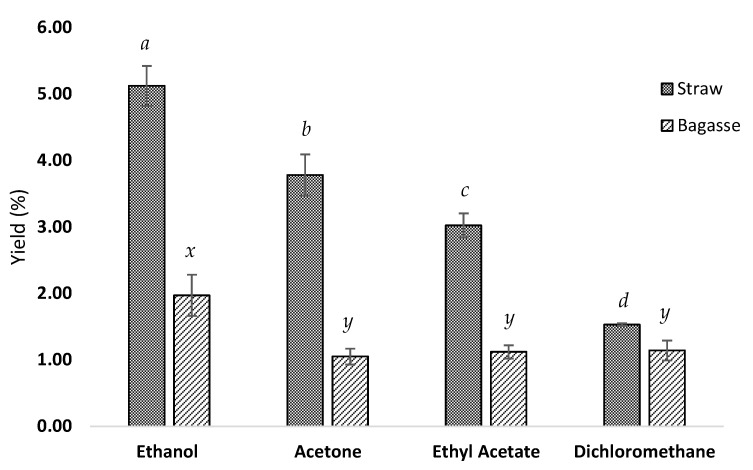
Sugarcane is primarily harvested to meet up to 80% of global sugar demand. Recently, lipids recovered from their biomass (straw and bagasse) have attracted much attention due to their possible utilisation in biofuel production but also by the presence of health-promoting compounds as phytosterols (i.e., improvement of cardiovascular function) or 1-octacosanol (i.e., anti-obesity). Although this fraction is commonly obtained through solid-liquid isolation, there is scarce information about how different solvents affect the composition of the extracts. This research work aimed to study whether, in sugarcane straw and bagasse samples, Soxtec extraction with widely used dichloromethane (DCM) would be suitable to recover most of the lipid classes when compared to other available solvents such as food grade ethanol (EtOH) or solvents without regulation restrictions for food and drug applications (i.e., acetone and ethyl acetate). The obtained results allow concluding that sugarcane waxes from straw and bagasse are complex lipid mixtures of polar and non-polar compounds. According to the extraction yield, the best results were obtained with ethanol (5.12 ± 0.30% and 1.97 ± 0.31%) for both straw and bagasse, respectively. The extractant greatly influenced the lipid composition of the obtained product. Thus, DCM enriched the isolates in glycerolipids (mono-, di- and triglycerides), free fatty acids, fatty alcohols, fatty aldehydes, phytosterols and hydrocarbons. On the other hand, EtOH resulted in polar isolates rich in glycolipids. Therefore, depending on the application and objectives of future research studies, the solvent to recover such lipids needs to be carefully selected.
甘蔗的主要收获目的是满足全球高达80%的食糖需求。最近,从其生物质(秸秆和蔗渣)中提取的脂质因其在生物燃料生产中的潜在用途,以及所含的具有促进健康作用的化合物,如植物甾醇(即改善心血管功能)或1-二十八烷醇(即抗肥胖),而备受关注。尽管这一部分通常通过固液分离获得,但关于不同溶剂如何影响提取物成分的信息却很少。本研究旨在探讨,与其他可用溶剂(如食品级乙醇(EtOH)或无食品和药物应用监管限制的溶剂(即丙酮和乙酸乙酯)相比,在甘蔗秸秆和蔗渣样品中,使用广泛应用的二氯甲烷(DCM)进行索氏提取是否适合回收大多数脂质类别。所得结果表明,来自秸秆和蔗渣的甘蔗蜡是极性和非极性化合物的复杂脂质混合物。根据提取率,秸秆和蔗渣分别使用乙醇提取时效果最佳(分别为5.12±0.30%和1.97±0.31%)。提取剂对所得产品的脂质组成有很大影响。因此,DCM使甘油脂质(单甘油酯、二甘油酯和三甘油酯)、游离脂肪酸、脂肪醇、脂肪醛、植物甾醇和碳氢化合物在分离物中富集。另一方面,EtOH导致富含糖脂的极性分离物。因此,根据未来研究的应用和目标,需要仔细选择用于回收此类脂质的溶剂。