Chen Mengtao, Lan Xinyue, Zhu Longjiao, Ru Ping, Xu Wentao, Liu Haiyan
Research Center for Sports Nutrition and Eudainomics, Institute for Sports Training Science, Tianjin University of Sport, Tianjin 301617, China.
School of Public Health, North China University of Science and Technology, Tangshan 063210, China.
Foods. 2022 Sep 2;11(17):2675. doi: 10.3390/foods11172675.
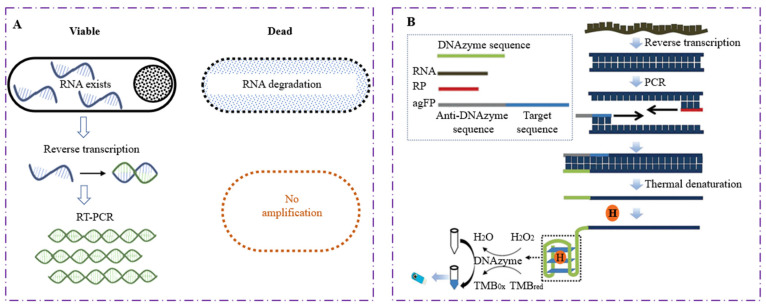
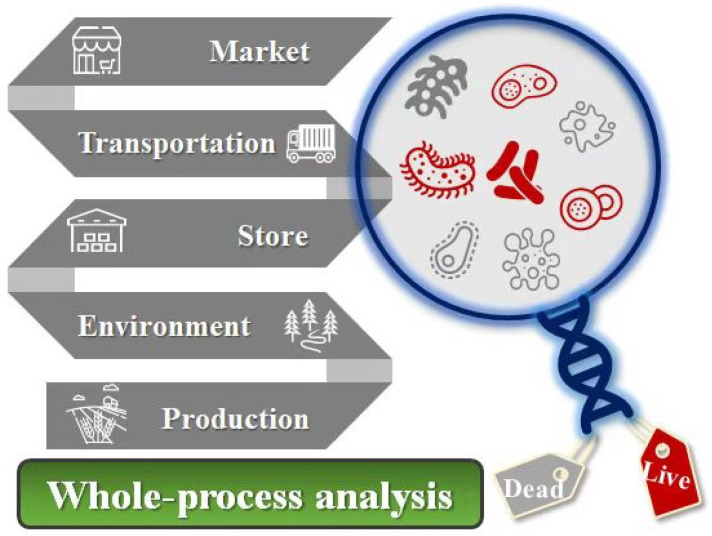
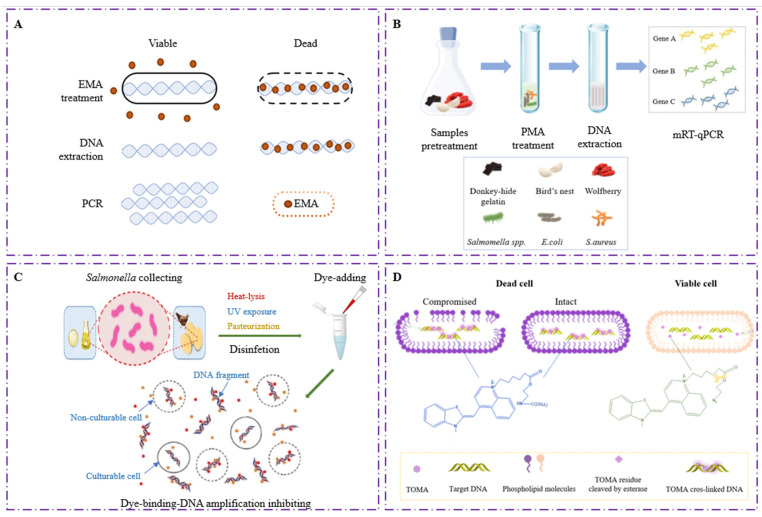
Living foodborne pathogens pose a serious threat to public and population health. To ensure food safety, it is necessary to complete the detection of viable bacteria in a short time (several hours to 1 day). However, the traditional methods by bacterial culture, as the gold standard, are cumbersome and time-consuming. To break through the resultant research bottleneck, PCR mediated nucleic acid molecular recognition technologies, including RNA-based reverse transcriptase PCR (RT-PCR) and DNA-based viability PCR (vPCR) have been developed in recent years. They not only sensitively amplify detection signals and quickly report detection results, but also distinguish viable and dead bacteria. Therefore, this review introduces these PCR-mediated techniques independent of culture for viable and dead foodborne pathogen detection from the nucleic acid molecular recognition principal level and describes their whole-process applications in food quality supervision, which provides a useful reference for the development of detection of foodborne pathogens in the future.
存活的食源性病原体对公众和群体健康构成严重威胁。为确保食品安全,有必要在短时间内(几小时到1天)完成对活菌的检测。然而,作为金标准的传统细菌培养方法既繁琐又耗时。为突破由此产生的研究瓶颈,近年来已开发出PCR介导的核酸分子识别技术,包括基于RNA的逆转录PCR(RT-PCR)和基于DNA的活菌PCR(vPCR)。它们不仅能灵敏地放大检测信号并快速报告检测结果,还能区分活菌和死菌。因此,本综述从核酸分子识别原理层面介绍这些独立于培养的用于检测存活和死亡食源性病原体的PCR介导技术,并描述它们在食品质量监管中的全过程应用,为未来食源性病原体检测技术的发展提供有益参考。