Nanjing Institute of Geography and Limnology, Chinese Academy of Sciences, Nanjing 210006, China.
Department of Epidemiology and Biostatistics, School of Public Health, Anhui Medical University, Hefei 230032, China.
Int J Environ Res Public Health. 2022 Aug 23;19(17):10482. doi: 10.3390/ijerph191710482.
Air pollution nowadays has seriously threatened the health of the Chinese population, especially in the vulnerable groups of fetuses, infants and toddlers. In particular, the effects of air pollution on children's neurobehavioral development have attracted widespread attention. Moreover, the early detection of a sensitive period is very important for the precise intervention of the disease. However, such studies focusing on hyperactive behaviors and susceptible window identification are currently lacking in China.
The study aims to explore the correlation between air pollution exposure and hyperactive behaviors during the early life stage and attempt to identify whether a susceptible exposure window exists that is crucial for further precise intervention.
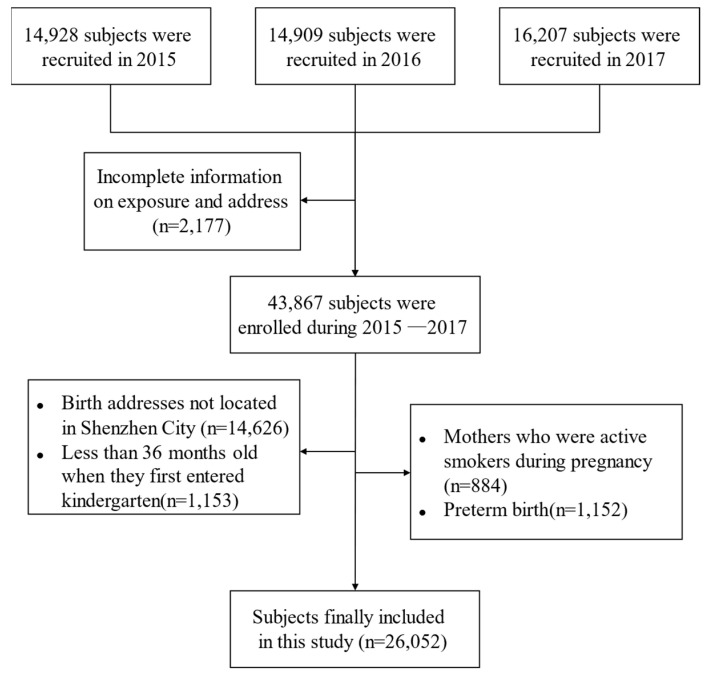
Based on the Longhua Child Cohort Study, we collected the basic information and hyperactivity index of 26,052 children using a questionnaire conducted from 2015 to 2017, and the Conners' Parent Rating Scale-revised (CPRS-48) was used to assess hyperactive behaviors. Moreover, the data of air pollution concentration (PM, PM, NO, CO, O and SO) were collected from the monitoring station between 2011 to 2017, and a land-use random forest model was used to evaluate the exposure level of each subject. Furthermore, Distributed lag non-linear models (DLNMs) were applied for statistic analysis.
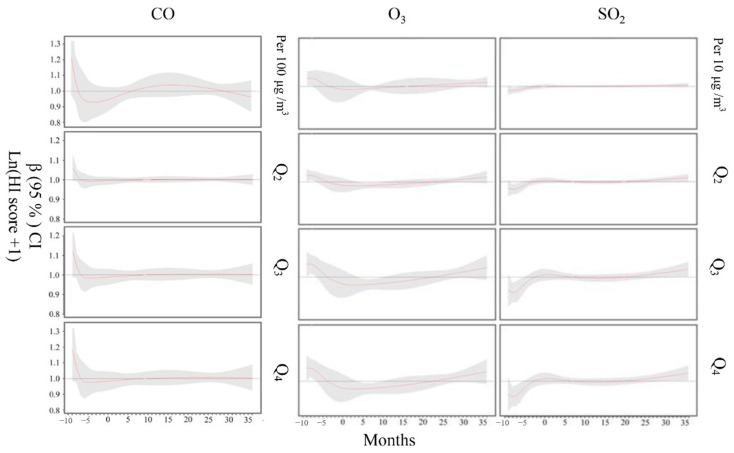
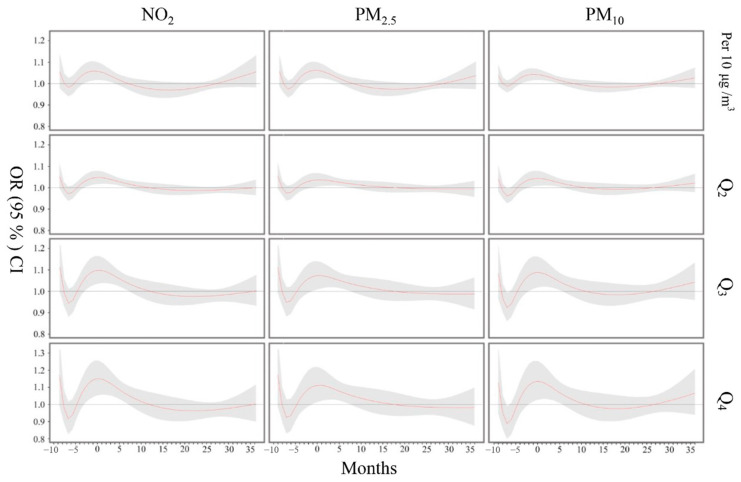
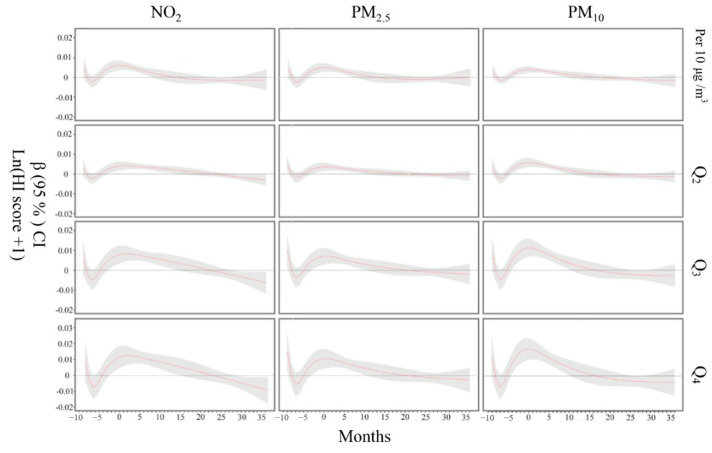
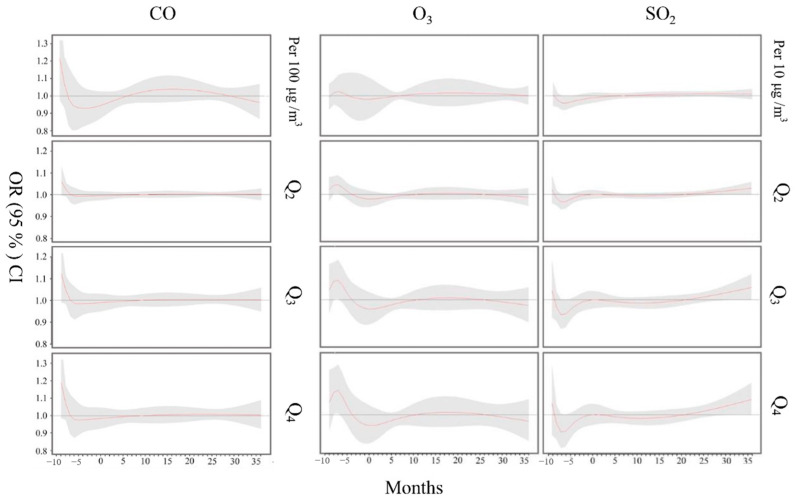
The risk of child hyperactivity was found to be positively associated with early life exposure to PM, PM and NO. In particular, for an increase of per 10 µg/m in PM, PM and NO exposure concentration during early life, the risk of child hyperactivity increased significantly during the seventh month of pregnancy to the fourth month after birth, with the strongest association in the ninth month of pregnancy (PM: OR = 1.043, 95% CI: 1.016-1.071; PM: OR = 1.062, 95% CI: 1.024-1.102; NO: OR = 1.043, 95% CI: 1.016-1.071). However, no significant associations among early life exposure to CO, O and SO and child hyperactive behaviors were observed.
Early life exposure to PM, PM and NO is associated with an increased risk of child ADHD-like behaviors at the age around 3 years, and the late-prenatal and early postnatal periods might be the susceptible exposure windows.
如今,空气污染严重威胁着中国民众的健康,尤其是胎儿、婴儿和幼儿等脆弱群体。特别是空气污染对儿童神经行为发育的影响引起了广泛关注。此外,对敏感时期的早期检测对于疾病的精确干预非常重要。然而,目前中国缺乏此类针对多动行为和易感窗口识别的研究。
本研究旨在探讨生命早期阶段空气污染暴露与多动行为之间的相关性,并尝试确定是否存在易感暴露窗口,这对于进一步进行精确干预至关重要。
基于龙华儿童队列研究,我们于 2015 年至 2017 年期间使用问卷调查收集了 26052 名儿童的基本信息和多动指数,同时使用康纳斯父母评定量表修订版(CPRS-48)评估多动行为。此外,我们还收集了 2011 年至 2017 年监测站的空气污染浓度(PM、PM、NO、CO、O 和 SO)数据,并使用土地利用随机森林模型评估每个研究对象的暴露水平。进一步采用分布式滞后非线性模型(DLNMs)进行统计分析。
研究发现,儿童多动的风险与生命早期暴露于 PM、PM 和 NO 呈正相关。具体而言,在生命早期,PM、PM 和 NO 暴露浓度每增加 10μg/m,妊娠第七个月至出生后第四个月儿童多动的风险显著增加,妊娠第九个月关联最强(PM:OR=1.043,95%CI:1.016-1.071;PM:OR=1.062,95%CI:1.024-1.102;NO:OR=1.043,95%CI:1.016-1.071)。然而,生命早期暴露于 CO、O 和 SO 与儿童多动行为之间并未观察到显著关联。
生命早期暴露于 PM、PM 和 NO 与儿童 ADHD 样行为风险增加相关,妊娠晚期和产后早期可能是易感暴露窗口。