Universidad Nacional Intercultural Fabiola Salazar Leguía de Bagua, Jr. Ancash 520, Bagua 01721, Amazonas, Peru.
Universidad Privada San Carlos, Sede Ilave, Jr. Ilo 343, Ilave 21501, Puno, Peru.
Int J Environ Res Public Health. 2022 Aug 30;19(17):10779. doi: 10.3390/ijerph191710779.
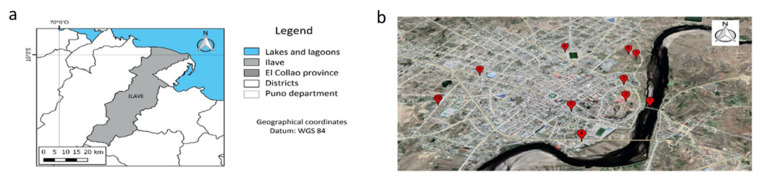
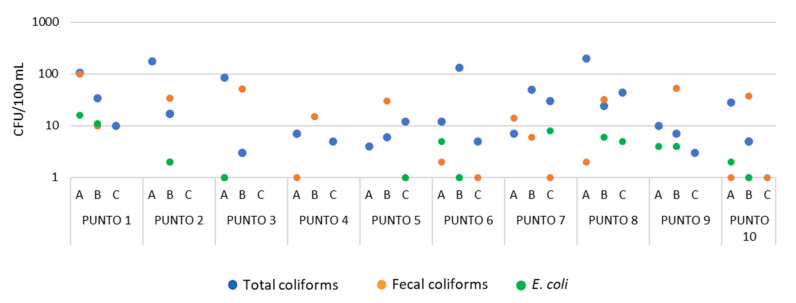
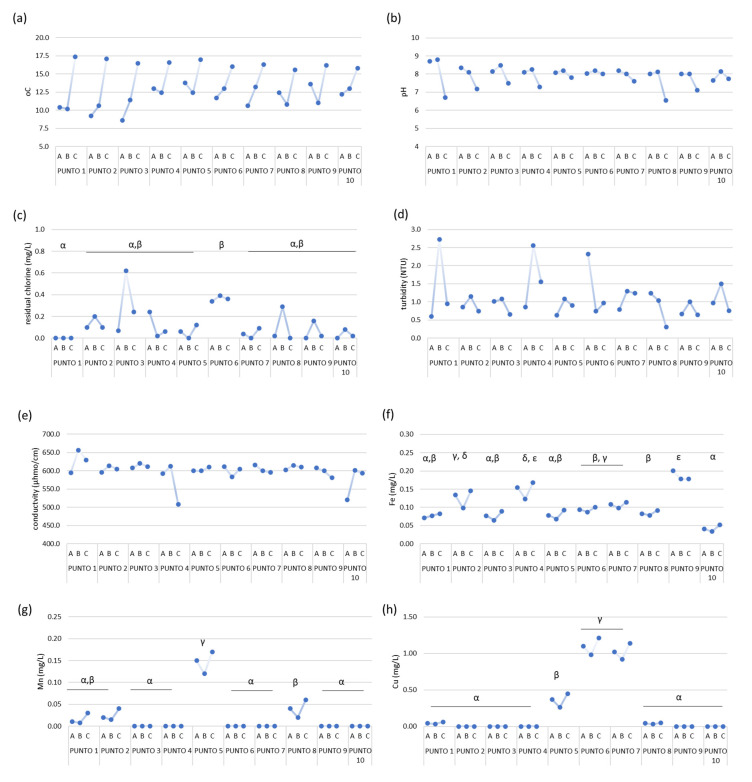
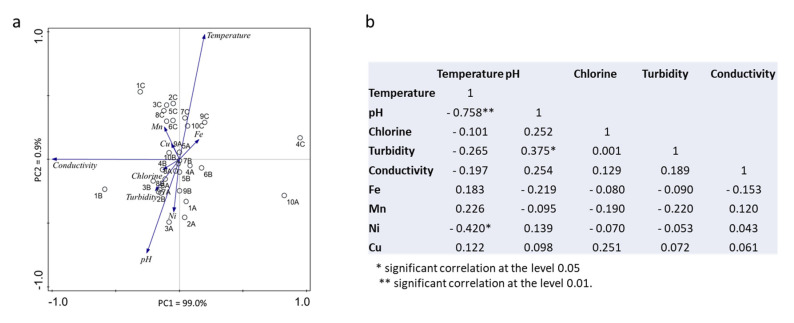
The region of Puno, in Peru, is described as a region with some health conditions that may be associated with the water quality, such as a high index of anemia or cases of acute diarrhea in children. This study aimed at monitoring the drinking water quality of the city of Ilave, in Peru, and determining possible correlations between physical-chemical and microbiological parameters, and the water distribution conditions, such as the period of water availability. Physical-chemical parameters (turbidity, residual chlorine, temperature, conductivity, and pH), microbiological parameters (presence of coliforms), and heavy metals (Zn, Mn, Ni, Fe, and Cu) were determined. All the parameters quantified were within the maximum permissible limits according to Peruvian regulations, except for residual chlorine, which was, for all the treated water samples, below the recommended value of 0.5 mg/L. Coliforms that should be absent from drinking water were detected in all the household samples. These results demonstrate the need for the inclusion of additional steps of re-chlorination along the distribution system to guarantee the maintenance of residual levels of chlorine that assure the microbiological quality of water. The quality of the drinking water was not observed to correlate with the period of water availability.
秘鲁普诺地区被描述为存在一些可能与水质有关的健康状况,例如贫血指数较高或儿童急性腹泻病例较多。本研究旨在监测秘鲁伊拉韦市的饮用水水质,并确定物理化学和微生物参数与供水条件(如供水时间)之间的可能相关性。测定了物理化学参数(浊度、余氯、温度、电导率和 pH 值)、微生物参数(大肠菌群存在情况)和重金属(Zn、Mn、Ni、Fe 和 Cu)。根据秘鲁法规,所有定量参数均在最大允许限值内,除余氯外,所有处理水样的余氯均低于 0.5mg/L 的推荐值。在所有家庭样本中均检测到饮用水中不应存在的大肠菌群。这些结果表明,需要在分配系统中增加加氯步骤,以保证维持余氯水平,确保水质的微生物质量。饮用水质量与供水时间无相关性。