Michael Kirolos G F T, Somani Bhaskar K
Northern Care Alliance NHS Foundation Trust, Salford M6 8HD, UK.
Department of Urology, University Hospital Southampton, Southampton SO16 6YD, UK.
J Clin Med. 2022 Aug 30;11(17):5118. doi: 10.3390/jcm11175118.
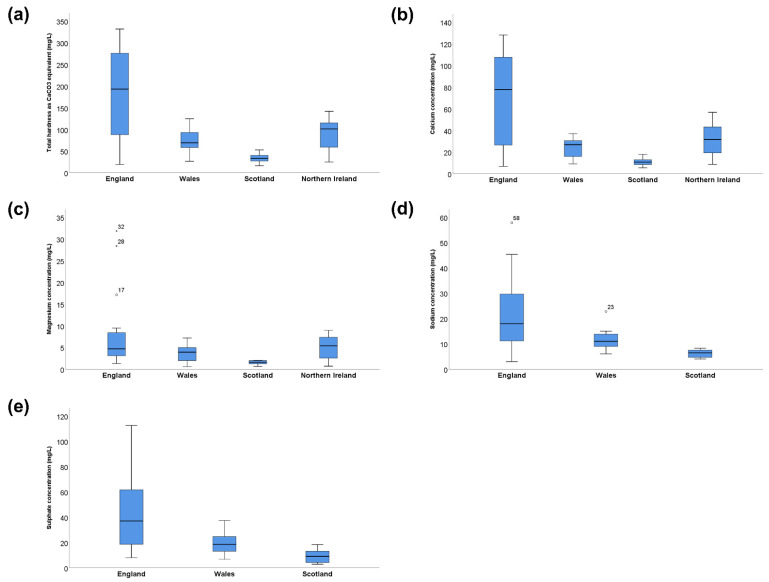
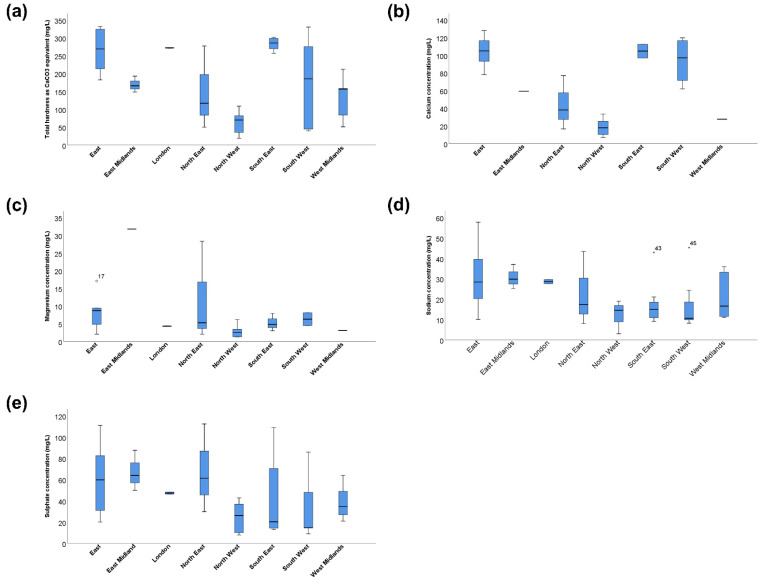
Introduction: The dissolved mineral content of drinking water can modify a number of excreted urinary parameters, with potential implications for kidney stone disease (KSD). The aim of this study is to investigate the variation in the mineral content of tap drinking water in the United Kingdom and discuss its implications for KSD. Methods: The mineral composition of tap water from cities across the United Kingdom was ascertained from publicly available water quality reports issued by local water supply companies using civic centre postcodes during 2021. Water variables, reported as 12-monthly average values, included total water hardness and concentrations of calcium, magnesium, sodium and sulphate. An unpaired t-test was undertaken to assess for regional differences in water composition across the United Kingdom. Results: Water composition data were available for 66 out of 76 cities in the United Kingdom: 45 in England, 8 in Scotland, 7 in Wales and 6 in Northern Ireland. The median water hardness in the United Kingdom was 120.59 mg/L CaCO3 equivalent (range 16.02−331.50), while the median concentrations of calcium, magnesium, sodium and sulphate were 30.46 mg/L (range 5.35−128.0), 3.62 mg/L (range 0.59−31.80), 14.72 mg/L (range 2.98−57.80) and 25.36 mg/L (range 2.86−112.43), respectively. Tap water in England was markedly harder than in Scotland (192.90 mg/L vs. 32.87 mg/L as CaCO3 equivalent; p < 0.001), which overall had the softest tap water with the lowest mineral content in the United Kingdom. Within England, the North West had the softest tap water, while the South East had the hardest water (70.00 mg/L vs. 285.75 mg/L as CaCO3 equivalent). Conclusions: Tap water mineral content varies significantly across the United Kingdom. Depending on where one lives, drinking 2−3 L of tap water can contribute over one-third of recommended daily calcium and magnesium requirements, with possible implications for KSD incidence and recurrence.
饮用水中的溶解矿物质含量可改变多种尿液排泄参数,对肾结石疾病(KSD)可能产生影响。本研究旨在调查英国自来水矿物质含量的变化,并讨论其对KSD的影响。方法:通过使用2021年市政中心邮政编码,从当地供水公司发布的公开水质报告中确定英国各城市自来水的矿物质成分。报告为年度平均值的水变量包括总水硬度以及钙、镁、钠和硫酸盐的浓度。采用非配对t检验评估英国各地水成分的区域差异。结果:英国76个城市中有66个城市有水质成分数据:英格兰45个、苏格兰8个、威尔士7个、北爱尔兰6个。英国水硬度中位数为120.59mg/L碳酸钙当量(范围16.02−331.50),而钙、镁、钠和硫酸盐的中位数浓度分别为30.46mg/L(范围5.35−128.0)、3.62mg/L(范围0.59−31.80)、14.72mg/L(范围2.98−57.80)和25.36mg/L(范围2.86−112.43)。英格兰的自来水明显比苏格兰的硬(碳酸钙当量分别为192.90mg/L和32.87mg/L;p<0.001),总体而言,苏格兰的自来水最软,矿物质含量最低。在英格兰,西北部的自来水最软,而东南部的水最硬(碳酸钙当量分别为70.00mg/L和285.75mg/L)。结论:英国各地自来水的矿物质含量差异显著。根据居住地点的不同,饮用2至3升自来水可提供超过每日推荐钙和镁需求量的三分之一,这可能对KSD的发病率和复发产生影响。