Stoots Simone J M, Geraghty Rob, Kamphuis Guido M, Jamnadass Enakshee, Henderickx Michaël M E L, Ventimiglia Eugenio, Traxer Olivier, Keller Etienne X, De Coninck Vincent, Talso Michele, Kallidonis Panagiotis, Emiliani Esteban, Bres-Niewada Ewa, Karim Sadaf S, Piccirilli Angela, Vagionis Athanasios, Somani Bhaskar K
University of Amsterdam, Amsterdam UMC, Department of Urology, Amsterdam, The Netherlands.
Freeman Hospital, Department of Urology, Newcastle, United Kingdom.
Cent European J Urol. 2021;74(1):71-75. doi: 10.5173/ceju.2021.0331.R1. Epub 2021 Feb 19.
Kidney stone disease is a common disease with high recurrence rates. Sufficient intake of water is the cornerstone in primary prevention of stone disease. However, the mineral composition of water can affect urinary minerals and influence stone formation. The aim of this study is to assess the variation in the mineral composition of bottled sparkling or carbonated drinking water across Europe.
The two largest supermarket chains in each participating country were visited to obtain data on mineral composition regarding bicarbonate, calcium, magnesium, potassium, sodium and sulphates of sparkling or carbonated waters by reading the ingredient labels on the bottles supplied by the manufacturers. Alternatively, the web-shops of these supermarkets were consulted.
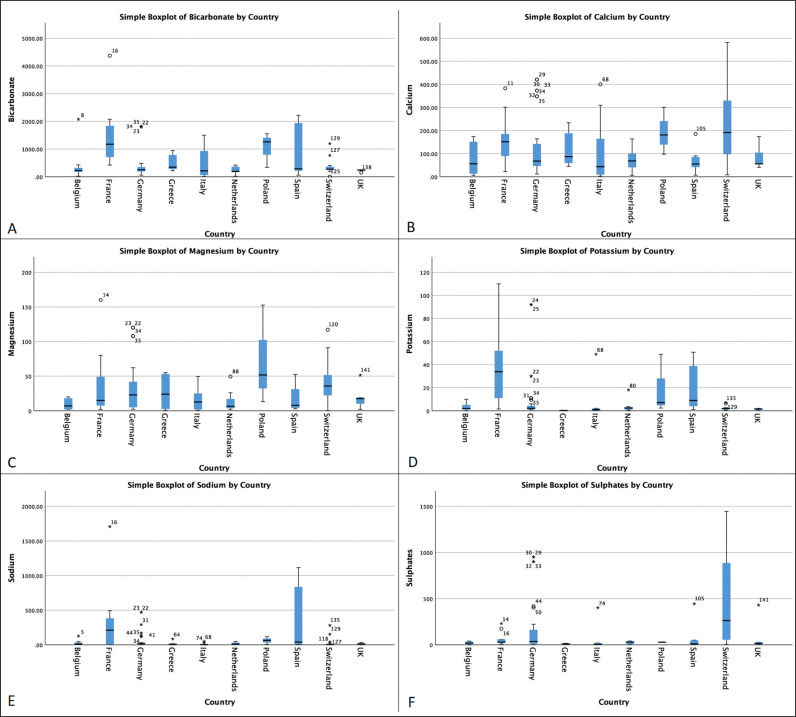
In total, 126 sparkling water brands across ten European countries were analysed regarding mineral composition. The median concentrations per mineral varied greatly. The greatest variation in median mineral content was found for sodium and sulphates with levels ranging from 3.1 mg/l to 63.0 mg/l and 6.0 mg/l to 263.0 mg/l respectively. A wide distribution of calcium content was found in Switzerland, with calcium levels reaching up to 581.6 mg/l.
This study confirms that the mineral composition of sparkling or carbonated water varies greatly across Europe. Patients with kidney stone disease should be aware that the mineral content of water may influence stone formation and be mindful of the great variation that exists between different water brands. Mineral water can be a source of potential promotors or inhibitors of stone formation and patients and urologists need to be mindful of this.
肾结石病是一种常见疾病,复发率很高。充足的水分摄入是结石病一级预防的基石。然而,水的矿物质成分会影响尿液中的矿物质,并影响结石形成。本研究的目的是评估欧洲各地瓶装气泡水或碳酸饮用水的矿物质成分变化。
走访了每个参与国家的两大超市连锁店,通过阅读制造商提供的瓶装水成分标签,获取有关气泡水或碳酸水中碳酸氢盐、钙、镁、钾、钠和硫酸盐的矿物质成分数据。或者,查询了这些超市的网店。
总共分析了十个欧洲国家的126个气泡水品牌的矿物质成分。每种矿物质的中位数浓度差异很大。钠和硫酸盐的中位数矿物质含量变化最大,分别为3.1毫克/升至63.0毫克/升和6.0毫克/升至263.0毫克/升。瑞士的钙含量分布广泛,钙含量高达581.6毫克/升。
本研究证实,欧洲各地气泡水或碳酸水的矿物质成分差异很大。肾结石病患者应意识到水的矿物质含量可能会影响结石形成,并注意不同水品牌之间存在的巨大差异。矿泉水可能是结石形成的潜在促进剂或抑制剂来源,患者和泌尿科医生需要对此予以关注。