Department of Orthopaedics, Quanzhou First Hospital Affiliated to Fujian Medical University, Quanzhou, China.
Front Endocrinol (Lausanne). 2022 Aug 23;13:971997. doi: 10.3389/fendo.2022.971997. eCollection 2022.
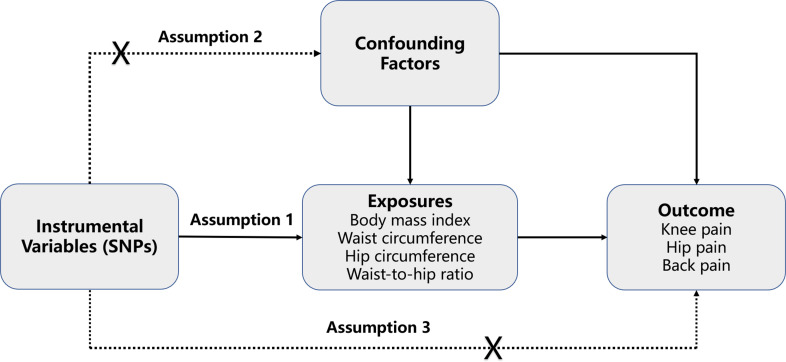
The association between obesity and musculoskeletal chronic pain has attracted much attention these days; however, the causal relationship between them is uncertain. Hence, this study performed a Mendelian randomization (MR) analysis to investigate the causal effects of body mass index (BMI), waist circumference (WC), hip circumference (HC), and waist-to-hip ratio (WHR) on knee pain, hip pain, and back pain.
The summary data for obesity and musculoskeletal chronic pain came from the genome-wide association study datasets. Significant and independent ( < 5 × 10; r < 0.001, kb = 10,000) single-nucleotide polymorphisms were extracted for MR analysis. The inverse variance weighted (IVW) and other methods were used for MR analysis, while sensitivity analyses were conducted to test the reliability and stability.
The positive causal effects of BMI on knee pain (odds ratio (OR) = 1.049; 95% CI: 1.034 to 1.063; = 9.88 × 10), hip pain (OR = 1.034; 95% CI: 1.024 to 1.044; = 1.38 × 10), and back pain (OR = 1.022; 95% CI: 1.007 to 1.038; = 0.004) were observed. WC and HC were also positively associated with knee pain (WC: OR = 1.057; 95% CI: 1.041 to 1.072; = 1.54 × 10; HC: OR = 1.034; 95% CI: 1.017 to 1.052; = 1.32 × 10) and hip pain (WC: OR = 1.031; 95% CI: 1.020 to 1.042; = 2.61 × 10; HC: OR = 1.027; 95% CI: 1.018 to 1.035; = 5.48 × 10) but not back pain. No causal relationship was found between WHR and musculoskeletal chronic pain. The results were robust according to sensitivity tests.
This study revealed that BMI was positively related to knee, hip, and back pain and that WC and HC were positively associated with knee and hip pain, while WHR was not related to any type of musculoskeletal chronic pain.
肥胖与肌肉骨骼慢性疼痛之间的关联近来引起了广泛关注,但它们之间的因果关系尚不确定。因此,本研究进行了孟德尔随机化(MR)分析,以探讨体重指数(BMI)、腰围(WC)、臀围(HC)和腰臀比(WHR)与膝关节疼痛、髋关节疼痛和背痛之间的因果关系。
肥胖和肌肉骨骼慢性疼痛的汇总数据来自全基因组关联研究数据集。提取显著且独立的( < 5 × 10;r < 0.001,kb = 10,000)单核苷酸多态性进行 MR 分析。采用逆方差加权(IVW)和其他方法进行 MR 分析,并进行敏感性分析以检验可靠性和稳定性。
BMI 与膝关节疼痛(比值比(OR)= 1.049;95%置信区间:1.034 至 1.063; = 9.88 × 10)、髋关节疼痛(OR = 1.034;95%置信区间:1.024 至 1.044; = 1.38 × 10)和背痛(OR = 1.022;95%置信区间:1.007 至 1.038; = 0.004)呈正相关。WC 和 HC 也与膝关节疼痛(WC:OR = 1.057;95%置信区间:1.041 至 1.072; = 1.54 × 10;HC:OR = 1.034;95%置信区间:1.017 至 1.052; = 1.32 × 10)和髋关节疼痛(WC:OR = 1.031;95%置信区间:1.020 至 1.042; = 2.61 × 10;HC:OR = 1.027;95%置信区间:1.018 至 1.035; = 5.48 × 10)呈正相关,但与背痛无关。WHR 与肌肉骨骼慢性疼痛之间没有因果关系。根据敏感性测试,结果是稳健的。
本研究表明,BMI 与膝关节、髋关节和背痛呈正相关,WC 和 HC 与膝关节和髋关节疼痛呈正相关,而 WHR 与任何类型的肌肉骨骼慢性疼痛均无关。