Annu Int Conf IEEE Eng Med Biol Soc. 2022 Jul;2022:288-291. doi: 10.1109/EMBC48229.2022.9871793.
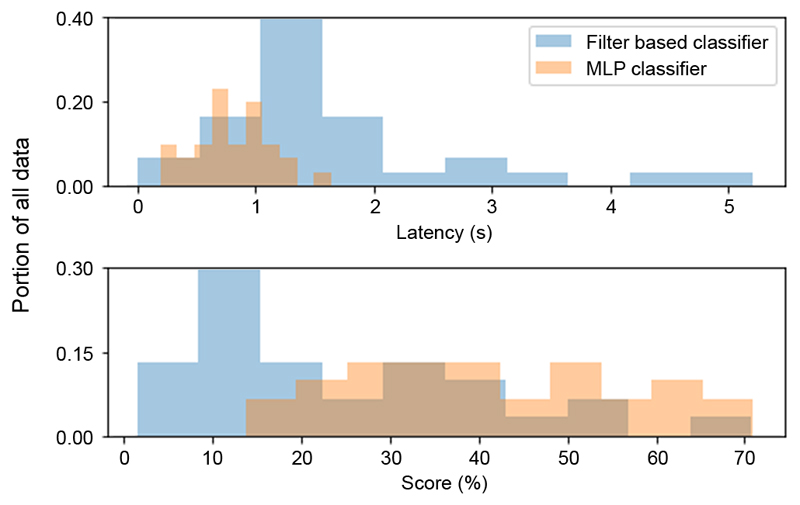
This work explores the potential utility of neural network classifiers for real- time classification of field-potential based biomarkers in next-generation responsive neuromodulation systems. Compared to classical filter-based classifiers, neural networks offer an ease of patient-specific parameter tuning, promising to reduce the burden of programming on clinicians. The paper explores a compact, feed - forward neural network architecture of only dozens of units for seizure-state classification in refractory epilepsy. The proposed classifier offers comparable accuracy to filter- classifiers on clinician-labeled data, while reducing detection latency. As a trade-off to classical methods, the paper focuses on keeping the complexity of the architecture minimal, to accommodate the on-board computational constraints of implantable pulse generator systems. Clinical relevance-A neural network-based classifier is presented for responsive neurostimulation, with comparable accuracy to classical methods at reduced latency.
这项工作探讨了神经网络分类器在下一代响应式神经调节系统中实时分类基于场电位的生物标志物的潜在用途。与基于经典滤波器的分类器相比,神经网络提供了易于针对患者特定参数进行调整的优势,有望减轻临床医生在编程方面的负担。本文探索了一种紧凑的前馈神经网络架构,仅由几十个单元组成,用于对难治性癫痫中的癫痫状态进行分类。与基于滤波器的分类器相比,所提出的分类器在临床医生标记的数据上提供了相当的准确性,同时减少了检测延迟。作为对经典方法的权衡,本文侧重于保持架构的复杂性最小化,以适应植入式脉冲发生器系统的板载计算限制。临床相关性-提出了一种用于响应式神经刺激的基于神经网络的分类器,与经典方法相比,其具有更低的延迟和相当的准确性。